One Hallmark of Aging Was Thought to Be Irreversible. An Engineered Enzyme Just Reversed It in Human Tissue.
Prefer to listen? Hit play for a conversational, audio‑style summary of this article’s key points.
Almost every longevity intervention slows the rate at which damage accumulates. This study demonstrates the other approach: removing damage that has already formed. Exercise, SGLT2 inhibitors, rapamycin, and caloric restriction all work upstream, reducing how fast damage builds. An engineered enzyme called CMLase, developed by researchers including the biotechnology company Revel Pharmaceuticals, instead reverses a specific form of aging damage after it has occurred, in aged human tissue.
The damage in question comes from sugar reacting with proteins, and it concentrates in the proteins your body cannot replace. Glucose reacts spontaneously with proteins, with no enzyme involved, forming permanent modifications called advanced glycation end products, or AGEs. This is the same Maillard chemistry that browns toast, running slowly at body temperature over years. It matters most in long-lived proteins like lens crystallins and arterial collagen, which are never or rarely replaced and therefore accumulate decades of damage that normal protein turnover would otherwise clear.
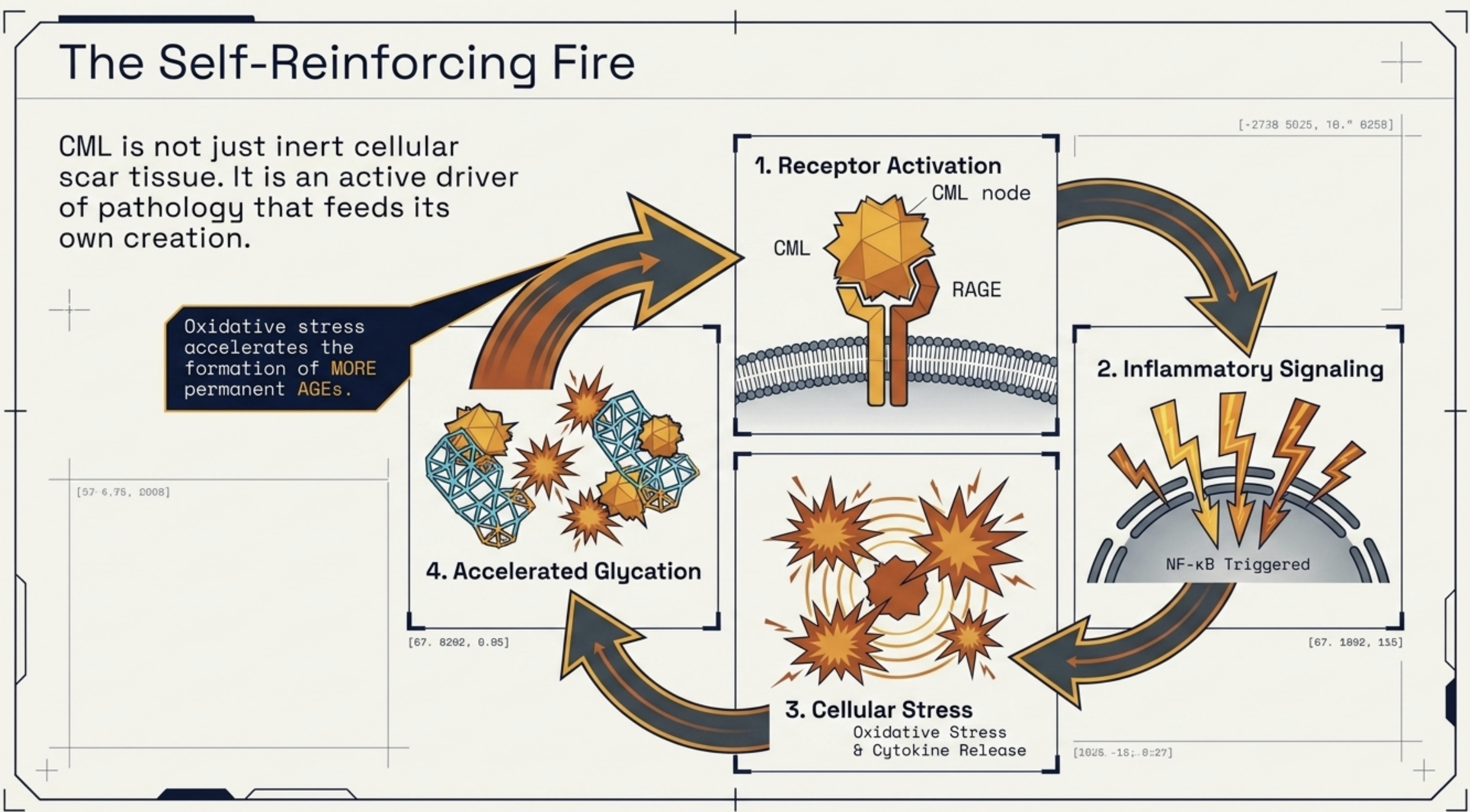
The specific adduct targeted, carboxymethyl-lysine, does two kinds of harm. CML is among the most abundant AGEs in aged tissue. Structurally, it reverses the charge on a lysine residue, disrupting how the protein behaves. Functionally, it is a primary ligand for RAGE, a receptor that when activated drives NF-κB signaling, inflammatory cytokines, and profibrotic changes. This creates a self-reinforcing loop, since the resulting oxidative stress accelerates the formation of still more AGEs.
CML had been considered chemically irreversible, and every prior tool worked only by preventing new damage. The body's glyoxalase system intercepts reactive precursors before they attach, and drugs like aminoguanidine did the same. None could remove an adduct once it had formed. The working assumption was that AGE burden was a one-way accumulation you could slow but not subtract from.
No enzyme in nature removes CML from proteins, so the team engineered one. They reasoned that CML contains a glycine-like substructure and screened glycine oxidases, then searched roughly 45,000 protein structures for one with an active site open enough to admit a protein-bound substrate. Starting from that scaffold, they used directed evolution across more than 500 million variants, with a clever selection that coupled enzyme activity to bacterial survival, to produce CMLase.
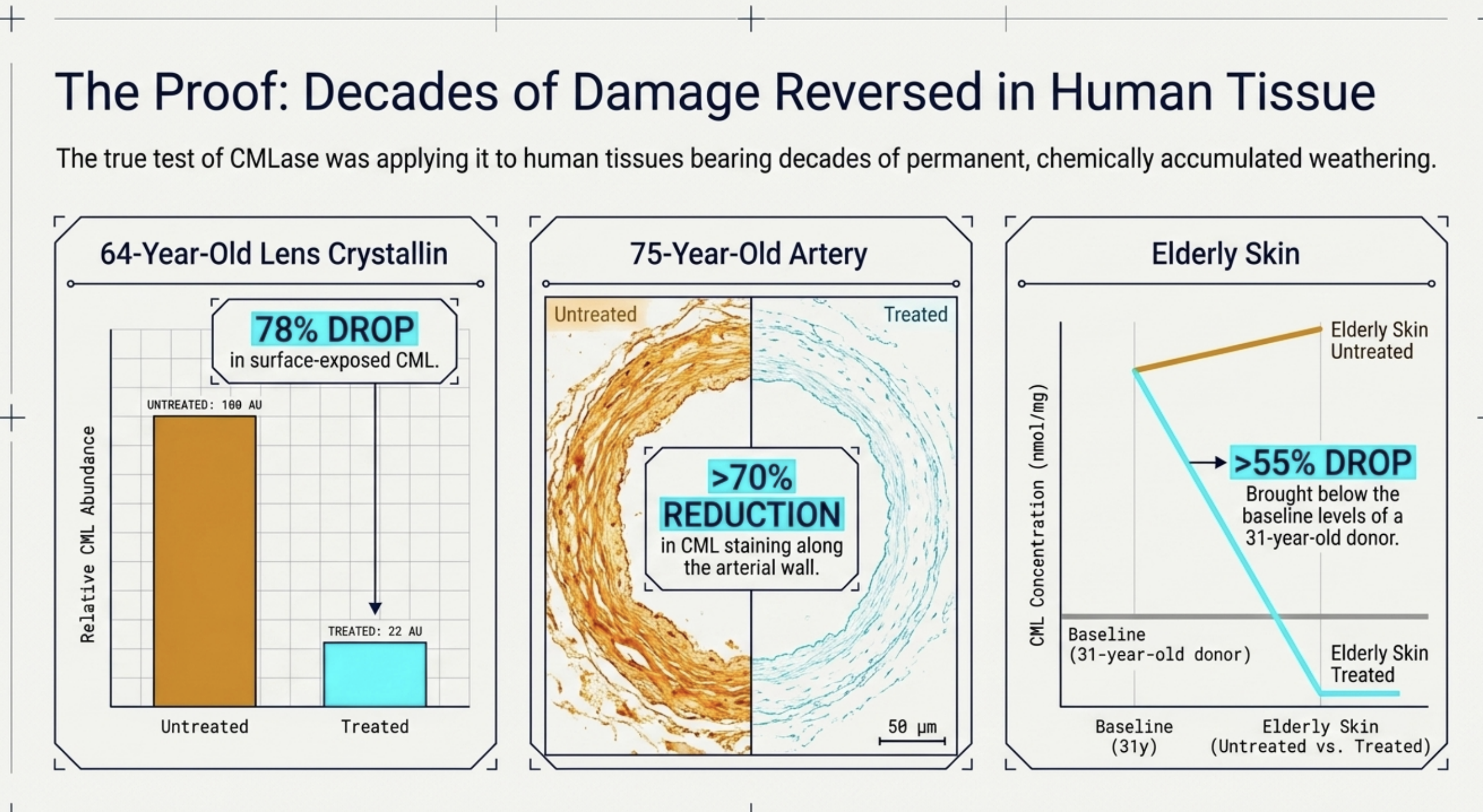
CMLase removed the majority of glycation damage across proteins and in human tissue. Across five test proteins, CML dropped 52 to 97 percent. In lens protein from a 64-year-old donor, surface-exposed CML fell 78 percent. In arterial tissue from a 75-year-old, CML staining fell more than 70 percent. In elderly skin, it fell more than 55 percent, to below the level found in skin from a 31-year-old donor.
The limitations are substantial and define this as a proof of concept, not a therapy. Chemical reversal was demonstrated but functional restoration was not, so it remains unknown whether removing CML restores tissue elasticity or quiets inflammation. Nothing was tested in a living organism; the experiments used homogenized protein or thin tissue sections where access is easiest. The enzyme is bacterial and would face immune obstacles in humans, its efficiency remains modest, and glucosepane, the crosslink most responsible for tissue stiffening, is untouched. The work also comes from a company with a direct commercial interest in the result.
The significance is the category, not the enzyme. A form of molecular aging the field had classified as permanent turned out to be reversible once the right tool was built. The directed evolution platform generalizes to other age-related protein modifications, with glucosepane named as the next target. After two decades in which the damage-repair approach to aging was largely theoretical, this is one of the first demonstrations that such a repair tool can be built and made to work on genuine human aging damage.
Introduction: Slowing the Damage Versus Removing It
Nearly every intervention in longevity medicine works the same way. Exercise preserves the mitochondrial machinery that aging degrades. SGLT2 inhibitors reduce the glucose load flowing through metabolic pathways. Rapamycin dials down anabolic signaling. Caloric restriction slows the whole system. These interventions differ enormously in mechanism, but they share a common logic: they reduce the rate at which damage accumulates.
None of them remove damage that has already accumulated.
For most kinds of cellular damage, this distinction matters less than it might seem, because the body replaces its own components continuously. Most proteins in the body last hours to days before being degraded and rebuilt. Damage a protein and the cell will eventually clear it and make a fresh one. The turnover machinery is itself a repair system, and slowing the rate of damage is genuinely sufficient when the damaged material is going to be replaced anyway.
But a subset of proteins are not replaced. Some of them last decades. The crystallin proteins that make up the lens of your eye are laid down before birth and are, for the most part, never replaced. The collagen in your arterial walls and skin turns over so slowly that a substantial fraction of what you are carrying at seventy was made in your twenties. These long-lived proteins accumulate chemical damage the way a stone building accumulates weathering, and no cellular process comes along to clear it.
The most abundant form of that damage comes from sugar. Glucose and its metabolic byproducts react spontaneously with proteins, no enzyme required, forming permanent chemical adducts called advanced glycation end products. They accumulate across a lifetime, they stiffen tissues, and they actively drive inflammation through a dedicated receptor. And for the entire history of the field, they have been considered irreversible. The body has defenses that intercept the reactive precursors before they attach, and drugs have been developed to do the same. But once the adduct forms on a protein, there has been no known way to take it off.
A new paper published in Nature Communications reports an engineered enzyme that does exactly that. Called CMLase, it was evolved in the laboratory across more than 500 million variants to find one specific glycation adduct on a protein, remove it, and restore the original amino acid underneath. When applied to lens protein from a 64-year-old donor, arterial tissue from a 75-year-old, and skin from elderly donors, it reversed the majority of the accumulated damage. In skin, the treated tissue showed less glycation damage than skin from a 31-year-old.
Nothing about this has happened in a living organism, and the distance from this result to a therapy is considerable. But the conceptual claim is significant on its own terms: a form of molecular aging that the field had classified as permanent turns out to be reversible once someone builds the right tool.
What Glycation Actually Is
To understand why this result matters, it helps to understand what glycation is, why it is different from almost every other chemical process in the body, and why the proteins it affects most are the ones you can least afford to lose.
Almost everything that happens inside a cell is catalyzed and controlled. Enzymes carry out reactions at specific sites, at specific rates, on specific substrates, and the cell regulates them continuously. This is what makes biology tractable. Reactions happen when they are supposed to, to the molecules they are supposed to happen to, and stop when the cell decides.
Glycation is not like this. It is a spontaneous chemical reaction between sugars and proteins that requires no enzyme, obeys no regulation, and has no off switch. Glucose circulating in the blood encounters a protein, and a small fraction of the time, the sugar's reactive carbonyl group attacks an amino group on the protein and forms a chemical bond. Nothing directed this. No cell decided it should happen. It occurred because two reactive chemical groups came into proximity and the thermodynamics permitted it.
This is the same chemistry that browns bread in a toaster and gives seared meat its crust, known as the Maillard reaction after the French chemist who described it. In a hot pan it runs in minutes. In the human body, at thirty-seven degrees, it runs across years and decades. The analogy is imperfect but the underlying chemistry is genuinely the same: sugars reacting with proteins to form progressively more complex and more stable modifications.
The initial products of this reaction are reversible. A sugar attaches loosely, and it can detach. But over time, through a series of rearrangements and oxidations, some of these early adducts convert into structures that are chemically stable and do not come off. These end states are called advanced glycation end products, or AGEs. The name is descriptive rather than dramatic: they are the endpoint of a glycation process that has advanced past the point of reversal.
Why the Rate Depends on You
Because glycation is driven by chemistry rather than biology, its rate depends primarily on two variables: how much sugar is present, and how long the protein sticks around.
The first variable is why glycation is central to diabetes. Chronically elevated blood glucose means more sugar molecules colliding with more proteins, more often, and the resulting AGE burden accumulates faster. This is the principle behind the hemoglobin A1c test, which measures glycated hemoglobin as a proxy for average blood sugar over the preceding few months. A1c works precisely because glycation is unregulated. The amount of glycated hemoglobin is a passive record of how much glucose that hemoglobin was exposed to, unmodified by any cellular decision.
The second variable is the one that matters more for aging, and it is less widely appreciated.
The Proteins That Never Get Replaced
Most proteins in the body are temporary. The cell builds them, uses them, degrades them, and builds fresh ones. Turnover times vary from minutes to weeks depending on the protein, but the vast majority of your proteome is replaced continuously. A protein that accumulates glycation damage will typically be broken down and recycled before that damage amounts to much, and the replacement is undamaged.
This turnover is itself a repair mechanism, and it is why glycation damage does not simply accumulate everywhere at the same rate. It accumulates where turnover is slow.
And in a few places, turnover is close to absent. The crystallin proteins that give the lens of the eye its transparency are synthesized before birth and are essentially never replaced. The lens is one of the only tissues in the body where the same protein molecules you were born with are still doing their job at eighty. Collagen in the extracellular matrix, the structural scaffolding of skin, arteries, tendons, and basement membranes, turns over on a timescale of years to decades. A meaningful fraction of the collagen in a seventy-year-old's arterial wall was laid down decades earlier and has been sitting there ever since, exposed to circulating glucose the entire time.
These long-lived proteins are where AGE accumulation becomes consequential. Every hour of exposure adds to a total that nothing is subtracting from. The result is a slow chemical weathering that tracks with age more faithfully than almost any other molecular process, which is why AGE burden in skin and lens has been proposed as a biological age marker in its own right.
What the Damage Does
The consequences fall into two categories, and both matter.
The first is structural. Glycation alters the physical and chemical properties of the protein it modifies, and in the extracellular matrix, some AGEs form crosslinks that covalently tie adjacent collagen molecules together. Collagen depends on being able to slide and flex relative to its neighbors. Crosslinked collagen cannot, and the tissue built from it becomes stiffer and less elastic. This contributes to the arterial stiffening that raises blood pressure with age, to the loss of skin elasticity, and to the reduced compliance of tissues throughout the body. Crosslinking also makes the protein harder for degradative enzymes to break down, which slows the already slow turnover further and compounds the problem.
The second consequence is inflammatory, and it is the one that connects glycation to the broader biology of aging. AGEs are not merely inert scar tissue on proteins. Certain AGEs are recognized by a dedicated cell surface receptor, and that recognition triggers an active signaling response. Understanding that receptor is what makes the specific target of this study make sense.
Why This Particular Adduct, and Why It Was Considered Permanent
Advanced glycation end products are not a single molecule. They are a chemically diverse family, dozens of distinct structures formed through different reaction pathways from different sugar-derived precursors. Among them, one has emerged as both the most abundant in aged human tissue and the most biologically active. It is called carboxymethyl-lysine, abbreviated CML, and it is the target of this study.
What CML Is
Lysine is one of the twenty standard amino acids, and it has a distinguishing feature: the end of its side chain carries an amino group with a positive charge at physiological pH. That positive charge is functional. It participates in the electrostatic interactions that hold proteins in their folded shapes, it mediates binding to negatively charged partners, and it serves as the attachment point for many of the regulatory modifications cells use to control protein behavior. Lysines are frequently found on protein surfaces, exposed to the surrounding fluid, precisely because charged residues are stable there.
That surface exposure makes lysine the most common site of glycation damage. When a reactive sugar-derived carbonyl attacks a lysine side chain and the resulting adduct undergoes oxidation, the product is carboxymethyl-lysine: the original lysine with a small carboxymethyl group attached to its terminal nitrogen.
The chemical consequence is a charge reversal. What was a positively charged amino group becomes a negatively charged carboxyl group. In terms of how the protein behaves, this is not a minor decoration. A residue that was attracting negative charges is now repelling them. A binding interaction that depended on that positive charge is disrupted. And any regulatory modification that would normally attach at that lysine can no longer do so, because the site is occupied.
CML is also chemically stable, more so than many other AGEs. Once formed, it does not spontaneously revert, does not hydrolyze off under physiological conditions, and persists for as long as the protein carrying it persists. On a lens crystallin, that means the rest of your life.
The Receptor That Makes It Worse
If CML only altered protein structure, it would be a slow degenerative problem. What makes it a driver of active pathology is that the body has a receptor that recognizes it.
The receptor for advanced glycation end products, universally called RAGE, is a cell surface protein expressed on endothelial cells, immune cells, neurons, and others. Its function is pattern recognition, similar in principle to the receptors of innate immunity that detect bacterial cell wall components. It binds molecular patterns associated with damage and stress, and AGEs are among its principal ligands. CML in particular is one of the best-characterized RAGE ligands.
When CML-modified proteins engage RAGE, the receptor initiates a signaling cascade that activates NF-κB, the master transcriptional regulator of inflammation. NF-κB translocates to the nucleus and turns on genes for inflammatory cytokines, adhesion molecules, and profibrotic growth factors. The cell shifts into an inflammatory, tissue-remodeling state.
This creates a self-reinforcing loop that is worth spelling out, because it is the mechanistic core of why AGEs matter for aging rather than just for diabetes. Accumulated CML activates RAGE. RAGE activation drives inflammation and oxidative stress. Oxidative stress accelerates the formation of additional AGEs, since the conversion of early glycation products into stable AGEs is itself an oxidative process. More AGEs mean more RAGE activation. The system feeds itself, and the loop has no natural terminus because nothing removes the accumulated adducts.
The reach of this axis extends well beyond blood vessels and skin. CML accumulation has been linked to oxidative stress and mitochondrial damage in microglia, the immune cells of the brain, which connects glycation biology directly to the neuroinflammatory processes implicated in neurodegeneration. Healthspan's earlier research review on glucose and ketone metabolism in Alzheimer's disease described the AGE-RAGE axis as one of the mechanisms through which chronic hyperglycemia damages the brain. This paper is working on the same axis from the opposite end, not preventing the ligand from forming but removing it after the fact.
Why Everything Before This Worked Upstream
The body is not defenseless against glycation, but its defenses share a common limitation.
The principal endogenous system is the glyoxalase pathway, built around the enzyme Glo1. It intercepts methylglyoxal and related reactive dicarbonyls, the highly reactive intermediates that form during glucose metabolism and that go on to attack proteins. Glyoxalase detoxifies these precursors before they can attach. It is an effective system, and its capacity declines with age, which is one reason AGE accumulation accelerates in later life. But it operates entirely on free precursors in solution. Once a precursor has reacted with a protein and formed a stable adduct, glyoxalase has nothing to act on.
The pharmacological attempts followed the same logic. Aminoguanidine, developed in the 1990s and taken into clinical trials for diabetic complications, works by trapping reactive carbonyl intermediates before they can modify proteins. Alagebrium was designed to break existing AGE crosslinks, an approach closer to repair, but its chemistry targeted a specific crosslink structure and clinical results were disappointing. Neither restores a modified residue to its original state.
So the entire toolkit, endogenous and pharmacological, addresses formation rather than removal. This is why the field's working assumption has been that AGE burden is a one-way accumulation. You can slow how fast it builds, through glycemic control, through reduced dietary AGE intake, through anything that lowers oxidative stress. You cannot subtract what is already there.
That assumption is what this study set out to test, and the way they tested it was to build an enzyme that had never existed.
Building an Enzyme That Did Not Exist
Enzymes are catalysts, and evolution has produced them for essentially every chemical transformation biology needs to perform routinely. The problem the team faced is that removing CML from a protein is not something biology has ever needed to do. There is no evolutionary pressure to evolve such an enzyme, because glycation damage accumulates in long-lived proteins late in life, well after reproduction. So no such enzyme exists. They had to make one.
Finding a Starting Point
Directed evolution, the technique they used, cannot create activity from nothing. It amplifies and refines activity that is already weakly present. So the first task was finding an enzyme that could do something faintly resembling the target reaction.
The insight came from looking at CML's structure. The carboxymethyl group attached to the lysine, together with the nitrogen it is attached to, forms a chemical substructure that closely resembles glycine, the simplest amino acid. If an enzyme existed that oxidized glycine, it might recognize the glycine-like portion of CML and act on it.
Glycine oxidases do exist. The team tested one from Bacillus subtilis and found what they were hoping for: weak activity on free CML, roughly thirty-fold less efficient than on its native substrate glycine, but real. The enzyme recognized CML floating free in solution and cleaved it, releasing lysine.
But free CML is not the problem. The problem is CML attached to a protein. And on peptide-bound CML, the enzyme did nothing at all. They screened sixteen related glycine oxidases from other organisms. Eight showed activity on free CML. None showed any activity on a peptide.
The Structural Bottleneck
Modeling explained why. Glycine oxidase active sites evolved to accept glycine, which is tiny. The pocket is sized accordingly, and a helix sits near the entrance, further restricting access. A free CML molecule can just fit. A CML residue in the middle of a protein chain, with the rest of the protein attached on both sides, cannot get anywhere near the catalytic site.
So the team went looking for a glycine oxidase that naturally lacked that helix. They queried protein databases for every sequence annotated as a glycine oxidase or amino acid oxidase with an available AlphaFold structure, filtered by size, and arrived at 44,783 candidates. They then computationally aligned every one of those structures against a reference, screening specifically for enzymes missing ten or more amino acids in the helix region.
Fewer than fifty sequences met the criterion. Among them, a glycine oxidase from Calidithermus roseus, a thermophilic bacterium, was missing twenty amino acids near the active site, including the entire twelve-residue helix. And it showed detectable activity on a peptide-bound CML substrate. Weak activity, but activity where nothing else had shown any.
That structural search is worth appreciating. They were not looking for an enzyme that did the reaction. They were looking for an enzyme with a hole in the right place, on the reasoning that an open active site would let a larger substrate in. Forty-five thousand structures screened for the absence of a helix.
Growth as a Readout
Improving that enzyme required testing enormous numbers of variants, which meant they needed a way to test them fast. The solution was a genetic selection, and it is elegant.
They engineered E. coli that cannot manufacture lysine. Such a bacterium dies unless lysine is supplied. Then they supplied lysine only in a form that had to be liberated by the enzyme: a short peptide with CML in the middle, sized so it could enter the periplasm, the space between the bacterial membranes, but not the cytoplasm. The enzyme variants were targeted to the periplasm, along with trypsin, a protease that cleaves protein chains specifically after lysine residues.
The logic chains together. If a variant successfully converts peptide-bound CML back to lysine, trypsin now has a site to cut. It cleaves the peptide into fragments small enough to enter the cell, where they are broken down and the lysine released. The bacterium survives and forms a colony. If the variant does not work, no lysine is liberated, and the cell dies.
Enzyme activity becomes growth. Instead of assaying variants one at a time, they could plate hundreds of millions and let the ones that worked select themselves.
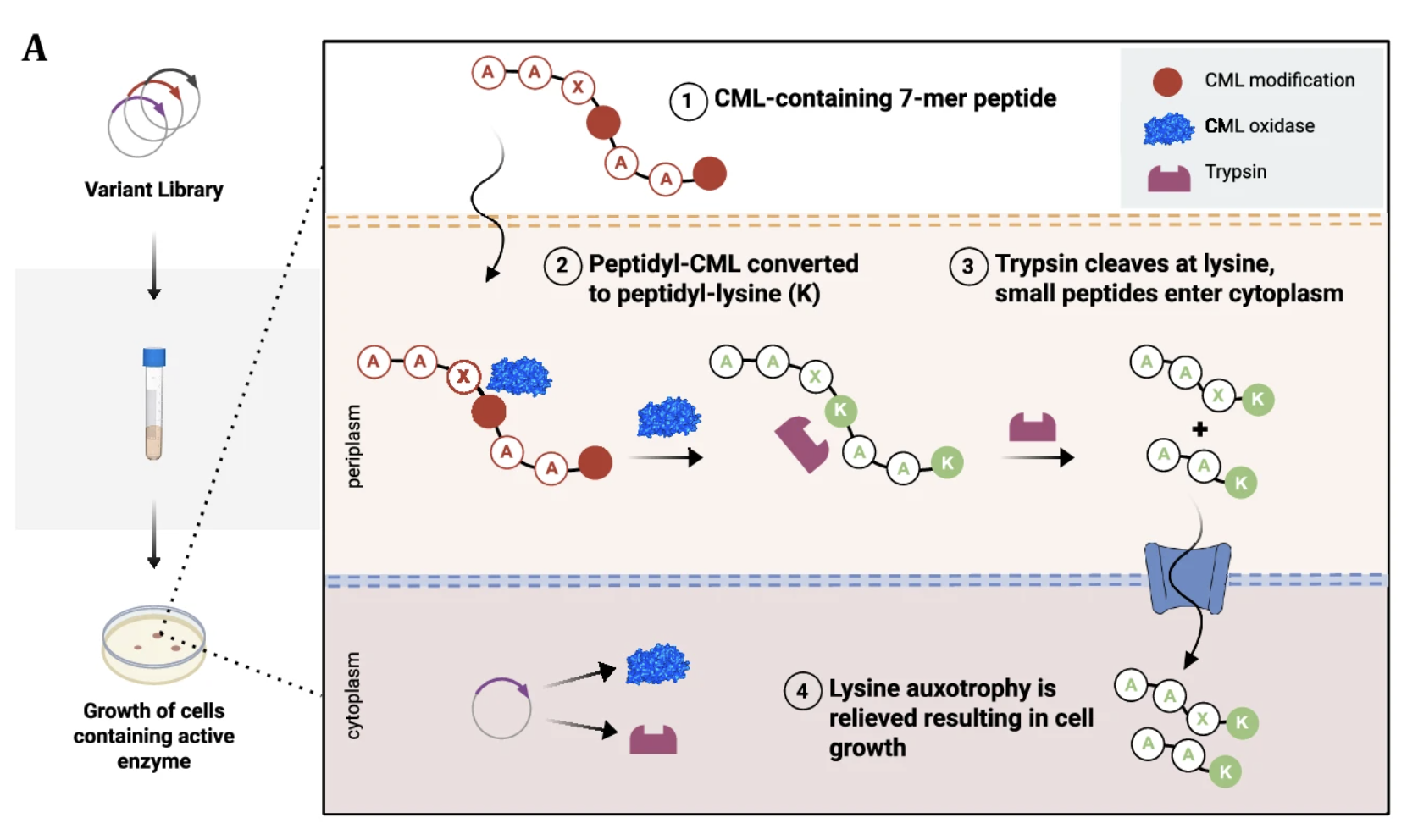
Figure 2A: Turning enzyme activity into survival. Bacteria engineered to be unable to make lysine were fed a CML-containing peptide sized to enter the periplasm but not the cytoplasm. Enzyme variants that successfully converted CML back to lysine created a cleavage site for trypsin, releasing fragments small enough to enter the cell and relieve the lysine deficiency. Only bacteria carrying a working enzyme survived, allowing hundreds of millions of variants to be screened by growth alone.
Five Rounds
The evolution proceeded through five rounds, each targeting a different limitation. Random mutagenesis first, then targeted modification of two flexible loops partially obstructing the active site, then substitutions in the binding pocket guided by a related enzyme with much higher affinity for CML, then stabilizing mutations that improved thermostability, then a final round of random mutagenesis selected against peptides with varied amino acids flanking the CML site, to ensure the enzyme would not become specialized to one sequence context.
Across the campaign, more than 500 million variants were screened. The final enzyme, CrGO-897, carries fifteen amino acid substitutions and a two-residue deletion relative to the starting scaffold, and shows more than a tenfold improvement in catalytic efficiency on peptide substrates. They named it CMLase.
One detail deserves emphasis. Every selection was performed on free CML or short peptides, because those are what the bacterial system can handle. Yet activity on full-length protein improved with every round anyway. The enzyme was never directly selected for the thing it ultimately needed to do, and it got better at it regardless.
The team also checked specificity carefully. CMLase does not oxidize other standard amino acids, does not act on glycine or arginine at peptide termini, and shows no activity on carboxymethyl-arginine, a chemically related adduct on a different residue. It appears genuinely selective for CML on lysine.
What CMLase Does to Damaged Proteins
With an enzyme in hand, the question became how well it worked on proteins that resemble the ones that matter in aging tissue.
Across Different Proteins
The team tested CMLase against a panel of physiologically relevant proteins, each chemically modified to carry CML: bovine serum albumin, collagen, hemoglobin, casein, and a total protein extract from retinal tissue. These were chosen to span different structural classes, from the flexible transport protein albumin to the rigid triple helix of collagen.
After overnight incubation, CML levels dropped across every substrate, with reductions ranging from 52 percent for albumin to 97 percent for casein. A catalytically inactive control enzyme produced no reduction, confirming the effect depended on catalysis rather than on the enzyme simply binding and blocking antibody detection.
The variation across proteins is informative rather than disappointing. Different proteins present their lysines differently. Some sit exposed on flexible surfaces, easily reached. Others are tucked into structured regions where a large enzyme cannot approach. The spread from 52 to 97 percent reflects protein architecture, not inconsistent enzyme performance.
Site by Site
To understand what determines whether a given CML residue gets repaired, the team used mass spectrometry to map the modification status of individual lysines on albumin, before and after treatment. Thirty-three CML-modified lysine sites were detectable. Thirty showed reduced CML after CMLase treatment. Twenty-one dropped by more than half, and seven by more than 90 percent.
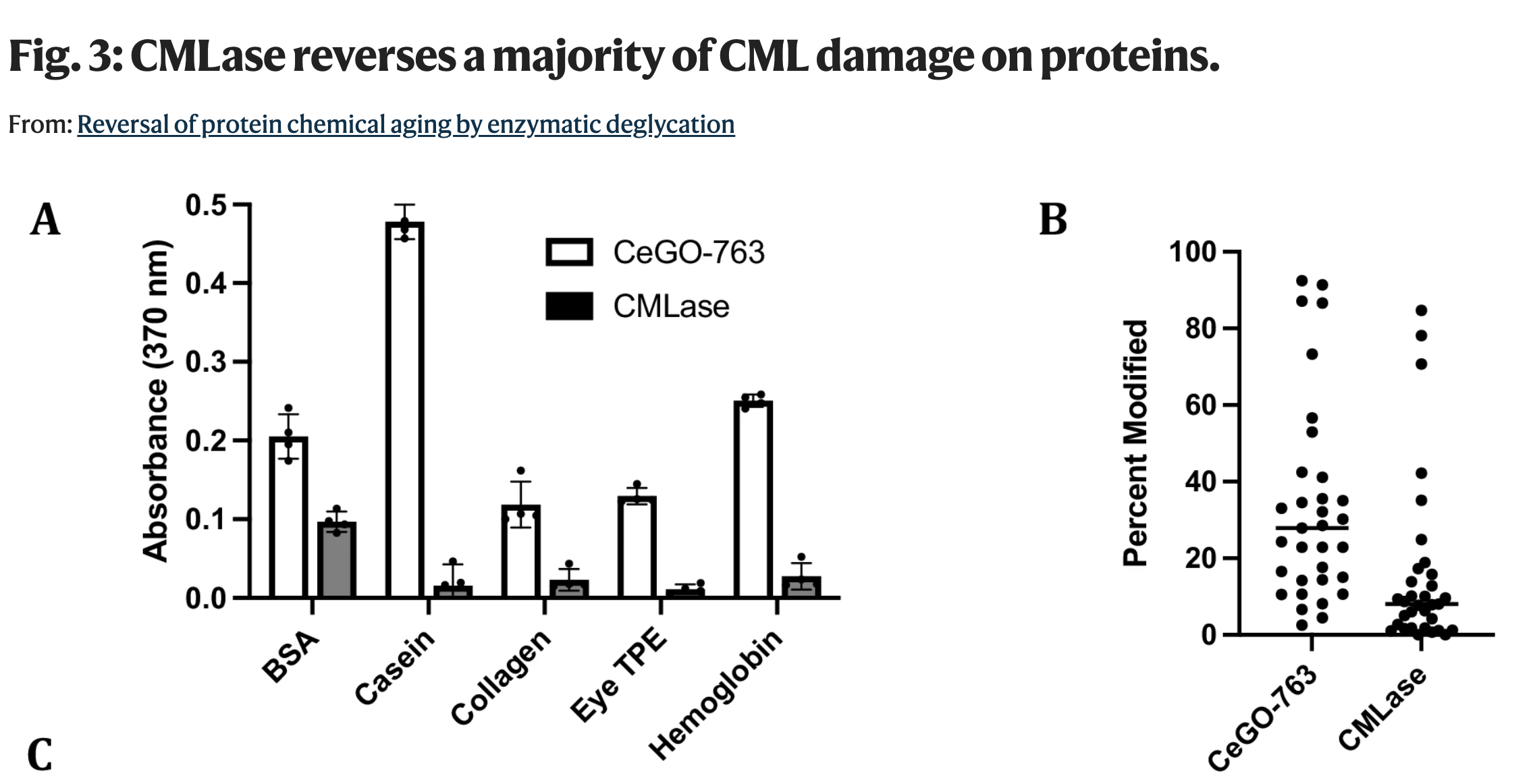
Figure 3: CMLase reverses most glycation damage across different proteins and most modified sites. Panel A shows CML reduction across five protein substrates spanning different structural classes, ranging from 52 percent for albumin to 97 percent for casein, with no reduction from a catalytically inactive control enzyme. Panel B maps repair at 33 individual glycation sites on albumin, with each point representing the fraction of that lysine still carrying CML after treatment with the active enzyme versus the inactive control.
The pattern of which sites were repaired and which resisted turned out to be more complicated than simple surface accessibility. Three lysines, K51, K232, and K573, all sit on surface-exposed helices in similar structural contexts. Their repair rates were 90 percent, 38 percent, and zero. Being on the surface was not sufficient.
Local flexibility correlated weakly with repair, suggesting the region needs some conformational freedom for the enzyme to engage, but flexibility alone did not predict success either. What emerged more clearly was a sequence effect. Sites flanked by bulky hydrophobic or aromatic residues resisted repair, while sites near cysteines were repaired more readily. The enzyme appears to prefer hydrophilic, solvent-accessible local environments, and the immediate neighbors of a CML residue matter as much as its position in the folded structure.
The authors make a point here that reframes what complete repair would need to mean. Not all glycation sites are equally pathogenic. Some lysines are functionally critical, sitting at binding interfaces or catalytic sites, and their modification does real damage. Others can be modified with minimal consequence. If the harmful effects concentrate at a subset of hotspot residues, then removing 70 percent of total CML burden might restore most of the lost function, provided the right 70 percent comes off. Complete removal may not be the relevant benchmark.
Human Tissue
The prepared protein experiments establish that the enzyme works on CML. They do not establish that it works on the CML that actually accumulates in a human body over decades, which forms under different conditions, at different sites, embedded in tissue architecture that has been aging alongside it.
Testing that required human tissue, and the reason is worth stating. CML accumulates over a lifetime, and a mouse lives two years. Mouse models are nearly useless for studying a process whose defining feature is decades of accumulation. So the team went directly to human samples from elderly donors.
Lens. Lens crystallins are the longest-lived proteins in the body, and consequently among the most heavily glycated. Soluble lens protein from a 64-year-old donor was incubated with CMLase overnight. Total CML content, measured by mass spectrometry after acid hydrolysis, fell 45 percent. Measured by antibody-based ELISA, it fell 78 percent.
The discrepancy between those two numbers is itself a finding, and the authors interpret it well. Mass spectrometry after hydrolysis measures every CML residue in the sample, including those buried inside folded protein. The antibody can only see CML that is exposed on the surface. That the antibody-detectable pool dropped further than the total pool indicates the enzyme is preferentially clearing surface-exposed CML, which is exactly what would be expected for a large enzyme reaching a large substrate. It also happens to be the pool that matters most for RAGE engagement, since RAGE binds CML on protein surfaces.
Artery. Sections of abdominal aorta from a 75-year-old donor were incubated with CMLase and stained for CML. Before addressing the treatment result, the team established their staining was measuring what they thought. Arterial tissue from donors aged 20 to 25 showed no specific CML staining. Tissue from the 75-year-old showed strong staining, concentrated along the arterial wall and adjacent to atherosclerotic lesions. Fifty years of accumulation, visible as the difference between a blank section and a dark one.
CMLase treatment reduced CML staining in the elderly arterial tissue by more than 70 percent.
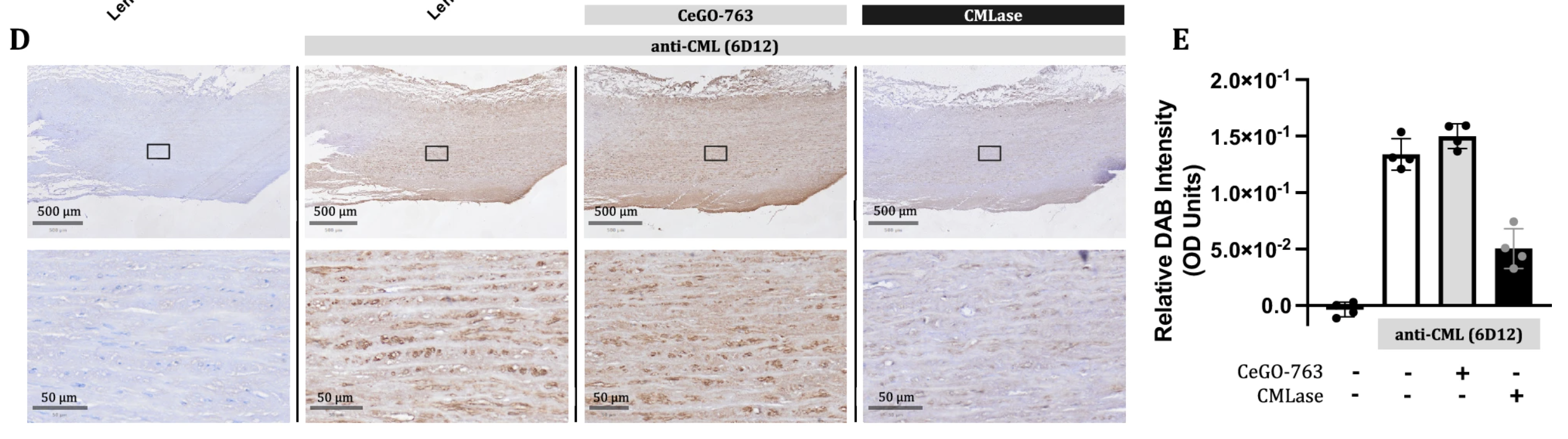
Figure 4: CMLase removes glycation damage accumulated over decades in human arterial tissue. Consecutive sections of abdominal aorta from a 75-year-old donor were incubated overnight with no enzyme, with a catalytically inactive control, or with CMLase, then stained for CML. Brown staining indicates glycation damage. Quantification of staining intensity showed a reduction of more than 70 percent in the treated sections.
Skin. Elderly skin sections showed more than 55 percent reduction in CML staining across both epidermal and dermal layers. And the comparison the team ran is the one that will get quoted: after treatment, CML staining in the elderly skin was lower than in untreated skin from a 31-year-old donor.
That comparison should be read carefully. It is a measurement of one chemical modification in fixed tissue sections, not a claim that the skin became younger in any functional sense. But as a demonstration that accumulated glycation damage can be removed rather than merely slowed, it lands.
What This Study Does Not Show
The authors are notably direct about the boundaries of their result, and those boundaries are substantial enough that they should shape how the finding is understood.
Chemical reversal is not functional restoration. The study demonstrates that CML can be removed from aged proteins. It does not demonstrate that removing it accomplishes anything physiologically. Nobody has shown that deglycated arterial tissue regains elasticity, that treated skin recovers mechanical properties, that lens protein becomes more transparent, or that RAGE signaling quiets down. The chemical claim is established. The functional claim, which is the one that would matter clinically, remains entirely open. The authors say this plainly.
Nothing happened in a living organism. Every experiment used either homogenized protein in solution or thin, formalin-fixed, paraffin-embedded tissue sections. Both are conditions where substrate accessibility is maximized, and the authors acknowledge this directly. Intact living tissue is a fundamentally harder environment. The extracellular matrix is dense, cross-linked, and not designed to admit large foreign proteins. Whether an enzyme of this size can penetrate that architecture in a living organ, reach sequestered modifications in the interstitial space, and remain active long enough to do useful work is unknown and untested. CMLase has never been given to an animal.
The enzyme is bacterial. It derives from a thermophilic bacterium and carries fifteen engineered mutations, which means the human immune system will not recognize it as self. For any therapy requiring repeat dosing, immunogenicity is a serious obstacle, potentially requiring protein de-immunization or immunomodulation. This is a well-known problem in enzyme therapeutics and it is not trivially solved.
Catalytic efficiency remains modest. CMLase is more than tenfold better than its starting scaffold, but still 10 to 50-fold less efficient than naturally evolved enzymes that modify proteins. In a laboratory incubation running overnight, that is workable. In a living system where the enzyme is being cleared, degraded, and diluted, it may not be.
CML is one adduct among many. Advanced glycation end products are a diverse family, and CML is only one member. Glucosepane, the dominant protein crosslink in aged human extracellular matrix and the one most directly implicated in tissue stiffening, is untouched by this enzyme and remains resistant to any known reversal. Removing CML would not restore tissue mechanics if crosslinks are what stiffened the tissue. The authors name glucosepane explicitly as a target for future engineering, which is an honest acknowledgment that the most mechanically consequential lesion is still standing.
Sample sizes are small. The human tissue work used single donors for the lens and arterial experiments. This is a proof-of-concept demonstration, not a study designed to characterize variation across individuals.
The work comes from a company with a direct commercial interest. CMLase was engineered by Revel Pharmaceuticals, a biotechnology company founded to develop enzymes that reverse age-related molecular damage, in collaboration with researchers at Calico and the University of Colorado Anschutz Medical Campus. The corresponding author is Revel's chief executive. This does not invalidate the work, which is technically rigorous, published in a peer-reviewed journal, and unusually candid about its own limitations. But it is context worth holding, particularly given that the most quotable finding, elderly skin showing less glycation damage than skin from a 31-year-old, is also the most commercially useful one.
Why It Matters Anyway
Given that list of limitations, it would be easy to file this as a preliminary result and move on. That would be a mistake, because the significance of the paper is not really about CMLase.
The claim that changed is a claim about categories. For as long as the field has studied advanced glycation end products, CML has been classified as chemically stable and irreversible. That classification was not a guess. It reflected the actual chemistry, the absence of any enzyme in any organism known to reverse it, and the failure of every pharmacological attempt to do anything except prevent formation. The reasonable conclusion was that this particular form of molecular aging was one-way.
What this study demonstrates is that the irreversibility was never intrinsic to the chemistry. It was a statement about available tools. Once someone screened forty-five thousand protein structures for an active site with the right geometry and then evolved it across five hundred million variants, the supposedly permanent modification came off. In aged human tissue. At rates above 70 percent.
That is a different kind of finding from a therapeutic result. It is a demonstration that a category of damage the field had written off is, in principle, addressable.
The platform is the point. The authors are explicit that the directed evolution approach generalizes. The same strategy, find a scaffold with weak promiscuous activity toward the target chemistry, engineer access to the active site, build a selection that couples activity to survival, and evolve, could in principle be applied to other age-related protein modifications. They name glucosepane as the obvious next target, and glucosepane is arguably the more consequential lesion, since it is the crosslink most implicated in the stiffening of aged extracellular matrix.
Whether that works is an open question. Glucosepane is a crosslink connecting two residues rather than an adduct on one, which is a harder chemical problem. But the method now has a proof of concept behind it, and that changes the calculation for whether it is worth attempting.
It tests a paradigm that has been mostly theoretical. The distinction between slowing damage and repairing it has been discussed in aging biology for roughly two decades, most prominently in the damage-repair framework that argues aging is the accumulation of specific molecular lesions and that each lesion type requires a corresponding repair intervention. The framework has been criticized as more compelling in principle than in practice, precisely because the repair tools did not exist.
This is one of the first demonstrations that a repair tool can be built and made to work on real human tissue for a genuine hallmark of aging. It does not validate the framework as a whole, and it does not establish that repairing this lesion produces any benefit. But it moves the argument from whether such a thing is possible to whether it is useful, which is a more tractable question.
What it means for how the rest of the field is understood. Almost everything Healthspan writes about operates upstream. Glycemic control, SGLT2 inhibition, exercise, dietary AGE reduction, all of these reduce the rate at which glycation damage forms. They remain the only available interventions, and they matter, because the accumulated burden at seventy is a function of the rate maintained across the preceding decades. Nothing here changes that.
But it does suggest that upstream is not permanently the only place to work. The proteins that cannot be replaced have been accumulating damage that nothing could remove, and the practical response was to slow the rate and accept the total. This paper is the first indication that the total might eventually be negotiable.
Conclusion: The Scars We Assumed Were Permanent
Aging leaves marks on proteins that live too long to be replaced. The lens you are reading this with contains proteins made before you were born, carrying every chemical modification they have picked up since. The collagen in your arteries has been sitting in the bloodstream for decades, reacting slowly with the sugar flowing past it. These are not cells that can be cleared and regrown. They are the parts of you that have to last, and the damage they accumulate has been accumulating in one direction only.
The response to this, across the entire history of the field, has been to work on the rate. Keep glucose lower. Reduce oxidative stress. Intercept the reactive precursors before they attach. All of this is sound, and it remains the only practical intervention available today. The burden a person carries at seventy is largely a function of the rate they maintained across the fifty years before, which is a real argument for metabolic health beyond the ones usually made for it.
What this study demonstrates is that the rate may not be the only variable. An enzyme built specifically for the purpose, from a scaffold that evolution produced for an unrelated reaction, removed the majority of one particular glycation adduct from human lens, arterial, and skin tissue that had spent decades accumulating it. The modification the field had classified as permanent turned out to be permanent only in the absence of a tool designed to remove it.
The distance from that result to a therapy is considerable, and this article has spent real space on why. Nothing has been shown to work in a living organism. Chemical reversal has not been connected to functional recovery. The enzyme is bacterial, its efficiency is modest, and the crosslink most responsible for tissue stiffening remains untouched. Any of these could prove to be the obstacle that stops the approach.
But the conceptual result stands independent of whether CMLase becomes a drug. A form of molecular damage that had been categorized as irreversible was reversed, in aged human tissue, by an enzyme that did not exist three years ago. The category was wrong. That is worth knowing regardless of what happens next, because it changes what the field is entitled to assume about the rest of the damage that has been filed the same way.
Related studies