Low Testosterone Is Blamed on Aging. A Study of Nearly 5,000 Men Says the Real Driver Is the Fat Around Your Organs.
For most men under 60, low testosterone is more about body fat than age. A study of nearly 5,000 American men in the Journal of the Endocrine Society found that chronological age explained just 2.5% of the variation in testosterone between men, while body fat measures each explained roughly 18 to 20%, about seven to eight times as much. The decline men are taught to blame on aging is, for most under 60, substantially driven by something they can change.
Visceral fat, the fat around the organs, seems to be the real culprit. It suppresses testosterone through four interlocking mechanisms: it converts testosterone to estrogen via the aromatase enzyme, it quiets the brain's signal to the testes, it drives insulin resistance that lowers the SHBG carrier protein, and it pumps out inflammatory signals that suppress production. These compound, and low testosterone in turn promotes more fat, creating a self-reinforcing spiral.
A tape measure works as well as an expensive scan. Waist circumference predicted testosterone as well as, or slightly better than, a DXA visceral-fat scan (explaining ~20% versus ~18% of the variation). A man can gauge his own fat-related risk at home. As a rough landmark, a waist over about 43 to 45 inches signals that low testosterone is far more likely driven by visceral fat than by age.
The size of the fat effect is large. Across the range of body fat observed, predicted testosterone fell from around 900 ng/dL in the leanest men to roughly 250 in the fattest, spanning the entire clinical range from robustly normal to unambiguously low. This is the difference between a man who would never be flagged and one who would be handed a prescription.
Low testosterone from fat is often functional and reversible. Much of the low testosterone in men with excess fat is not a broken reproductive system but a functional, adaptive suppression driven by the metabolic environment. The machinery is intact. When men lose visceral fat, testosterone tends to rise, and the more visceral fat lost, the greater the increase, shown across lifestyle change, bariatric surgery, and the newer GLP-1 weight-loss medications.
The things that raise testosterone are the things that improve metabolic health. Losing visceral fat, resistance training and building muscle, and protecting sleep each address the mechanisms that suppress testosterone, and for men with significant, stubborn visceral fat, medical weight-loss tools can help by reducing the fat that drives the suppression. These treat the cause rather than overriding the symptom, and deliver metabolic benefits that testosterone replacement alone does not.
The elevated-estrogen piece is real but widely misunderstood. Men with high visceral fat often have both low testosterone and elevated estrogen, and some symptoms blamed on low testosterone are partly an estrogen story. But the elevated estrogen is a readout of the fat problem, not a villain to attack with drugs. Men need estrogen for bone, brain, and libido. Reduce the fat and both hormones move back toward balance together.
The population-wide testosterone decline may track rising adiposity, among other factors. Average male testosterone has fallen over recent decades. The cause is genuinely unsettled, with physical activity, sleep, diet, environmental exposures, and measurement differences all plausibly contributing, and no single factor established as definitive. But rising visceral fat is among the best-supported drivers and by far the most actionable, which reframes part of the cultural "testosterone crisis" as a metabolic-health story rather than a mysterious diminishment of modern men.
The evidence has limits, and it points to better questions rather than a rule. The study is cross-sectional, so it shows strong association, not proof of causation in any individual; it measured a number, not a hypogonadism diagnosis; and it covered men aged 20 to 59, not older men, in whom age plays a larger role. What it establishes firmly is that among men under 60, body fat is a far better correlate of testosterone than age, a strong reason to assess the whole man, his body composition, metabolic markers, symptoms, and goals, before deciding whether a low number calls for fat loss, hormone therapy, or both.
Introduction: The Story Men Are Told About Testosterone
There is a story about testosterone that nearly every man absorbs by middle age. It goes like this: testosterone peaks in your twenties, declines steadily and inevitably as you get older, and that decline explains the fatigue, the softening physique, the flagging drive and mood that so often accompany the passing decades. The story has a tidy solution attached to it, replace what age has taken, and a booming industry has grown up around delivering exactly that. Testosterone prescriptions have climbed for years, and a wave of direct-to-consumer platforms now makes getting a prescription easier than ever, often on the strength of a single lab result and a short online questionnaire.
The story is compelling because it contains real elements. Testosterone does decline somewhat with age. Low testosterone genuinely can cause the symptoms men worry about. And restoring it can, in the right patients, help. The story also rests on a central assumption that a large new analysis calls into serious question: that the decline is primarily about age at all.
The study, published in the Journal of the Endocrine Society, examined nearly 5,000 American men and asked a deceptively simple question. When a man's testosterone is low, how much of that is explained by his age, and how much by his body composition, specifically, by how much fat he carries and where he carries it? If the conventional story is right, age should dominate. It did not. Age explained a strikingly small share of the differences in testosterone between men. What explained far more, by a wide margin, was adiposity, and above all the visceral fat packed deep in the abdomen.
The implication reorders how men, and their doctors, should think about a low testosterone reading. For a large share of men, particularly those under 60, a low number may say more about their waistline and metabolic health than about their age, and it may point to something modifiable rather than something to be managed with lifelong hormone replacement. That distinction is not academic. It is the difference between treating a reversible metabolic problem at its root and committing to a permanent prescription for a decline that was never really about getting older.
What follows is what the study found, why body fat, and visceral fat in particular, exerts such a powerful grip on testosterone, and what a low reading should actually prompt a man to do, which turns out to be quite different from what the prevailing story suggests.
What Testosterone Does, and What a Low Number Really Means
Before untangling what drives testosterone down, it helps to be clear about what testosterone does, and about a distinction that sits at the center of this entire topic and is constantly blurred: the difference between a low number on a lab report and a genuine medical condition.
Testosterone is the primary male sex hormone, but its reach extends well beyond reproduction. It supports the maintenance of muscle mass and strength, contributes to bone density, influences the distribution of body fat, and plays a role in libido, mood, energy, and cognition. It is also, and this turns out to be central to the story, a metabolic hormone: testosterone helps drive the breakdown of fat and limits the body's tendency to store it. These broad effects are why low testosterone can produce such a diffuse, hard-to-pin-down cluster of symptoms, fatigue, reduced drive, loss of muscle, increased body fat, low mood, and why so many men, feeling those things in midlife, wonder whether their testosterone is to blame.
It is also true that testosterone declines with age, at least somewhat. Longitudinal studies do show a gradual downward drift over the decades. But the size of that decline, when isolated from other factors, is far more modest than the cultural narrative suggests, and it is highly variable from man to man, shaped heavily by health and lifestyle rather than following a fixed biological schedule. This is the first crack in the inevitable-decline story: the age-related fall is real but small, and it is entangled with everything else that changes as men get older.
Now the critical distinction. Having a testosterone level below a given threshold is not the same as having clinical hypogonadism, the actual medical diagnosis that warrants treatment. Real hypogonadism is defined by more than a single number. It requires consistently low testosterone confirmed on repeat morning measurements, the presence of characteristic symptoms, and ideally an evaluation of why the levels are low, including hormones from the brain that reveal whether the problem lies in the testes themselves or in the signaling upstream. A single blood draw showing a number under 300 does not establish any of that. Testosterone fluctuates by time of day, by recent sleep, by acute illness and stress, and by whether a man is in a period of caloric deficit.
This distinction matters enormously for interpreting the study at the heart of this article, and for interpreting your own lab results. The research measured biochemical testosterone, the number, in thousands of men. It did not diagnose hypogonadism in them, and its authors are explicit on this point. What it can tell us is what that number tracks with across a population. And what it found is that the number tracks far more tightly with how much fat a man carries than with how old he is. Understanding why requires looking at the paradigm this study challenges, and where that paradigm came from.
How Much of the "Testosterone Crisis" Is an Adiposity Crisis?
There is a widespread sense, amplified across podcasts, supplement ads, and men's health media, that testosterone is in freefall, that men today are hormonally diminished compared to their fathers and grandfathers. And there is some real evidence behind the anxiety: population studies have documented that average testosterone levels in men have declined over recent decades, even after accounting for age. Something does appear to be happening to men's testosterone at the population level, beyond individual aging.
What explains it is genuinely unsettled, and honesty requires saying so. A number of factors have shifted over the same decades and plausibly contribute: falling physical activity, worsening sleep, changes in diet, environmental exposures that may affect hormones, and even differences in how testosterone was measured across eras, which complicate the comparison. Untangling their relative contributions is difficult, and no single one has been established as the definitive cause. Anyone claiming certainty about why men's testosterone has fallen is overstating what the evidence supports.
That said, one factor stands out for how much support it has and how well it fits the biology. Over the same period, obesity and visceral fat have risen dramatically across the male population. If visceral fat suppresses testosterone as powerfully as this study and the mechanisms behind it indicate, then a population getting heavier would be expected to show a meaningful population-level testosterone decline, which is what has been observed. This does not prove that rising adiposity is the whole story, or even that it is the largest single piece. It does make it one of the most credible drivers, and, importantly, the one most within a man's control. The other candidates are real, but visceral fat is the one with both strong mechanistic backing and a clear lever attached.
The framing matters, because the competing stories lead to very different responses. If men are simply victims of an inexorable hormonal decline imposed by the modern world, the response is fatalism, or a prescription. If a meaningful share of the decline tracks a rise in visceral fat, then part of the problem, at least, is something men can actually do something about, at both the individual and population level. The point is not that adiposity explains everything. It is that, among the many plausible drivers, it is the best-supported and the most actionable.
This mirrors the reframe the study delivers for the individual, scaled up to the population. Just as a given man's low testosterone is often more about his metabolic health than his age, a meaningful part of the broader decline likely reflects rising adiposity rather than some mysterious diminishment of modern men. That is a more measured story than the one usually told, and, for the part that adiposity drives, a more hopeful one.
Where the Inevitable-Decline Story Came From
Every dominant medical narrative has an origin, and the idea that testosterone falls inexorably with age traces largely to a landmark study begun in the 1980s: the Massachusetts Male Aging Study. It was a serious, influential piece of work, and it did something valuable, tracking testosterone across a large group of men and documenting that, on average, levels were lower in older men than younger ones. From this and similar cross-sectional snapshots grew the concept sometimes called "andropause," a male analogue to menopause, a steady age-driven hormonal decline that the passing years impose on every man.
The concept was intuitive, it fit what men experienced, and it proved commercially powerful. If testosterone decline is simply what happens as men age, then the logical response is to replace it, and an entire treatment paradigm followed from that premise. For decades, a low reading in an aging man was interpreted, almost reflexively, as age-related hypogonadism, the natural and expected consequence of getting older.
But there was a flaw built into the foundation of this story, and it is the flaw the new research exposes. The early studies compared younger men to older men and attributed the difference to age. Yet older men in these populations did not differ from younger men only in age. They also, on average, carried more body fat, and specifically more visceral fat, which accumulates steadily across adulthood. They had higher rates of insulin resistance, metabolic syndrome, and chronic disease. Age and adiposity rose together, hand in hand, and the studies had no clean way to separate them. When researchers saw testosterone falling as age climbed, they credited age, but age was traveling with a companion that was never properly accounted for.
This is a classic problem in studying aging, and it recurs across the field: almost everything that goes wrong in the body becomes more common with age, which makes age look like the cause of things that are actually driven by the conditions that accumulate alongside it. Muscle loss, cognitive decline, metabolic dysfunction, and, as it turns out, falling testosterone have all been attributed to the calendar when a substantial part of the story lies in what happens to the body over the years, much of it modifiable, rather than in the years themselves.
Untangling the two requires a study designed to pit age and adiposity against each other directly, in the same population, at the same time, and to measure which one actually accounts for the differences in testosterone between men. That is precisely what the researchers set out to do.
The Study
To separate age from adiposity, the researchers turned to one of the best resources available for this kind of question: the National Health and Nutrition Examination Survey, or NHANES, a large, nationally representative sampling of the American population. From it they drew 4,984 men aged 20 to 59, a range chosen deliberately to focus on the decades in which the age-versus-fat question is most consequential and least contaminated by the frank testicular decline and frailty of advanced age.
Two features of the study's measurement approach give its findings unusual weight. The first is how testosterone was measured. Many studies, and many commercial labs, rely on immunoassays, which are cheaper but less accurate for testosterone. This study used liquid chromatography-mass spectrometry, the gold-standard method, calibrated to national reference standards. The testosterone numbers here are about as trustworthy as the field allows.
The second is how body composition was measured. Rather than relying on body mass index, a crude proxy that cannot distinguish muscle from fat or reveal where fat sits, the study used DXA scanning, the same technology used for bone density, which precisely quantifies total body fat and, crucially, visceral adipose tissue, the metabolically dangerous fat packed deep around the abdominal organs. It also recorded each man's waist circumference, the simple tape-measure figure, so the researchers could test whether that accessible measurement captured the same signal as the sophisticated scan.
With these measurements in hand, the analysis was straightforward in concept and powerful in execution. The researchers built statistical models that pitted the candidate explanations against one another and asked how much of the variation in testosterone between men each one could account for. They started with age alone. Then they tested total body fat, visceral fat, and waist circumference, each alongside age, to see which explained more. They further checked whether the relationships held after accounting for SHBG, the carrier protein, and across several different testosterone thresholds, to be sure the findings were not an artifact of where the cutoff was drawn.
The result is a clean, direct comparison, in the same large population, at the same time, of how much chronological age versus body fat actually explains about a man's testosterone. And the two did not come close.
The Headline Finding: Fat Explains Far More Than Age
The central result was not subtle. When the researchers modeled testosterone against age alone, age accounted for just 2.5% of the variation between men. That is a strikingly small number for a factor that the entire cultural and clinical narrative treats as the primary driver. Put plainly, if all you know about a man is his age, you know almost nothing about what his testosterone will be.
Body fat told a completely different story. Total body fat explained about 18% of the variation in testosterone. Visceral fat explained about 18% as well. And waist circumference, the humble tape measure, explained about 20%. Each of these measures of adiposity accounted for roughly seven to eight times as much of the difference in men's testosterone as age did. The factor everyone blames turned out to be nearly irrelevant next to the factor almost no one talks about.
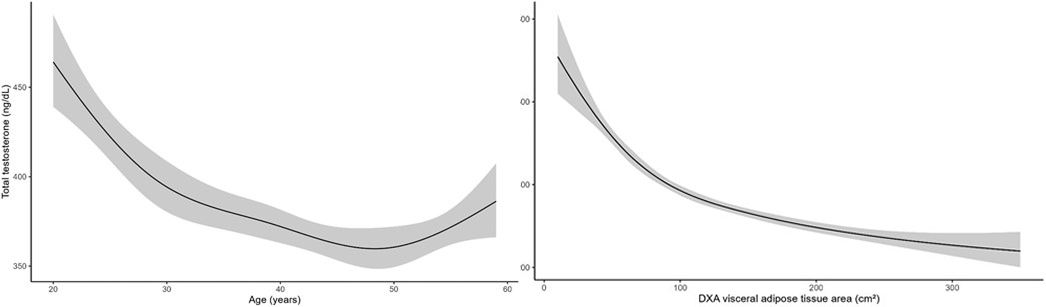
Figure 1: Age barely predicts testosterone; visceral fat strongly predicts it. Left, the relationship between age and testosterone is nearly flat; age explained just 2.5% of the variation between men. Right, testosterone falls steeply as visceral fat rises. The contrast between these two curves is the study's central finding.
The way the two interacted in the models is just as telling as the raw numbers. When adiposity was added to a model that already contained age, the age effect largely collapsed, its statistical strength fading to near irrelevance once body fat was accounted for. This is the signature of what statisticians call mediation, and in plain terms it means this: much of what looks like age-related testosterone decline is actually fat-related decline wearing age's clothing. Men's testosterone does fall as they move from their twenties into midlife, but the models indicate that this happens largely because men tend to accumulate fat over those years, not because of the years themselves. Hold body fat constant, and most of the apparent age effect disappears.
The magnitude of the fat effect is worth making concrete, because it is large. Across the range of body fat the study observed, predicted testosterone fell from around 900 nanograms per deciliter in the leanest men to roughly 250 in the fattest, a difference that spans the entire clinical spectrum from robustly normal to unambiguously low. A similar gradient held for visceral fat: as visceral fat climbed from low to high, predicted testosterone dropped from around 700 to about 230. These are not marginal shifts. They are the difference between a man who would never be flagged as low and one who would be handed a prescription.
One more finding cuts directly against the inevitable-decline narrative. The prevalence of biochemically low testosterone did not climb relentlessly with age. It rose from the twenties into the forties, then plateaued, and even ticked down slightly in the fifties, despite body fat continuing to rise. If testosterone simply eroded with age, you would expect the opposite, a steady increase in low readings decade after decade. The plateau suggests that low testosterone is something men tend to cross into during midlife as metabolic burden accumulates, not a line that keeps dropping as the birthdays pass.
Taken together, these results deliver a coherent and disruptive message. Chronological age is a weak predictor of a man's testosterone. Body fat, and especially visceral fat, is a strong one. Which raises the question the next section answers: why would fat, sitting in the abdomen, exert such a powerful pull on a hormone made in the testes?
Why Visceral Fat Lowers Testosterone
It is one thing to show that belly fat tracks with low testosterone, and another to explain why. The mechanisms matter here, because they are what make the relationship causal rather than coincidental, and they reveal why visceral fat in particular, the fat packed deep around the abdominal organs, is so much more damaging to testosterone than fat elsewhere on the body. The paper points to four interlocking pathways, and they reinforce one another.
The first is aromatization. Fat tissue is not inert storage; it is an active endocrine organ, and one of the things it does is produce an enzyme called aromatase, which converts testosterone into estrogen. The more fat a man carries, the more aromatase he has, and the more of his testosterone is quietly converted into estradiol. This does double damage: it directly lowers testosterone, and the resulting higher estrogen signals back to the brain that hormone levels are adequate, which suppresses the body's own drive to produce more testosterone. Fat, in effect, both burns testosterone and tells the body to stop making it.
Estrogen: the other half of the story. The aromatization pathway deserves a closer look, because it points to something most men never hear. When visceral fat converts testosterone into estrogen, the result is not only less testosterone but more estrogen, and men with significant visceral fat frequently have both at once: a suppressed testosterone level alongside an elevated estrogen level. This matters because some of the symptoms men reflexively blame on low testosterone, stubborn fat storage, low drive, mood changes, softer body composition, can be driven as much by the elevated estrogen as by the diminished testosterone. The hormonal picture in a man carrying excess visceral fat is not simply a testosterone deficiency; it is a shifted balance between the two hormones, tilted by the fat itself. This is worth stating carefully, because it is a point the internet gets badly wrong. The elevated estrogen in men with obesity is not a villain to be attacked directly, and the popular impulse to suppress it with drugs meant for other purposes is misguided and can cause real harm, since men need estrogen too, for bone health, brain function, and libido among other things. The elevated estrogen is not the disease. It is another readout of the same underlying problem, too much visceral fat producing too much aromatase. Reduce the fat, and both sides of the imbalance move back toward normal together: testosterone rises, excess estrogen falls, without any drug aimed at either hormone.
The second is suppression of the brain's signaling to the testes. Testosterone production is governed by a chain of command, the hypothalamus and pituitary in the brain send hormonal signals that tell the testes to produce testosterone. Visceral fat disrupts this chain. Through the elevated estrogen described above, and through inflammatory signals, excess fat dampens the brain's signaling, so the testes receive a weaker instruction to produce. The factory is intact, but the orders coming down the line have quieted.
The third is insulin resistance and its effect on a carrier protein. Most testosterone in the blood does not float freely; it rides on a carrier protein called sex hormone-binding globulin, or SHBG, made by the liver. Visceral fat drives insulin resistance, and insulin resistance suppresses the liver's production of SHBG. Lower SHBG means less measured total testosterone, which is what a standard blood test captures. The study confirmed this directly: men with more visceral fat had lower SHBG, and that accounted for part, though not all, of their lower testosterone. Insulin resistance also appears to act directly on the testes, further reducing their output.
The fourth is inflammation, and this is where visceral fat's special danger comes in. Unlike the subcutaneous fat under the skin, visceral fat is metabolically aggressive, secreting a steady stream of inflammatory signaling molecules into the bloodstream. That chronic, low-grade inflammation, the same "inflammaging" implicated across so much of age-related disease, independently suppresses testosterone production at multiple points in the system. This is why waist size, which reflects visceral fat specifically, tracks testosterone better than overall weight or even total body fat. It is not just how much fat a man carries, but where it sits.
It is not just how much fat a man carries, but where it sits, that determines his testosterone.
These four mechanisms do not operate in isolation; they compound. More fat means more aromatization, more inflammation, more insulin resistance, weaker brain signaling, and lower SHBG, each pushing testosterone down and several of them reinforcing the others. And there is a cruel feedback loop layered on top: low testosterone itself promotes the accumulation of more fat, because testosterone normally helps drive fat breakdown and limit fat storage. So low testosterone begets more visceral fat, which begets lower testosterone. A man can descend that spiral for years and experience it simply as "getting older," when what is actually happening is a self-reinforcing metabolic problem with a clear point of intervention.
That last point is the hopeful one, and it sets up everything that follows. A decline driven by fat is a decline with a lever attached to it. Unlike the calendar, visceral fat can be reduced, and when it is, several of these mechanisms reverse at once.
A Tape Measure Does the Job
Buried in the study's results is a finding that is genuinely useful for any man trying to make sense of his own risk, and it costs nothing to act on. Among all the ways the researchers measured body fat, the humble waist circumference, a tape measure around the abdomen, performed as well as the sophisticated DXA scan at predicting testosterone. In fact, it performed slightly better, explaining about 20% of the variation in testosterone versus about 18% for the DXA-derived visceral fat measurement.
This matters because visceral fat, the metabolically dangerous kind, normally requires specialized imaging to quantify precisely. A DXA scan or a CT scan can measure it directly, but most men will never get one. Waist circumference is a proxy anyone can measure at home, and this study demonstrates that for the purpose of gauging fat-related testosterone risk, that proxy captures essentially all the useful information the expensive scan provides. The tape measure is not a poor substitute; it is, for this purpose, just as good.
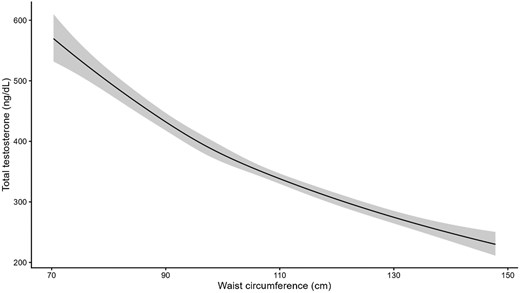
Figure 2: Waist circumference predicts testosterone as well as an expensive scan. Predicted testosterone falls steadily as waist circumference rises. This simple tape-measure figure explained slightly more of the variation in testosterone (about 20%) than the DXA-derived visceral fat measurement (about 18%).
The study even offers rough landmarks. The researchers noted that visceral fat areas of roughly 100, 200, and 300 square centimeters correspond to waist circumferences of about 95, 105, and 115 centimeters in adult men, or very roughly 37, 41, and 45 inches. A visceral fat area around 100 square centimeters, a waist near 37 inches, marks a widely used threshold above which metabolic risk rises meaningfully. And the testosterone gap across this range is large: the predicted difference between a man below that threshold and one carrying a very high visceral fat burden exceeded 400 nanograms per deciliter. In practical terms, the study's authors suggested that a middle-aged man with a waist over about 110 to 115 centimeters, roughly 43 to 45 inches, is far more likely to have low testosterone because of excess visceral fat than because of his age.
Functional, and Often Reversible
The most consequential implication of this research is not about measurement at all. It is about what a fat-driven decline in testosterone means for a man's prospects, and here the news is genuinely encouraging. A decline caused by visceral fat is, in principle, a decline that can be reversed, because visceral fat can be lost, and when it is, the mechanisms that suppressed testosterone begin to run in reverse.
The study frames this through a concept that deserves wider understanding: functional hypogonadism. This is the idea that much of the low testosterone seen in men with excess adiposity is not the result of a broken or failing reproductive system, but a functional, adaptive suppression, the body dialing testosterone down in response to a metabolic environment of excess fat, inflammation, and insulin resistance. The machinery is intact. It is being told to run quietly by the conditions surrounding it. Change those conditions, and the machinery can respond.
There is striking evidence for how readily testosterone responds to metabolic circumstances, and some of it comes from the opposite extreme of adiposity. The paper points to studies of lean, healthy men subjected to severe caloric deficit under physical stress, in whom testosterone can plummet to near-castrate levels within weeks, and then recover rapidly once normal eating resumes. Sleep deprivation produces a similar transient suppression. These are not men whose testes have failed; they are men whose bodies have temporarily throttled testosterone in response to stress and energy shortage, and who bounce back when the stressor lifts. Testosterone, in other words, is highly responsive to the state of the body, up as well as down. It is not a fixed quantity ticking down with age but a dynamic signal that reflects current conditions.
The same responsiveness applies to fat loss. When men with obesity lose significant weight, their testosterone tends to rise, and the more visceral fat they shed, the more it rises. This has been shown across the spectrum of weight-loss approaches, from lifestyle change to bariatric surgery, and, notably, the study points to the newer GLP-1 receptor agonist medications, which produce substantial reductions in visceral fat and have been associated with increases in testosterone as that fat comes off. The lever works. Reduce the visceral fat that is suppressing testosterone, and testosterone responds.
This reframes the entire clinical question for a large share of men. If a man's low testosterone is being driven by visceral adiposity, then addressing that adiposity is not merely a general health recommendation running alongside his hormone concern. It is a direct treatment for the hormone concern itself, one that works on the actual cause rather than overriding it. And it comes with a cascade of other benefits, to cardiovascular risk, insulin sensitivity, and inflammation, that testosterone replacement does not provide. Fat loss treats the low testosterone and the metabolic dysfunction that produced it, at the same time.
None of this means fat loss is easy, and none of it means testosterone therapy never has a role. But it establishes something important: for many men, low testosterone is a modifiable condition with a root cause that responds to intervention, not a permanent deficit to be managed indefinitely. That distinction should sit at the center of how a low reading is evaluated.
What Actually Raises Testosterone
If visceral fat is the lever, the practical question becomes how to move it, and here the evidence points to a handful of approaches that work, notably, the same approaches that improve metabolic health broadly. This is not a coincidence. Because the low testosterone is a symptom of metabolic dysfunction, the things that fix the metabolism tend to raise the testosterone.
The first and most direct is losing visceral fat. This is the root cause for most men under 60 with low testosterone, and reducing it addresses several of the suppressing mechanisms at once: less aromatase converting testosterone to estrogen, less inflammation, better insulin sensitivity, and restored SHBG. The evidence is consistent across the spectrum of methods, from lifestyle change through to more aggressive interventions, and the relationship is dose-dependent: the more visceral fat a man loses, the more his testosterone tends to rise. Importantly, it is visceral fat specifically that matters most, which means the goal is not simply a lower number on the scale but a smaller waist and less fat around the organs.
Resistance training and building muscle is the second lever, and it works through more than fat loss. Muscle is metabolically active tissue that improves insulin sensitivity and glucose disposal, directly countering one of the mechanisms that suppresses testosterone. Building and preserving muscle also shifts body composition in the direction that supports healthy hormone levels, and resistance training has independent benefits for the metabolic environment in which testosterone is produced. For a man trying to raise his testosterone by improving his body composition, adding muscle and losing visceral fat are complementary halves of the same project.
Sleep is the third, and it is more powerful than most men appreciate. The study itself notes that even short-term sleep restriction can meaningfully lower testosterone in healthy young men, a striking demonstration of how responsive the hormone is to the body's state. Testosterone production is tied to sleep, with much of the daily output occurring during the night, so chronic sleep deprivation and untreated sleep disorders directly suppress it. For a man with low testosterone who sleeps poorly, sleep is not a side issue; it may be a substantial part of the problem, and one of the more immediately fixable.
Finally, for men whose visceral fat is significant and resistant to lifestyle change alone, the newer weight-loss medications have become a relevant tool, precisely because they are effective at reducing the visceral fat that drives the hormonal suppression. As that fat comes off, testosterone tends to follow, addressing the cause rather than overriding it, and delivering the metabolic benefits that testosterone replacement alone does not. These are prescription medications with their own considerations, appropriate for some men and not others, which is a decision for a clinician who can weigh the whole picture.
What unites all of these is that they treat the low testosterone by treating the man, improving the underlying metabolic health that the low reading was signaling in the first place. That is the opposite of overriding a symptom, and it is why, for most men under 60, this is where the conversation should start. It is also why doing it well benefits from proper assessment and guidance: knowing how much visceral fat is actually driving a given man's low reading, tracking whether the interventions are moving both the fat and the hormone, and deciding if and when to add other therapies is exactly the kind of thing that rewards measurement and clinical oversight rather than guesswork.
What the Study Can and Cannot Tell Us
This is a large, well-designed analysis using gold-standard measurements, but its design bounds what it can claim, and reading it well means holding those limits clearly.
The most important is that this is a cross-sectional study, a single snapshot of thousands of men at one point in time, not a study that followed men as they gained or lost fat and watched their testosterone move. That means it can establish association but not, on its own, causation. It shows that men with more visceral fat have lower testosterone, powerfully and consistently, but a snapshot cannot fully prove that the fat caused the lower testosterone rather than the reverse, or that some third factor drove both. The case for causation rests on combining this study's associations with the known biological mechanisms and with separate evidence that losing fat raises testosterone. That combination is persuasive, but this study is one pillar of the argument, not the whole structure.
The study also measured testosterone at a single point in time, without the repeat measurements, symptom assessment, and additional hormone testing needed to diagnose clinical hypogonadism. This is a study of biochemical testosterone, the number, not of the medical condition. Its authors are explicit that a low value here should not be equated with a diagnosis, and its findings describe what the number tracks with across a population, not who is or isn't a candidate for treatment.
The age range matters too, and it cuts in a specific direction. The study examined men aged 20 to 59. It deliberately did not include older men, in whom genuine age-related testicular decline, frailty, and other factors play a larger role. So the central finding, that fat matters far more than age, applies to younger and middle-aged men and should not be stretched to men in their seventies and eighties, where the balance between age and adiposity may look different. This is a study about the decades when the question is most actionable, not a claim about all men everywhere.
Finally, even a well-built model like this one cannot account for everything. Physical activity, diet quality, sleep, alcohol, medications, and chronic illness all influence testosterone and were not fully captured. Some of the association attributed to adiposity could reflect these intertwined factors, though that does not change the core message, since those factors, like visceral fat, are largely modifiable, and largely not a matter of age.
None of these limitations undermine the central finding, which is robust across multiple fat measures, multiple testosterone thresholds, and appropriate statistical checks. But they define its proper scope: this is strong evidence that, among men under 60, body fat is a far better correlate of testosterone than age, and a well-grounded basis for investigating metabolic causes before attributing a low reading to aging. It is not proof of causation in any individual man, and not a diagnostic or treatment rule. It is a powerful reason to ask better questions.
What This Means
Strip this research down to its practical core, and it offers a man a genuinely different way to think about his testosterone, and a genuinely different first move if his levels are low.
The reframe is this: for most men under 60, a low testosterone reading is more likely a statement about metabolic health than about age. It is, more often than not, a signal pointing at visceral fat and the cluster of dysfunction that travels with it, insulin resistance, inflammation, rising cardiometabolic risk. That is not bad news. It is arguably the best news a man with low testosterone could receive, because it means the problem has a cause, the cause is largely modifiable, and addressing it improves far more than a single hormone. A decline driven by the calendar would be something to accept. A decline driven by visceral fat is something to act on.
For a man looking at a low number, that changes the first question from "how do I replace this?" to "why is this low, and what is it telling me?" The most productive starting point is often the simplest and cheapest: a tape measure around the waist. A man carrying substantial visceral fat has, in that fat, both the likeliest explanation for his low testosterone and his highest-yield lever for raising it, through the same fat loss that would improve his metabolic health across the board. And the tools for that, from training and nutrition to, where appropriate, the newer weight-loss medications that strip visceral fat effectively, work on the root rather than the symptom.
But the deeper lesson is not really about testosterone at all. It is about how a single lab value should be handled. A low reading is the beginning of a clinical question, not the end of one. Answering it well means asking why, measuring more than one thing, looking at the whole man, his body composition, his metabolic markers, his symptoms, his history, and his goals, and only then deciding what genuinely serves his long-term health. Sometimes that will include testosterone therapy, which has a real and valuable place. Often it will start somewhere else. The point is that the decision should follow the assessment, not precede it.
This is precisely the gap that a well-designed hormone program is built to fill, and it is the logic behind Healthspan's Men's Hormone Health program. Rather than converting a low number into an automatic prescription, the model starts with a comprehensive assessment: gold-standard hormone testing confirmed properly, body composition and the metabolic markers that so often explain a low reading, symptoms, and the full clinical picture. From there, care is matched to the cause, addressing the visceral fat and metabolic dysfunction driving the suppression when that is the story, using testosterone therapy when it is genuinely warranted, and often combining approaches, all under clinical supervision and tracked over time. It is the difference between treating a number and treating a man, and it is the standard this research argues for.
The testosterone on a man's lab report is real, and if it is low and he has symptoms, it deserves a serious response. But for most men in the decades this study examined, the most serious response is not to reach past the cause to replace the hormone. It is to read the number for what it most often is, a message about metabolic health, and to act on what it is pointing at.
Conclusion: Read the Number for What It Is
For decades, a man watching his testosterone slip has been handed a simple explanation and a simple fix: this is what aging does, and here is the hormone to replace what age has taken. This study, built on nearly 5,000 men and the best measurement tools available, tells a different and more useful story. Age, it turns out, explains almost none of the variation in men's testosterone. Body fat, and the visceral fat around the organs in particular, explains a great deal. The decline that men have been taught to accept as the work of time is, for most men under 60, substantially the work of something they can change.
That reframing matters because it moves the answer from resignation to agency. A hormone falling on a fixed biological schedule is a loss to be managed. A hormone suppressed by visceral fat, through aromatization, inflammation, insulin resistance, and a quieted signal from the brain, is a problem with a lever attached, and pulling that lever improves not just testosterone but the metabolic health the low reading was quietly announcing. The same intervention treats the number and the disease beneath it.
It also reframes what a low reading should set in motion. Not a reflexive prescription, but a real question: why is this low, and what is it telling me about the rest of my health? For some men the answer will still include testosterone therapy, appropriately and with genuine benefit. For many, especially those carrying excess weight around the middle, the answer starts with the fat itself. The distinction between those two paths cannot be drawn from a single number. It requires looking at the whole man, which is exactly what a low reading should prompt and too often does not.
The lab value is real, but it is not the whole story, and for most men it is not even the main one. It is a message. The task is to read it correctly, and for a great many men, what it is pointing at is not the calendar on the wall but the tape measure around the waist.
- Adam W Potter, Karl E Friedl, Adiposity, not chronological aging, is the dominant determinant of circulating testosterone in US adult men, Journal of the Endocrine Society, Volume 10, Issue 9, September 2026, bvag194, https://doi.org/10.1210/jendso/bvag194
Related studies