Autopsied Brains, Molecular Scans, and 200,000 Women All Point the Same Way on Hormone Therapy and Alzheimer's
Prefer to listen? Hit play for a conversational, audio‑style summary of this article’s key points.
For two decades, women were warned that hormone therapy might raise their dementia risk. New evidence suggests the opposite, for estrogen-based therapy. That warning traced to a single influential trial and drove hormone therapy use from roughly 27 percent of women down to under 5 percent. Three recent studies, using three very different methods, now converge on the conclusion that estrogen-based hormone therapy is associated with less Alzheimer's pathology and lower dementia risk, not more.
Alzheimer's is disproportionately a women's disease, and estrogen is the leading suspect. Nearly two-thirds of Alzheimer's patients are women, a gap not explained by longevity alone. Estrogen supports the brain in many ways, and menopause represents an abrupt withdrawal of a hormone the brain has relied on for decades, coinciding with the window when the earliest silent stages of Alzheimer's are thought to begin.
The original warning came from a rigorous trial that was applied too broadly. The Women's Health Initiative Memory Study (WHIMS) was a randomized trial, the gold standard, and it found that hormone therapy roughly doubled dementia risk. But it tested a specific scenario: estrogen-plus-progestin combination therapy, given to women aged 65 and older, more than a decade past menopause. Its own estrogen-only arm did not show the same clear harm. The error was generalizing that one narrow finding to all hormone therapy, all formulations, all timings.
Study one found lower tau, the protein most tied to Alzheimer's decline, in the brains of hormone therapy users. Using PET imaging and fluid biomarkers in postmenopausal women, researchers found hormone therapy users had lower tau tangle burden and lower tau markers in blood and spinal fluid. Most striking, hormone therapy appeared to erase the extra brain-pathology burden normally carried by APOE4, the strongest Alzheimer's risk gene. It was a small, cross-sectional study, so it shows mechanism, not proof.
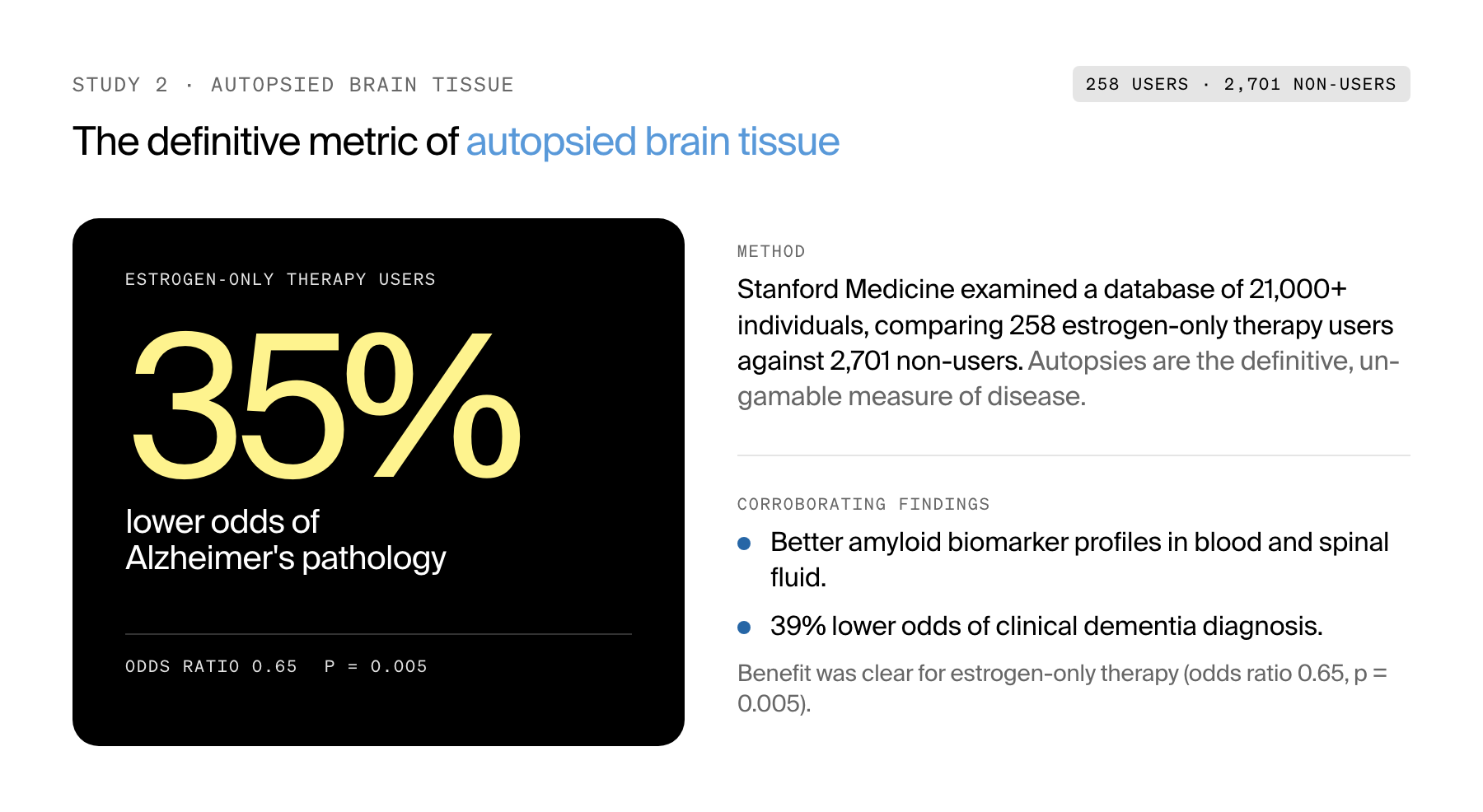
Study two provided the gold-standard evidence: autopsied brains. A Stanford team examined actual brain tissue after death, the one measure that cannot mislead, comparing 258 estrogen-only therapy users against 2,701 non-users. Estrogen-only therapy was associated with 35 percent lower odds of Alzheimer's pathology (odds ratio 0.65, p=0.005). Blood and spinal-fluid biomarkers, clinical dementia diagnoses (39 percent lower odds), and memory testing all pointed the same direction within the single study.
Study three, in nearly 200,000 women, showed the benefit is targeted, not universal. Following 183,450 women for over 13 years, hormone therapy was associated with about 10 percent lower all-cause dementia risk overall, and 16 percent for Alzheimer's specifically. But the benefit concentrated in specific groups: women with surgical menopause (about 26 percent lower risk), APOE4 carriers, and women with less lifetime estrogen exposure. Women with all three factors saw the largest association, around 32 percent.
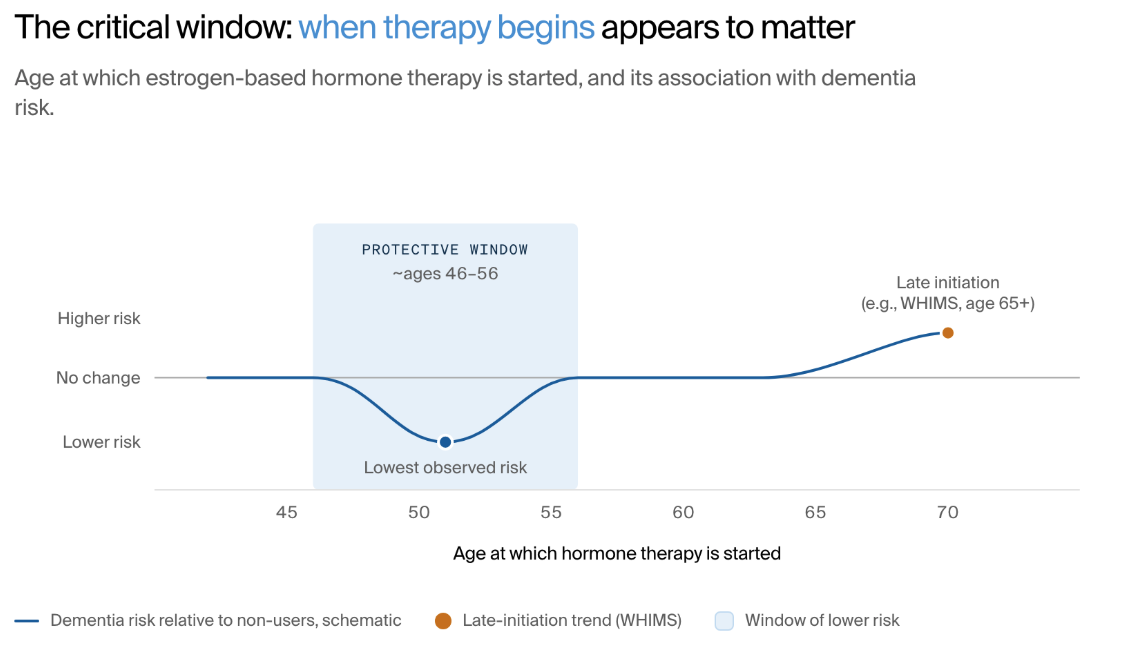
Timing appears decisive, and it resolves the paradox with WHIMS. In the large population study, hormone therapy was protective when started between roughly ages 46 and 56, the menopausal transition and its immediate aftermath, but not when started earlier or later. This is the "critical window" hypothesis, now observed in nearly 200,000 women. WHIMS gave therapy to women in their late sixties, well outside this window, which is likely why it found harm where the newer studies find benefit.
The power of this evidence is that three very different methods converge. Molecular brain imaging, post-mortem pathology, and population-scale outcomes are about as different as three approaches can be, with different biases and assumptions. They agree not just in direction but in specifics, most notably that APOE4 carriers, the highest genetic-risk women, appear to benefit most, a finding that emerged independently from both the imaging study and the population study.
None of this proves hormone therapy prevents Alzheimer's, and no researcher claims it does. All three studies are observational, so they cannot establish causation, and women who take hormone therapy differ from those who don't in ways that are hard to fully account for. The findings are specific to estrogen-based, largely oral therapy and to particular subgroups, drawn mostly from white, relatively advantaged populations. Notably, the one randomized trial to date pointed the other way, so the reassuring evidence still sits a rung below the highest standard of proof.
The real takeaway is a better question, not a blanket rule. Hormone therapy remains a decision about relieving menopausal symptoms, made with a clinician, weighing real tradeoffs that extend well beyond the brain, including breast cancer, blood clots, and cardiovascular risk. What this research changes is the background: women no longer need to carry an unsupported fear of dementia into that conversation, and for the right woman starting near the right time, the brain-health considerations may lean gently in favor. The decision is individual, and it depends on who a woman is, when she starts, and what she is weighing.
Introduction: A Warning That May Have Been Backwards
For the better part of two decades, women approaching menopause have navigated a difficult and often frightening message: that hormone therapy, the most effective treatment for menopausal symptoms, might raise their risk of dementia. The warning traced back to a landmark trial published in the early 2000s, it was serious, it came from good science, and its effect was profound. Use of menopausal hormone therapy, once common, collapsed. By some estimates, the share of women using it over their lifetimes fell from around 27 percent to under 5 percent. A generation of women, and their doctors, backed away.
The stakes of getting this question right are enormous, because Alzheimer's disease is not an equal-opportunity illness. Roughly two-thirds of the people who develop it are women, a disparity that cannot be explained by women simply living longer. Something about female biology, and in particular the hormonal transition of menopause, appears to shape the risk. If hormone therapy influences that risk, in either direction, it matters for tens of millions of women. Which is exactly why a message that may have been pointing the wrong way is worth reexamining with care.
And that reexamination is now underway. Over roughly the past two years, three separate studies, using three very different and complementary methods, have converged on a conclusion that runs opposite to the old warning, at least for estrogen-based therapy. One looked at the earliest molecular signatures of Alzheimer's in the brains of living women. One went further than any prior study, examining the actual autopsied brains of women after death, the definitive, gold-standard measure of Alzheimer's pathology. And one followed nearly 200,000 women over more than a decade to ask not just whether hormone therapy helps, but which women it helps and when. Each has real limitations. But taken together, by three independent roads, they point the same direction: estrogen-based hormone therapy is associated with less Alzheimer's pathology and lower dementia risk, not more.
This is not a simple reversal, and it would be a mistake to read it as one. The story that emerges is more nuanced and more interesting than either "hormone therapy causes dementia" or "hormone therapy prevents it." It is a story about timing, about which formulation, about which women, and about why a trial that got so much right may nonetheless have delivered a conclusion that did not generalize the way everyone assumed. What follows is how the fear took hold, what these three new studies actually found, how they fit together, and, just as important, what they still cannot tell us. It is one of the most consequential questions in women's health, and after twenty years of confusion, the picture is finally coming into focus.
Why Women, and Why Estrogen
To understand why hormone therapy might affect Alzheimer's risk at all, you have to start with a fact that is still not widely appreciated: Alzheimer's disease is, to a striking degree, a women's disease. Nearly two-thirds of those who develop it are women. For a long time this was waved away as an artifact of longevity, women live longer, and age is the biggest risk factor for Alzheimer's, so of course more women get it. But that explanation does not hold up. Even after accounting for their longer lives, women carry a higher age-adjusted risk. The disparity is real, and it points to something about female biology specifically.
The leading suspect is estrogen, and the timing of its decline. Estrogen is not only a reproductive hormone; it is a powerful actor in the brain. Throughout a woman's reproductive years, estrogen supports a remarkable range of brain functions. It helps maintain the connections between neurons, promotes the brain's use of glucose for energy, supports blood flow and the integrity of the blood-brain barrier, and tempers inflammation. The brain, in other words, runs partly on estrogen, and has adapted to its steady presence.
One molecule makes this dependence especially concrete. Estrogen directly switches on the production of a protein called brain-derived neurotrophic factor, or BDNF, one of the brain's most important tools for keeping neurons alive, forming new connections between them, and supporting learning and memory. Decades ago, researchers discovered that the gene for BDNF carries an estrogen-responsive switch, meaning estrogen can regulate BDNF production directly at the level of the gene [6]. When estrogen is present, BDNF production is supported; when estrogen falls, BDNF tends to fall with it. This link is not incidental to Alzheimer's; reduced levels of both estrogen and BDNF are seen in people with the disease, the cells that respond to estrogen sit alongside the cells that produce BDNF, and in animal studies, estrogen replacement raises BDNF levels in exactly the brain regions, the hippocampus and cortex, most important for memory and most vulnerable in Alzheimer's [7]. It is one clean molecular example of the broader pattern: a specific thread connecting the loss of estrogen at menopause to the machinery the brain relies on to maintain itself, and a plausible piece of why the hormonal transition might leave the brain more vulnerable.
Menopause changes all of this. It is not a gentle tapering but a relatively abrupt withdrawal of a hormone the brain has relied on for decades. Researchers increasingly describe the menopausal transition as a genuine neurological transition, a period during which the brain must adapt to running without a resource it had come to depend on. Brain imaging studies have captured this directly, showing measurable shifts in brain energy metabolism and, in some women, the early emergence of Alzheimer's-associated changes during and after the menopausal transition. This transition happens to coincide, in timing, with the window in which the earliest, silent stages of Alzheimer's are thought to begin, often decades before any symptom appears.
There is also a specific and telling clue in how estrogen intersects with the single most important genetic risk factor for Alzheimer's, a gene variant called APOE4. Carrying APOE4 raises Alzheimer's risk substantially, and, importantly, it does so more powerfully in women than in men. A woman carrying APOE4 faces a steeper risk than a man carrying the same variant. This sex-specific penalty is one of the clearest fingerprints that female biology, and the hormonal environment in particular, shapes how Alzheimer's risk unfolds. It also raises an obvious question: if the loss of estrogen contributes to risk, might restoring some of it, through hormone therapy, help protect the brain?
That question is biologically reasonable, and it is exactly the question researchers have chased for years. But reasonable is not the same as proven, and this is where the story gets complicated. Because when it was first put to a rigorous test, the answer that came back was not reassuring at all. It was alarming.
The Shadow of WHIMS: Where the Fear Came From
The warning that reshaped a generation of medical decisions came from a study called the Women's Health Initiative Memory Study, or WHIMS. To understand both its authority and its limits, you have to understand what it was, because it was, in important respects, an excellent study, and its central finding was real.
WHIMS was part of the larger Women's Health Initiative, one of the most ambitious efforts ever mounted to test hormone therapy rigorously. Most of what we knew about hormone therapy and the brain before it came from observational studies, which watch what happens to women who happen to take hormones versus those who don't. Those studies are useful but vulnerable to a stubborn problem: women who choose hormone therapy tend to differ from those who don't, in wealth, health, education, and access to care, and those differences, not the hormones, can drive apparent benefits. WHIMS was built to cut through that. It was a randomized controlled trial, the gold standard, in which women were assigned by chance to receive either hormone therapy or a placebo, so that the groups would be alike in every respect except the treatment. When it reported, in 2003 and 2004, that hormone therapy increased the risk of dementia, that finding carried the full weight of the strongest study design in medicine. [4,5]
But the details of who was studied, and how, turned out to matter enormously, and they are the key to everything that has happened since. WHIMS enrolled women aged 65 and older. That is not a small detail. These women were, on average, well over a decade past menopause when they began hormone therapy. The trial was not testing what happens when a woman starts hormones during the menopausal transition, in her late forties or early fifties; it was testing what happens when hormones are introduced to a much older brain, one that had already spent many years without estrogen and, in some women, had likely already begun accumulating the silent early changes of Alzheimer's.
The formulation mattered too. The arm of the study that showed the clearest increase in dementia risk used a specific combination: conjugated equine estrogens plus a synthetic progestin. And the risk it showed was not subtle, in these older women, the combination therapy roughly doubled the rate of dementia [4]. Progestin is added to estrogen therapy for a particular medical reason, to protect the uterus, since estrogen alone can raise the risk of uterine cancer in women who still have one. But that progestin component may carry different effects on the brain and blood vessels than estrogen alone. Tellingly, the separate arm of the trial that tested estrogen alone, given to women who had had hysterectomies and so did not need the progestin, did not show the same clear harm; its effect on dementia was smaller and not statistically significant [5]. That contrast was easy to overlook at the time, but it was an early hint that estrogen alone and estrogen-plus-progestin might not be the same story. WHIMS, in other words, found its clearest harm from one particular combination product, given late.
Out of this came two ideas that now sit at the center of the entire field. The first is the critical window hypothesis: the proposition that estrogen's effect on the brain depends heavily on when it is given, potentially protective if started around the time of menopause, when the brain is still estrogen-adapted and relatively healthy, but potentially harmful if started years later, once the brain has changed and early damage may already be present [8]. The same hormone, on this view, is not simply good or bad for the brain; its effect flips depending on the timing. The second idea is that estrogen alone and estrogen-plus-progestin may not be equivalent, and lumping them together, as much of the early research and public messaging did, may have obscured real differences.
WHIMS answered its own question honestly and well: giving this combination therapy to women in their late sixties and beyond does not protect against dementia and may increase risk. That conclusion still stands. The error was not in the study; it was in how broadly its conclusion was applied, to all hormone therapy, for all women, at all ages and timings. And it is precisely that overgeneralization that the three new studies allow us to revisit, because each was designed, in different ways, to look at the questions WHIMS could not answer.
Study One, The Mechanism: Lower Tau in Living Brains
If hormone therapy protects the brain, that protection should be visible in the actual biology of Alzheimer's disease, not just in whether someone eventually receives a diagnosis. This is where the first of the three studies comes in, and it looked at the disease at its molecular roots.
Alzheimer's is defined by two abnormal proteins that accumulate in the brain: amyloid-beta, which forms sticky plaques between neurons, and tau, which forms tangles inside them. Of the two, tau tends to track more closely with actual cognitive decline, when and where tau tangles spread through the brain corresponds fairly well to when and where thinking begins to fail. Crucially, both proteins begin accumulating years, even decades, before a person notices any symptoms. Modern brain imaging can now detect them in living people, using PET scans with tracers that bind to amyloid or tau and light them up. This lets researchers see the disease taking hold long before it announces itself, and ask whether hormone therapy changes that early trajectory.
A team centered at McGill University did exactly this, drawing on two independent groups of postmenopausal women who had undergone this kind of detailed brain imaging and biomarker testing [1]. They compared women who had used hormone therapy with those who had not, looking at how much tau and amyloid had accumulated in their brains, and at the levels of tau markers in their cerebrospinal fluid and blood.
The women who had used hormone therapy had less tau. On PET imaging, they showed lower tau tangle burden, and the difference was not trivial, it was a moderate-to-large effect, consistent across the stages through which tau is known to spread in the brain. The same pattern held in fluid: hormone therapy users had lower concentrations of a key tau marker, phosphorylated tau, in both cerebrospinal fluid and blood. Across imaging and fluid, in two separate groups of women, the signal pointed the same way, less of the protein most tightly linked to Alzheimer's cognitive decline.
The most intriguing finding, though, concerned APOE4, the genetic variant that raises Alzheimer's risk more steeply in women. Among women who had not used hormone therapy, the expected pattern appeared: APOE4 carriers had substantially higher tau and amyloid burden than non-carriers. The gene exacted its usual toll. But among the women who had used hormone therapy, that gap largely disappeared. APOE4 carriers who had used hormone therapy looked, on their brain scans, much like non-carriers, as if the therapy had blunted the genetic penalty. This is a genuinely striking observation, because it suggests hormone therapy might matter most precisely for the women at highest genetic risk, a theme the later studies would echo.
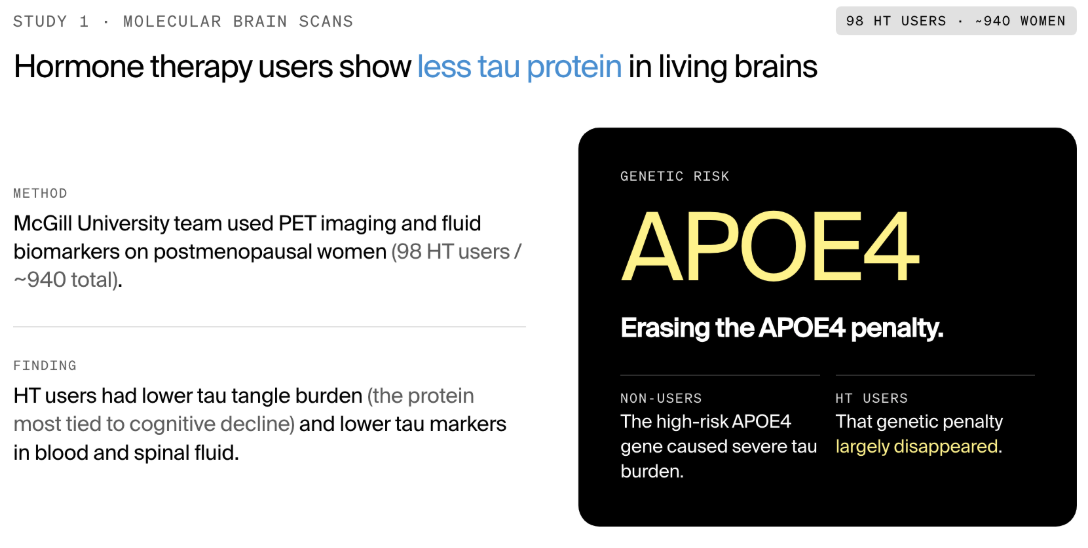
Two honest caveats bound what this study can claim, and the researchers were explicit about both. First, it is cross-sectional, a single snapshot in time, not a record of women followed as their brains changed. It can show that hormone therapy users had less tau, but it cannot prove the therapy caused the difference. Second, the number of hormone therapy users was small, roughly 98 users among some 940 women across the two groups, a reflection of how sharply hormone therapy use fell after WHIMS. That small sample limits how finely the findings can be sliced, and it means the results need confirmation in larger groups. What this study offers is not proof, but mechanism: a plausible biological signature of protection, visible in the brain's actual chemistry, and a specific hint about who might benefit most. The question it raises is whether that molecular signal translates into what ultimately matters, the disease itself.
Study Two, The Gold Standard: What Autopsied Brains Revealed
Every method for studying Alzheimer's in living people is, in the end, an approximation. A clinical diagnosis of dementia is a judgment call, and an imperfect one; memory problems have many causes, from strokes to poor sleep to depression, and even skilled clinicians misattribute them. Biomarkers in blood and spinal fluid are a major advance, but they are still indirect readings, inferring the state of the brain from molecules that leak out of it. There is only one way to know with certainty how much Alzheimer's pathology a brain actually contains, and that is to examine the brain tissue itself, after death. This is the definitive, gold-standard measure, and it is what makes the second study the most important of the three.
A team at Stanford Medicine set out to do something no prior study of hormone therapy had done at scale: to look directly at autopsied brains [2]. They drew on two large resources. One was a national database of brain autopsies, in which the brains of people who had died, many of whom had been followed for years beforehand, were examined for the two hallmarks of Alzheimer's, amyloid plaques and tau tangles, and scored for how much pathology was present. The other was a large study of living participants with blood and spinal-fluid biomarkers, used to corroborate the autopsy findings. In total, the analysis spanned more than 21,000 participants. Because estrogen-only therapy is prescribed mainly to women who have had a hysterectomy, and who therefore don't need progestin to protect the uterus, the hormone therapy users in this study were overwhelmingly on estrogen alone, which let the researchers isolate estrogen's effect in a way WHIMS's combination arm could not.
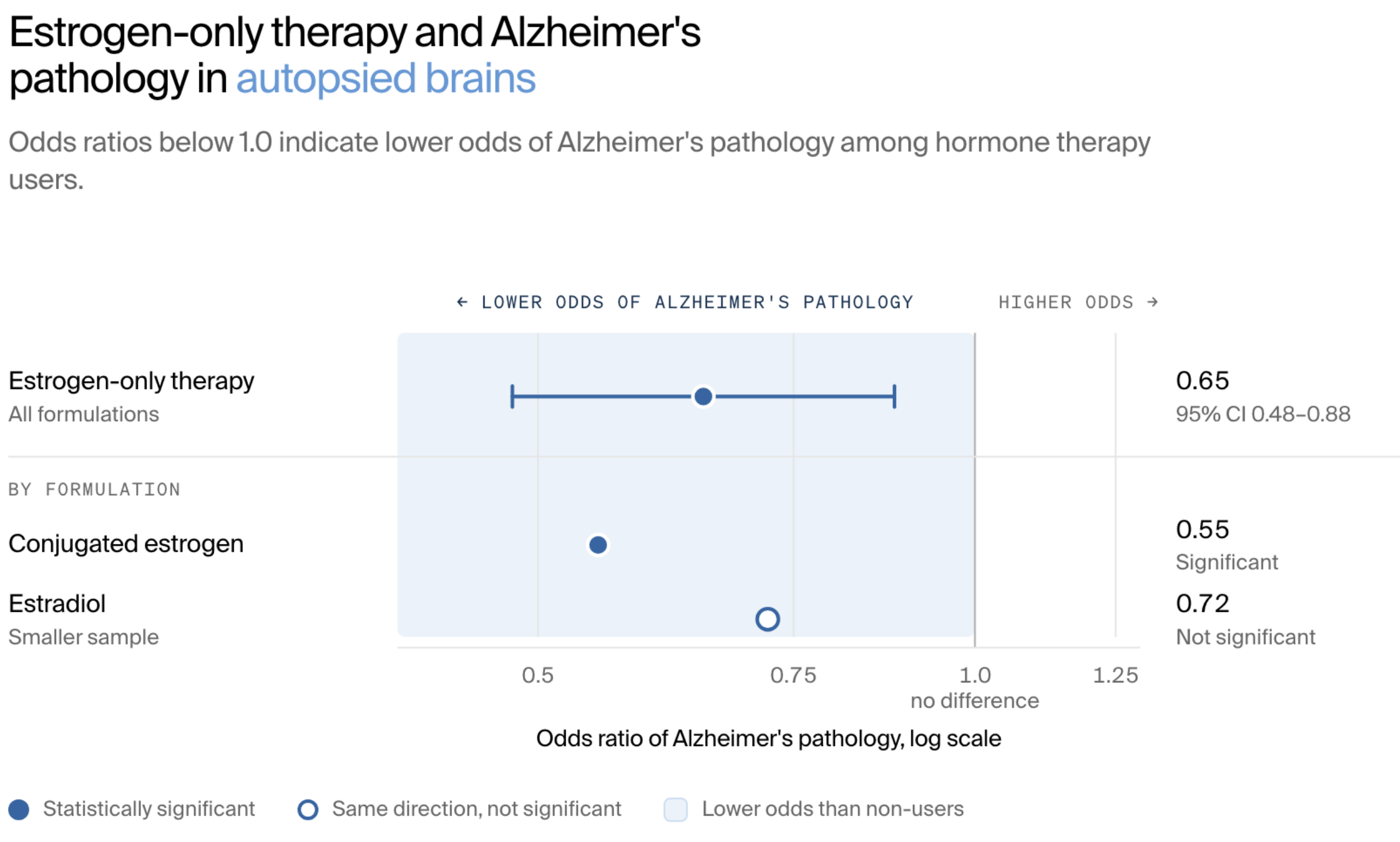
The central comparison was between women who had used estrogen-only hormone therapy and women who had used none. In the autopsy database, that meant comparing the brains of 258 estrogen-only users against those of 2,701 women who had never used any hormone therapy, and the result was clear. Estrogen-only therapy was associated with significantly lower odds of Alzheimer's pathology, an odds ratio of 0.65, meaning hormone therapy users had roughly 35 percent lower odds of showing the defining brain changes of Alzheimer's. The finding was statistically robust, with a confidence interval running from 0.48 to 0.88 and a p-value of 0.005, comfortably clear of the threshold where results are considered reliable. This is the finding that gives the study its weight, because it is measured in the one place that cannot mislead: the brain tissue itself. Not a diagnosis that might be wrong, not a biomarker standing in for the real thing, but the actual pathology.
The rest of the evidence lined up behind it. In the living participants, estrogen-only therapy was associated with better amyloid biomarker profiles in both blood and spinal fluid, the molecular signatures pointing the same direction as the autopsies. And beyond the pathology, hormone therapy users had roughly 39 percent lower odds of having received a clinical dementia diagnosis in their lifetimes, along with better performance on memory testing and better preservation of the ability to live independently. Four different kinds of evidence, autopsy pathology, blood biomarkers, spinal-fluid biomarkers, and clinical outcomes, all converged, within a single study, on the same conclusion.
There was a further wrinkle worth noting for its honesty. When the researchers looked at specific formulations, the association was statistically clear for conjugated estrogen, with an odds ratio of 0.55, but did not reach significance for estradiol, a different estrogen preparation, at an odds ratio of 0.72. The authors were careful about how to read this. Both formulations pointed in the same protective direction; the difference was that the estradiol group was smaller, which makes statistical significance harder to reach. As one of the authors put it plainly, the lack of significance for estradiol most likely reflects the smaller sample, not evidence that one estrogen is genuinely better than the other, an important distinction, and a sign of researchers resisting the temptation to over-interpret their own data.
The limitations remain real, and the researchers stressed them. This is still observational, not a randomized trial; the women who used estrogen-only therapy were not randomly assigned to it, so some other difference between them and non-users could contribute to the result. It applies specifically to estrogen-only, oral therapy, not to estrogen-plus-progestin and not to topical formulations, which were not captured. And the women in the autopsy sample skewed older, meaning many had started therapy relatively late; if anything, as the researchers noted, that would tend to understate the benefit that earlier initiation might provide. But even with those bounds, this study moved the evidence onto firmer ground than it had ever occupied. For the first time, the claim that estrogen-based hormone therapy is associated with less Alzheimer's rested not on a proxy, but on the brain itself.
Study Three, For Whom and When: The Responsive Subgroups
The first two studies establish that estrogen-based hormone therapy is associated with less Alzheimer's, in the brain's chemistry and in its actual pathology. But they leave the most practical questions unanswered. Does this hold up across a very large population? And, more importantly, is the benefit the same for every woman, or does it depend on who she is and when she starts? The third study was built to answer exactly this, and it is the one that turns a general finding into something closer to a map.
The study drew on the UK Biobank, a research resource of extraordinary scale, and followed 183,450 postmenopausal women for an average of more than 13 years, amounting to some 2.43 million person-years of observation [3]. Over that time, nearly 4,000 developed dementia. Because the group was so large and so richly documented, the researchers could do something the smaller studies could not: divide women into subgroups and ask whether hormone therapy's association with dementia risk differed among them. This is the move from "does it work" to "for whom, and when."
The headline result was a modest overall benefit. Across all the women, those who had used hormone therapy for at least a year had about 10 percent lower risk of all-cause dementia, and a somewhat stronger reduction, about 16 percent, for Alzheimer's disease specifically. A 10 percent reduction is real but not dramatic, and on its own it might seem underwhelming. The important finding is what that average concealed, because the benefit was far from evenly distributed.
Three groups of women stood out as benefiting substantially more than average. The first was women who had undergone surgical menopause, that is, women whose ovaries were removed or whose menopause was induced by surgery, often years before natural menopause would have occurred. For these women, hormone therapy was associated with roughly a 26 percent reduction in dementia risk, more than double the overall effect. This makes biological sense: surgical menopause causes an abrupt, early, and total loss of estrogen, arguably the situation in which replacing it would matter most.
The second group was APOE4 carriers, the women at highest genetic risk. Here, hormone therapy was associated with a meaningful risk reduction, whereas in non-carriers the association was weaker and less consistent. This echoes precisely what the first study found in brain chemistry, that hormone therapy seemed to matter most for the women carrying the highest-risk gene, and it is a remarkable convergence, because the two studies used completely different methods and populations to arrive at the same specific insight.
The third group was women with lower lifetime exposure to their own natural estrogen, for instance, those who had a later first period or an earlier menopause, and thus fewer total years of estrogen before menopause. For them, hormone therapy was associated with roughly a 16 to 22 percent risk reduction. And the effects stacked: a woman who was an APOE4 carrier, had undergone surgical menopause, and had short lifetime estrogen exposure saw the largest association of all, around a 32 percent reduction. The pattern running through all three groups is coherent: the women who benefit most are those whose brains lost estrogen earliest, most abruptly, or most completely, or who were at highest risk to begin with.
Then came the finding that speaks most directly to the ghost of WHIMS: timing. The researchers examined the age at which women started hormone therapy, and the answer was strikingly specific. The protective association was evident in women who began hormone therapy between roughly ages 46 and 56, the years spanning the typical menopausal transition and its immediate aftermath. Starting earlier than that, or later, was not associated with the same benefit; in fact, starting well after this window trended, if anything, toward higher risk. This is the critical window hypothesis, no longer a hypothesis but an observed pattern in nearly 200,000 women. And it resolves the central paradox of the field. WHIMS gave hormone therapy to women in their late sixties, well outside this window, and found harm. These studies, looking at women who mostly started within it, find benefit. The apparent contradiction dissolves once timing is taken into account.
This study also did the careful work of testing whether its results were an illusion. One worry with observational data like this is reverse causation, the possibility that women in the earliest, undiagnosed stages of dementia are simply less likely to start or continue hormone therapy, which would make hormone therapy look protective when it is really just a marker of who was already healthy. The researchers addressed this by re-running their analysis after excluding women diagnosed with dementia within two, four, six, and eight years of the study's start. The association held. They also tested whether the results survived stripping out various other explanations, and the pattern persisted. None of this proves causation, an observational study never can, but it makes the most obvious alternative explanations less likely.
What this third study contributes, then, is precision. It confirms the direction of the first two in an enormous population, and it adds the crucial detail they lacked: that hormone therapy's association with lower dementia risk is not a blanket effect but a targeted one, concentrated in the women who lost estrogen earliest or carry the highest genetic risk, and present mainly when therapy begins in the window around menopause. It reframes the question from "is hormone therapy good or bad for the brain" to "for which woman, and at what point in her life."
How Three Different Methods Converge
Step back from the individual studies, and what makes this body of evidence persuasive comes into view. It is not that any one of these studies is definitive, none is. It is that three studies, using three fundamentally different methods, with different populations, different strengths, and different weaknesses, all point in the same direction. In science, that kind of convergence carries a weight that no single study can.
Consider how different the three approaches actually are. The first looked at living brains through PET imaging and fluid biomarkers, capturing the earliest molecular machinery of Alzheimer's, the tau and amyloid that accumulate years before symptoms. The second looked at brains after death, the definitive physical measure of how much disease a brain actually held. The third looked at nothing inside the brain at all, instead following the life trajectories of nearly 200,000 women to see who ultimately developed dementia. Molecular imaging, post-mortem pathology, and population-scale outcomes are about as different as three methods in this field can be. They are vulnerable to different biases and rely on different assumptions. When independent methods with independent weaknesses converge, the most likely explanation is that they are all detecting something real.
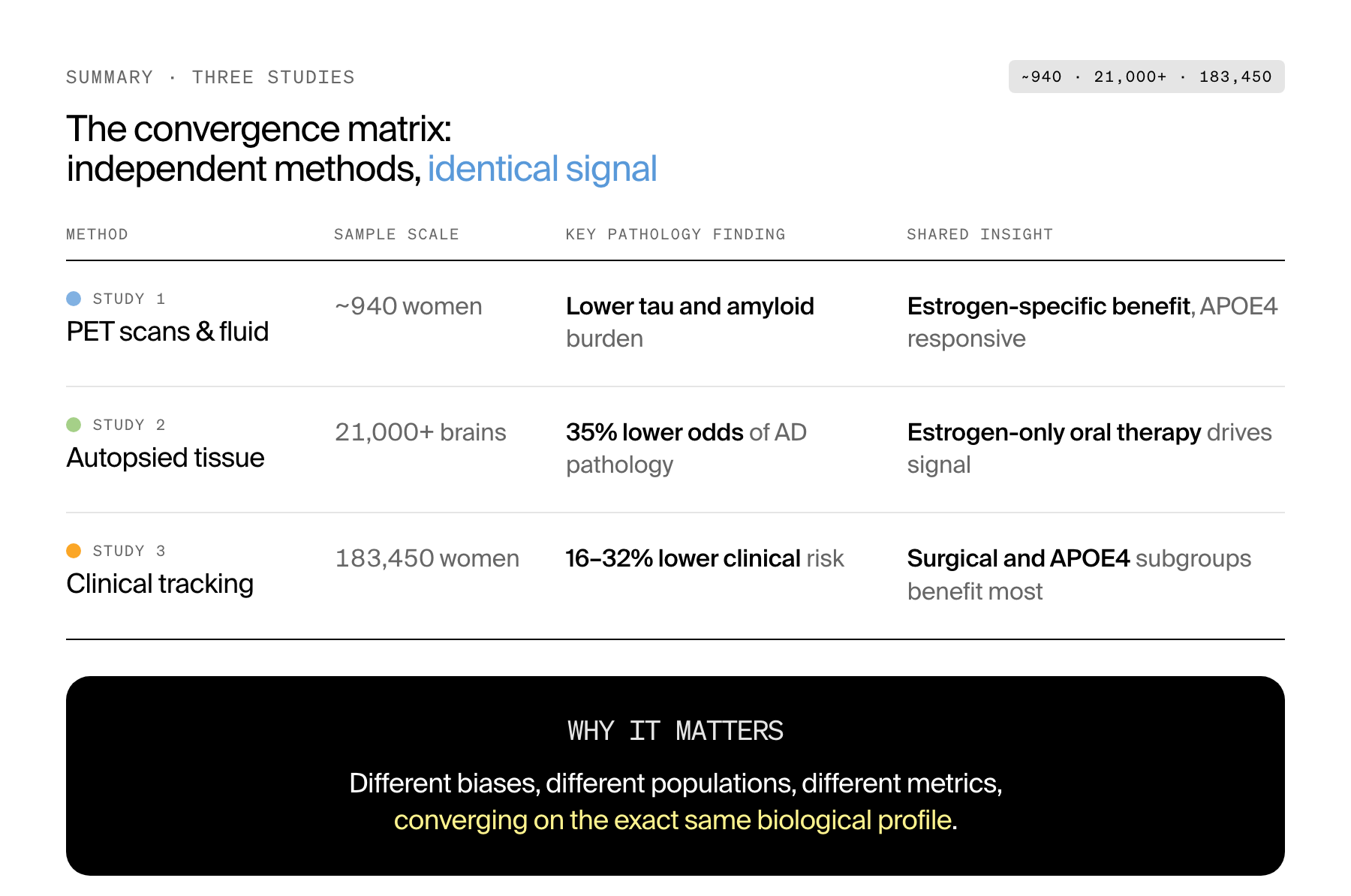
And they do not merely agree in broad direction; they interlock in specifics, which is more telling still. The first study found, in brain chemistry, that hormone therapy seemed to blunt the extra risk carried by the APOE4 gene. The third study found, in dementia outcomes across 183,450 women, that APOE4 carriers were among those who benefited most. Two entirely different methods, a few dozen women scanned in a research imaging program and nearly two hundred thousand women followed for over a decade, landed on the same unexpected, specific insight. That kind of agreement is hard to manufacture by chance or bias. Similarly, the estrogen-only signal runs through everything: the autopsy study isolated estrogen-only therapy and found lower pathology; the population study found its strongest effects in surgical-menopause women, who are precisely the women prescribed estrogen alone; and even WHIMS, in retrospect, showed its clearest harm in the combination arm, not the estrogen-alone arm. The thread is consistent across two decades of otherwise conflicting research.
Most importantly, the three studies together resolve the paradox that has haunted this field. For twenty years, the central puzzle was that observational studies tended to find hormone therapy protective while the WHIMS trial found it harmful. That looked like a flat contradiction, and in the absence of an explanation, the randomized trial, rightly, won. But the new studies supply the missing variable: timing, formulation, and the specific woman. Once you separate estrogen-only from estrogen-plus-progestin, and once you separate therapy started around menopause from therapy started in the late sixties, the contradiction dissolves. WHIMS was not wrong about what it tested. It simply tested the scenario, combination therapy, started late, in which hormone therapy is least likely to help and most likely to harm. The new studies illuminate the other scenarios, and in those, the picture is very different.
This is what a maturing science looks like. The early observational studies were suggestive but confounded. WHIMS was rigorous but narrow, and its narrowness was mistaken for generality. The new work does not overturn WHIMS so much as it locates WHIMS within a larger and more nuanced map, one in which the effect of hormone therapy on the brain depends on when it is given, what is given, and to whom. The answer was never going to be a simple yes or no. It was always going to be: it depends, and here is what it depends on.
What This Evidence Can and Cannot Tell Us
For all the strength of this convergence, it is essential to be clear about what these studies do not establish, because the temptation to over-read them is real, and on a question this consequential, precision matters more than enthusiasm.
The most important limitation applies to all three studies at once: none is a randomized controlled trial, and so none can prove causation. Every one of them is observational, comparing women who chose hormone therapy with women who did not. And women who take hormone therapy differ from those who don't in ways that are hard to fully erase. They tend to be healthier, wealthier, better educated, more engaged with the medical system, more likely to exercise and less likely to smoke. Researchers work hard to statistically adjust for these differences, and the third study in particular went to real lengths to rule out the most obvious confounds, including the possibility that early, undiagnosed dementia was causing women to avoid hormone therapy rather than the reverse. But statistical adjustment can never be as clean as randomization. It is entirely possible that some of the association between hormone therapy and lower dementia risk reflects not the hormones themselves but the kind of woman who takes them. This is the single most important caveat, and it cannot be waved away.
This matters especially because, on this exact question, a randomized trial once pointed the other way. WHIMS was randomized, and it found harm. The new studies make a strong case that WHIMS's harm was specific to its formulation and timing, and that case is coherent and well supported. But it remains true that the highest grade of evidence, the randomized trial, has so far been the discouraging one, and the reassuring evidence, however convergent, sits a rung below it on the ladder of proof. Resolving this properly will require new randomized trials, testing estrogen-based therapy, started near menopause, in the women most likely to benefit. Until those exist, humility is warranted.
The findings are also narrow in specific ways that are easy to lose in a summary. The autopsy study's clearest results apply to estrogen-only, oral therapy, not to the estrogen-plus-progestin combinations that many women with an intact uterus must take, and not to topical or patch formulations, which were not examined. The strongest subgroup findings, surgical menopause, APOE4 carriage, low lifetime estrogen exposure, describe specific populations, not women in general. The mechanism study rested on a small number of hormone therapy users. And all three drew heavily on populations that were predominantly white and, in the case of the largest study, somewhat healthier and more advantaged than the general public. Whether these findings extend cleanly to women of other backgrounds, to other formulations, and to other routes of administration is genuinely unknown.
Finally, and this cannot be stated too plainly, none of this makes hormone therapy an Alzheimer's prevention treatment, and none of the researchers involved claim that it does. Every one of these studies explicitly declines to recommend hormone therapy for the purpose of preventing dementia. Hormone therapy is a real medical intervention with real tradeoffs that extend well beyond the brain, including effects on the risk of breast cancer, blood clots, and cardiovascular disease, effects that themselves depend on formulation, timing, and the individual woman. A decision about hormone therapy has to weigh all of that, for a specific person, and cannot be driven by brain-health considerations alone, let alone by observational data that is still short of proof. What this research changes is not the answer to "should I take hormone therapy to prevent Alzheimer's," a question it cannot answer, but the background against which the broader hormone therapy conversation happens.
What This Means
So where does this leave a woman trying to make sense of it all, or anyone thinking clearly about brain health and aging? Not with a prescription, but with something arguably more useful: a corrected understanding, and a better set of questions.
The first thing this research changes is the default assumption. For twenty years, the reflexive message attached to hormone therapy was a warning about the brain, a vague sense that it might accelerate decline. That message, this body of work strongly suggests, was overstated and, for estrogen-based therapy started around menopause, may have been pointed in the wrong direction entirely. The fear that drove hormone therapy use down to a fraction of its former level was built on a real finding that was applied far too broadly. A woman weighing hormone therapy today, primarily for the reason it is actually prescribed, to relieve the genuine and sometimes debilitating symptoms of menopause, should not carry a fear of dementia into that decision that the evidence does not support. If anything, the brain-health considerations now lean gently the other way for the right candidates. That alone is a meaningful correction, because fear of dementia has kept some women from a therapy that could have substantially improved their quality of life.
The second thing this research offers is a reframing of the menopausal transition itself. These studies, together with the broader science of estrogen and the brain, point to menopause as a genuine neurological inflection point, a window during which the brain undergoes real change and during which the decisions a woman makes may carry consequences that unfold over decades. That is not a cause for alarm, but it is a reason for attention. The years around menopause appear to be a period when brain health is unusually worth thinking about deliberately, rather than by default, and hormone therapy is only one of many levers, alongside the well-established ones: cardiovascular health, physical activity, sleep, metabolic health, all of which shape dementia risk and all of which are especially worth tending during this transition.
The third and most important thing is the shift from a blanket answer to a personalized one. The single clearest lesson across all three studies is that the effect of hormone therapy on the brain is not uniform. It depends on when therapy is started, on which formulation is used, on whether a woman's menopause was natural or surgical, on how much estrogen her body produced over her lifetime, and on her genetic risk, including whether she carries APOE4. This is precisely the kind of decision that cannot be made from a headline, or from an article like this one. It is a decision to be made with a clinician who can weigh a specific woman's symptoms, her personal and family history, her genetic and cardiovascular risk profile, and her own priorities, and who can factor in the real tradeoffs that extend well beyond the brain. The value of this research is not that it tells any individual woman what to do. It is that it equips her, and her doctor, to have a far better informed conversation than was possible even a few years ago.
For years, women were handed a blunt instruction: avoid hormone therapy, it may harm your brain. The most accurate replacement for that instruction is not the opposite command. It is a better question: given who I am, when I am, and what I am weighing, what does the evidence actually say for me? After two decades of confusion, women finally have the beginnings of a real answer, and it is one worth having, precisely because it is honest about its own limits.
The Cost of a Question Left Unanswered
There is a human toll buried in this scientific story, and it is worth naming. For twenty years, a great many women avoided hormone therapy, or were steered away from it, in part out of a fear that it would harm their brains. Some of those women endured the hot flashes, sleep disruption, mood changes, and cognitive fog of menopause without the most effective treatment available, because the prevailing message told them the treatment carried a hidden danger. If the emerging picture is right, and the convergence of three very different studies suggests it may be, then a substantial share of that fear was misplaced, at least for estrogen-based therapy taken at the right time. That is not a small thing. It is decades of decisions, made by millions of women, shaped by a conclusion that was drawn too broadly from a single trial.
None of this means the pendulum should now swing hard the other way. The lesson of the last two decades is precisely about the danger of over-reading a study, and it would be a mistake to repeat that error in reverse, to treat this new and still-observational evidence as a green light it does not give. Hormone therapy is not a dementia prevention drug. The research cannot yet prove cause. The findings are specific to particular formulations, timings, and women. All of that is true and must be held firmly.
But something real has changed. The question of hormone therapy and the aging female brain, long clouded by a warning that turned out to be narrower than it seemed, is finally being answered with the tools capable of answering it: the molecular signatures of the disease, the definitive evidence of autopsied tissue, and the statistical power of hundreds of thousands of lives followed across time. Those tools are converging, and they are converging on a more hopeful and more precise picture than the one that has dominated for a generation, that for the right woman, starting near the right time, estrogen-based hormone therapy may be associated with a brain better protected against Alzheimer's, not less.
The deeper lesson reaches beyond hormones. Women's health has too often been governed by evidence that was thin, dated, or wrongly generalized, and menopause in particular has been under-studied relative to its importance. What these three studies represent, as much as any specific finding about estrogen and tau, is the field finally bringing serious scientific firepower to a question that affects half the population and shapes the last decades of their lives. The answer is still coming into focus, and honesty requires saying so. But for the first time in a long time, women and their doctors can approach this decision with evidence rather than fear, and with the right question rather than a blanket rule. After twenty years, that is real progress.
- Wang, YT., Therriault, J., Tissot, C. et al. Hormone therapy is associated with lower Alzheimer’s disease tau biomarkers in post-menopausal females -evidence from two independent cohorts. Alz Res Therapy 16, 162 (2024). https://doi.org/10.1186/s13195-024-01509-5
- Bruno J, Shaw JS, Hosseini SMH; for Alzheimer's Disease Neuroimaging Initiative. Association Between Menopausal Hormone Therapy and Alzheimer Disease Neuropathology. Neurology. 2026 Sep 8;107(5):e218413. doi: 10.1212/WNL.0000000000218413. Epub 2026 Aug 12. PMID: 42585606. https://pubmed.ncbi.nlm.nih.gov/42585606/
- Squires S, Saleh RNM, Pilling LC, Atkins JL, Ranson JM, Tai XY, Vauzour D, Llewellyn DJ, Minihane AM. Hormone replacement therapy and dementia risk among postmenopausal women: identifying responsive subgroups in the UK Biobank. Alzheimer's & Dementia. 2026;22(8):e71679. doi:10.1002/alz.71679. https://doi.org/10.1002/alz.71679
- Shumaker SA, Legault C, Rapp SR, et al. Estrogen plus progestin and the incidence of dementia and mild cognitive impairment in postmenopausal women: the Women's Health Initiative Memory Study: a randomized controlled trial. JAMA. 2003;289(20):2651-2662. doi:10.1001/jama.289.20.2651.
- Shumaker SA, Legault C, Kuller L, et al. Conjugated equine estrogens and incidence of probable dementia and mild cognitive impairment in postmenopausal women: Women's Health Initiative Memory Study. JAMA. 2004;291(24):2947-2958. doi:10.1001/jama.291.24.2947. https://doi.org/10.1001/jama.291.24.2947
- Sohrabji F, Miranda RC, Toran-Allerand CD. Identification of a putative estrogen response element in the gene coding for BDNF. Proceedings of the National Academy of Sciences USA. 1995;92(24):11110-11114. doi:10.1073/pnas.92.24.11110. https://pubmed.ncbi.nlm.nih.gov/7479947/
- Sohrabji F, Lewis DK. Estrogen-BDNF interactions: implications for neurodegenerative diseases. Frontiers in Neuroendocrinology. 2006;27(4):404-414. doi:10.1016/j.yfrne.2006.09.003. https://doi.org/10.1016/j.yfrne.2006.09.003
- Maki PM. Critical window hypothesis of hormone therapy and cognition: a scientific update on clinical studies. Menopause. 2013;20(6):695-709. doi:10.1097/GME.0b013e3182960cf8. https://pubmed.ncbi.nlm.nih.gov/23715379/
- Nerattini M, Jett S, Andy C, et al. Systematic review and meta-analysis of the effects of menopause hormone therapy on risk of Alzheimer's disease and dementia. Frontiers in Aging Neuroscience. 2023;15:1260427. doi:10.3389/fnagi.2023.1260427. https://doi.org/10.3389/fnagi.2023.1260427
Related studies