The Metabolic Inflexibility Theory of Alzheimer's
A theory worth taking seriously locates Alzheimer's in the brain's energy system, not its debris. After decades focused on amyloid plaques and tau tangles, a growing body of work argues that the disease is driven, in part, by the brain losing its metabolic flexibility: its ability to switch between fuels, route energy where it is needed, and adapt. On this view the plaques are as much a product of the energy failure as a cause of it. The framework was recently synthesized by researchers at the University of Kentucky's Sanders-Brown Center on Aging, building on years of evidence that the Alzheimer's brain fails to use glucose properly long before symptoms appear.
This is one dimension of the disease, not the whole of it. Alzheimer's is almost certainly a convergence of failures, energy metabolism, mitochondria, inflammation, protein quality control, growth signaling, vascular disease, genetics, that arrive at the same endpoint. Metabolic inflexibility is one real propellant among them, interacting with the rest. Its value is not that it explains everything, but that it explains an underappreciated part and connects the disease to the metabolic health of the whole body.
The distinction is flexibility, not fuel supply. The problem is not simply that the brain runs low on energy. It is that it loses the ability to adapt: to burn lactate or ketones when glucose is scarce, to move fuel between cells, to adjust to demand. A flexible brain can absorb a fuel shortage. An inflexible one cannot, and that is what turns a manageable shortage into a progressive collapse.
The trouble begins with the brain's immune cells. When amyloid appears, microglia mobilize and rewire their metabolism toward a fast, inefficient mode of burning glucose. Because that mode wrings far less energy from each glucose molecule, the activated immune cells consume enormous amounts of glucose and monopolize the local supply. Neurons, which cannot store fuel or easily switch to a backup, are starved by the competition, and astrocytes, which normally deliver their backup fuel, defect at the same time. The scarcity is the trigger; the lost ability to switch fuels is why it becomes fatal.
The energy failure runs in two phases, which resolves a long-standing puzzle. Years before symptoms, the vulnerable brain runs hot, a glia-driven overheating that burns glucose faster than normal. Only later does it tip into the hypometabolism that medicine recognizes, as the compensation is spent and no alternative fuel can be recruited. This explains why studies of brain energy in Alzheimer's have found it both elevated and depressed: they were looking at the same disease on opposite sides of the tipping point.
Amyloid and tau fit inside the theory rather than competing with it. The energy failure and the protein pathology drive each other in a self-reinforcing loop: amyloid provokes the glial crisis, and the starved, stressed brain in turn produces more amyloid and tau and clears them less well. Each cycle further degrades the brain's capacity to switch fuels, which is why the disease accelerates. It also helps explain why clearing amyloid alone has done so little, if the loop has more than one engine, removing one leaves the others running.
Metabolic flexibility can be built, and this is the actionable core. Flexibility is not only a brain property. It is a measurable, trainable trait of the whole body that declines with age and metabolic disease. Exercise is the strongest lever: aerobic training builds mitochondria and fat-burning capacity, and raises insulin sensitivity by large margins, while resistance training adds glucose-disposing muscle. Spacing meals and allowing real fasting periods makes the body practice switching between glucose and fat. Protecting sleep preserves the fuel-switching rhythm, and keeping visceral fat, insulin resistance, and inflammation in check maintains the environment that allows flexibility at all.
None of this is proven to prevent Alzheimer's, and that distinction matters. Building metabolic flexibility is well supported as a goal for metabolic health and healthspan. Whether it protects the brain specifically is the theory's proposal, not an established fact, and there is no proven way to prevent Alzheimer's. The honest framing is that these levers are good for the body regardless, and point in the direction the theory suggests, without being a cure.
One drug class sits squarely on the theory: SGLT2 inhibitors. By flushing glucose through the kidneys, they raise ketones, the alternative brain fuel the disease erodes, and they also reduce inflammation, improve insulin signaling, support mitochondria, and improve blood flow, pushing on several nodes of the same cascade at once. Large observational studies link them to lower dementia risk, though the randomized trials have not yet confirmed it, and most mechanistic detail is from animal models.
The Energy Theory of Alzheimer's
For half a century, research into the cause of Alzheimer's has concentrated on two proteins. Amyloid plaques form between neurons and tau tangles within them, and this accumulated pathology has anchored the field's understanding of the disease and nearly every drug developed to treat it. The most recent of those drugs clear amyloid from the brain, a genuine advance, though a limited one, slowing decline without halting it. That limited result, set against so clean a mechanism, has led a growing number of researchers to ask a more fundamental question: whether the plaques cause the disease or are a consequence of it.
An alternative theory has been taking shape, and it locates Alzheimer's somewhere less obvious: in the brain's energy system. Not in a simple shortage of energy, but in the loss of something more subtle and more fundamental, the brain's ability to adapt how it fuels itself. A healthy brain is metabolically flexible. It switches between fuels, shifts energy to the regions working hardest, and adjusts moment to moment to demand. The theory holds that Alzheimer's is, at its root, the progressive loss of that flexibility: a brain that gets locked into a rigid, self-defeating pattern of fuel use and, over years, collapses into energy failure. On this view, the plaques and tangles are not the engine of the disease but passengers on it, both driving the energy crisis and driven by it.
This idea has been assembled over years, out of findings that never fit the amyloid story cleanly, and it was sharpened recently into a single framework by researchers at the University of Kentucky's Sanders-Brown Center on Aging, who call it metabolic inflexibility.[1] It builds on a long thread of evidence: that the Alzheimer's brain shows failing glucose metabolism years before symptoms, that the disease travels with diabetes and metabolic dysfunction, that the brain's energy machinery falters early. What the theory adds is a unifying claim, that these are not scattered features but the disease itself, viewed at the level of energy.
This theory is best understood as one part of a larger picture, and it is worth being clear about how much it explains. Alzheimer's is almost certainly not one disease with one cause. It is better understood as a convergence of several distinct failures that arrive at the same devastating endpoint: energy metabolism breaks down, mitochondria falter, inflammation runs high, the cell's protein quality control fails, growth signaling through pathways like mTOR goes awry. We have examined several of these angles in our previous research reviews, and each captures something real. Metabolic inflexibility does not replace them or claim to be the single key. It is one dimension of the disease and one of its propellants, a distinct and underappreciated force that helps drive Alzheimer's forward and feeds the other failures as it does. Its value is not that it explains everything. It is that it explains something the plaque-centered view leaves out, and ties the disease to the metabolic health of the whole body.
If the theory holds, it changes where to look, for prevention and for treatment, and it changes what the rest of us should take from the science. It reframes a brain disease as something continuous with metabolic health, the same metabolic health that governs aging throughout the body. For anyone thinking seriously about how they age, that is a consequential idea: it means the condition most people fear losing themselves to may be shaped, in part, by the same levers that shape metabolic health everywhere else. What follows is how the brain's energy system works when it is flexible, how it becomes rigid and self-starving in Alzheimer's, the research-based strategies shown to build metabolic flexibility, and what the theory suggests, carefully, about protecting the aging brain.
The Brain Runs on a Flexible Energy Supply
To understand a theory about the brain losing its metabolic flexibility, you first have to see how much a healthy brain depends on having it.
The brain is the body's most energy-hungry organ by a wide margin. It makes up about two percent of body weight and burns roughly a fifth of the body's energy, and it does this without a reserve tank. Unlike muscle or liver, the brain stores almost no fuel and makes none of its own. It lives hand to mouth, drawing a constant supply from the bloodstream, and it has to route that supply precisely, to the regions firing hardest at any given moment, second by second.
Meeting a demand like that takes more than a large fuel supply. It takes adaptability, and this is the idea at the center of the theory: metabolic flexibility. A healthy brain can run on more than one fuel. Glucose is its staple, but it is not the only option. The brain can also burn lactate, the same molecule that accumulates in muscles during intense exercise. Long dismissed as a waste product, it is actually a valuable fuel, produced from glucose and delivered to neurons by the brain's support cells. It can also run on ketones, the fuel the body makes from fat during fasting, and on fatty acids themselves. It shifts among these depending on what is available and what the moment requires, leaning on glucose during hard mental work and more on fat-derived fuels like ketones during sleep. It can pour energy into an active region and pull it back from a quiet one. This capacity to sense, switch, and share fuels is what metabolic flexibility means, and the theory treats it as a defining feature of a healthy brain, as important as the raw amount of energy on hand.
It helps to be precise about what flexibility is not. It is not simply having enough energy. The theory draws a sharp line between two kinds of failure. One is bioenergetic failure, a plain shortage: not enough fuel to make enough energy. The other, the one the theory puts at the center of Alzheimer's, is metabolic inflexibility: the loss of the ability to adapt. An inflexible brain can still be metabolically busy, even frantic, while being locked into rigid patterns of fuel use that serve some needs and starve others. The engine has not run out of gas. It has lost the ability to change gears.
This flexibility also depends on cooperation between different kinds of brain cells, and that cooperation is where the theory says the trouble starts. Neurons are not the only cells that matter, and they do not work alone. Neurons are the cells that actually do the thinking: they fire the electrical signals and form the connections that carry memory, perception, and thought, and they are by far the most energy-hungry cells in the brain. But they are vastly outnumbered by glia, the brain's support cells, which for a long time were regarded as little more than packing material and are now understood to do much of the work that keeps neurons alive and functioning. Glia feed neurons, defend them, clear away waste, maintain the chemical balance they need to fire, and manage the brain's energy supply, the housekeeping that makes thought possible. Two kinds matter most here. Astrocytes, named for their star shape, are the brain's logistics network: they take up glucose from the bloodstream, convert and hand off fuel to neurons, recycle spent neurotransmitters, and help regulate blood flow to match local demand. Microglia are the brain's resident immune cells: they patrol constantly for damage and threats, clear away debris and dead cells, and prune unneeded connections. In a healthy brain these cells coordinate, sharing fuel and dividing the labor so that neurons, the hungriest and most vulnerable, get what they need to fire and maintain themselves. That cooperation is the last piece of metabolic flexibility, and as the next section shows, it is the first thing the disease breaks.
Where the Inflexibility Begins: The Brain's Immune Cells Turn on the Fuel Supply
If the theory has a starting point, a place where metabolic flexibility first gives way, it is in the microglia, the brain's immune cells. In a healthy brain they are vigilant and restrained. They move constantly through the tissue, extending and retracting fine processes to survey their surroundings, clearing away cellular debris and the occasional dying cell, pruning connections that are no longer needed, and standing ready to respond if something goes wrong. They are the brain's first line of defense, but in normal conditions that defense is measured, a quiet, continuous maintenance rather than an alarm. In Alzheimer's they undergo a change that sits at the center of the whole account, and it begins, as these things often do, as a reasonable response to a real threat.
When amyloid starts to collect, microglia detect it and mobilize. They change shape, swarm the deposits, and switch into an activated, inflammatory state to contain the problem. This is the immune system doing its job. But sustaining that response is energetically expensive, and to pay for it the microglia rewire how they produce energy, in a way that becomes the hinge of the disease.
The rewiring is a change in how the cell turns glucose into usable energy. Every cell has two ways to do this. The first, called oxidative phosphorylation, runs glucose all the way down: it breaks the sugar apart and then feeds the pieces into the mitochondria, the cell's power plants, which extract nearly everything of value. It is slow, it needs oxygen, and it is remarkably thorough, wringing on the order of fifteen times more energy out of each glucose molecule than the alternative. The second way stops partway. It breaks glucose down just a few steps, grabs the small amount of energy released early, and discards the rest before the mitochondria ever get involved. This route, called glycolysis, is fast and needs no oxygen, but it is wasteful, leaving most of the glucose's energy on the table.
Activated microglia swing hard toward glycolysis, the fast, wasteful route. For an immune cell that needs to mobilize in a hurry, speed matters more than efficiency, and glycolysis delivers energy quickly and can run even where oxygen is scarce. It is the metabolic equivalent of choosing an engine that burns fast and dirty over one that burns slow and clean. The catch is what thoroughness costs. Because the cell is now extracting only a fraction of the energy from each glucose molecule, it has to burn far more glucose to get the same work done, and that appetite is where the trouble begins.
Because glycolysis is so inefficient, activated microglia ramp their glucose uptake up dramatically to meet their needs. They become voracious, and they are good at winning the competition for fuel, carrying abundant glucose transporters and adding more as the disease progresses. The brain's immune cells begin to monopolize the local fuel supply. Though microglia are relatively few, the theory notes they can account for a sizable share of the brain's glucose use, and more in disease. The early overactivity seen on brain scans is, in large part, the sound of microglia feasting.
This is where neurons get hurt, and they get hurt by deprivation rather than by any direct attack. Neurons are the most energy-demanding cells in the brain and the least able to improvise. A large fraction of their energy goes to a single task, running the pumps that keep their electrical charge poised to fire, and they cannot store fuel or switch easily to a backup. So when activated microglia corner the shared glucose supply in a region, the neurons there are left short. The immune cells eat and the neurons starve. In the busy, energy-hungry hub regions that Alzheimer's attacks first, the neurons lose this competition.
Astrocytes make it worse. In a healthy brain they feed neurons and keep the chemical environment in balance. In Alzheimer's they too shift into a reactive, inflammatory state, pivot toward glycolysis, fill with droplets of fat that lock away lipids the brain needs, and pull back from their supportive duties. The cells that normally deliver fuel to neurons stop delivering. Between microglia seizing the glucose and astrocytes abandoning their deliveries, the neurons are squeezed from both sides.
This is what makes the disease metabolic inflexibility rather than simple scarcity, and it is the heart of the whole theory. A fuel shortage, by itself, is survivable. A healthy brain faced with less glucose in one region would do what a flexible system does: switch fuels. Neurons can run on more than glucose. They can burn lactate, which astrocytes normally produce and hand to them precisely for this purpose, and they can burn ketones when those are available. A flexible brain, pressed on its glucose supply, reroutes, draws on these alternatives, and rides out the shortfall.
According to the theory, the Alzheimer's brain cannot make that switch, and that is what turns a shortage into a spiral. The astrocytes that would normally supply backup lactate have defected into their own inflammatory, glycolytic state, so that fallback is gone. The machinery neurons use to take up and burn alternative fuels is itself degraded as the disease proceeds. And the brain's supply of ketones, which depends on the body's broader metabolic state, is typically low in the people most affected. So the starved neuron has nowhere to turn. The one thing that would have made the glucose shortage bearable, the ability to run on something else, is exactly the thing the disease has taken away. The scarcity is the trigger. The inflexibility is why the scarcity becomes fatal.
None of this is the neurons failing on their own, and that is the conceptual core of the theory. The early energy crisis of Alzheimer's is not a breakdown inside neurons. It is a reallocation of the brain's energy away from neuronal support and toward a chronic, self-sustaining inflammatory program in the glia, a program that started as defense and hardened into something the brain cannot switch off. The cells meant to protect the brain end up starving the cells the brain exists to serve. The flexibility is gone: fuel can no longer be shared where it is needed, because one set of cells has commandeered it.
Running Hot, Then Running Out
The most counterintuitive claim the theory makes is about time, and it overturns the natural assumption that Alzheimer's is a slow, steady dimming of the brain. The energy failure, the theory holds, comes in two phases, and the first is the opposite of the steady decline you would expect.
For years the signature metabolic finding in Alzheimer's has been the opposite of overactivity. Scans of patients' brains show hypometabolism, a drop in glucose use, and it tracks closely with shrinking brain tissue and failing memory. It looks like a brain running down. The easy interpretation was that the brain's energy use simply fades as the disease advances, a dimmer switch turning slowly toward off.
The theory assembles a different and stranger picture of how it starts. Long before any symptom, and long before that late decline, the vulnerable regions of the brain do not run down. They run hot. They burn glucose faster than normal, in a phase of hypermetabolism that can begin fifteen to twenty years before memory is affected, during the same silent window when amyloid is first collecting. And this early overheating is not the neurons working harder. It is the glia, the immune cells especially, ramping up their fuel consumption as they respond to the first signs of trouble, exactly the glycolytic feeding frenzy described above. The brain, in this first phase, is not starving. It is burning its reserves on an inflammatory fire.
The second phase is the one medicine recognizes, because it is the one that shows up by the time anyone is diagnosed. The early overheating cannot last. As neurons are starved, as the inflammatory program grinds on, as the brain's capacity to adapt erodes, the system tips from burning too much to being unable to burn enough. Hypermetabolism gives way to hypometabolism. In cellular terms, the collapse plays out differently in each population. The microglia, after years in their frantic glycolytic state, become exhausted and dysfunctional, many of them senescent, still inflammatory but no longer even effective at clearing debris. The astrocytes, which abandoned their fuel-delivery role early, remain reactive and scarred, walling off damage rather than supporting the neurons around them. And the neurons themselves, starved for so long and stripped of any backup fuel, begin to die in large numbers, taking with them the connections that memory and thought depend on. The fire burns out, and what remains is a brain that can no longer meet its own energy needs, failing in step with the loss of neurons and the arrival of symptoms.
That tipping point, from running hot to running out, is the loss of metabolic flexibility made visible. Phase one is the brain compensating. Pressed by the inflammatory fire and the fuel it consumes, the surviving neurons and glia push their mitochondria harder, pull in more glucose through additional transporters, and draw on what alternative fuels they can still reach, keeping the hub regions supplied even as demand outstrips the easy supply. That is a flexible system absorbing a shock. The collapse into phase two is what happens when that compensation is spent. The mitochondria, worked past their limit and damaged by years of oxidative stress, begin to fail; the glucose transporters on neurons are downregulated, so even available glucose gets in less readily; the astrocyte lactate supply is long gone; and ketone levels, which depend on the body's broader metabolism, are too low to fill the gap. There is no alternative fuel pathway left to recruit, because the machinery for switching fuels has itself broken down. A flexible brain could have found another way to keep its neurons fed. This one has run out of ways. It swings from burning too much to burning too little because it has lost the capacity to hold a workable middle, and that lost capacity is the disease. Seeing it in two phases also clears up a long-standing confusion in the field. Studies of brain energy in Alzheimer's have sometimes found it elevated and sometimes found it depressed, and no one could reconcile the two. The theory reconciles them: they were looking at the same disease on opposite sides of the tipping point.
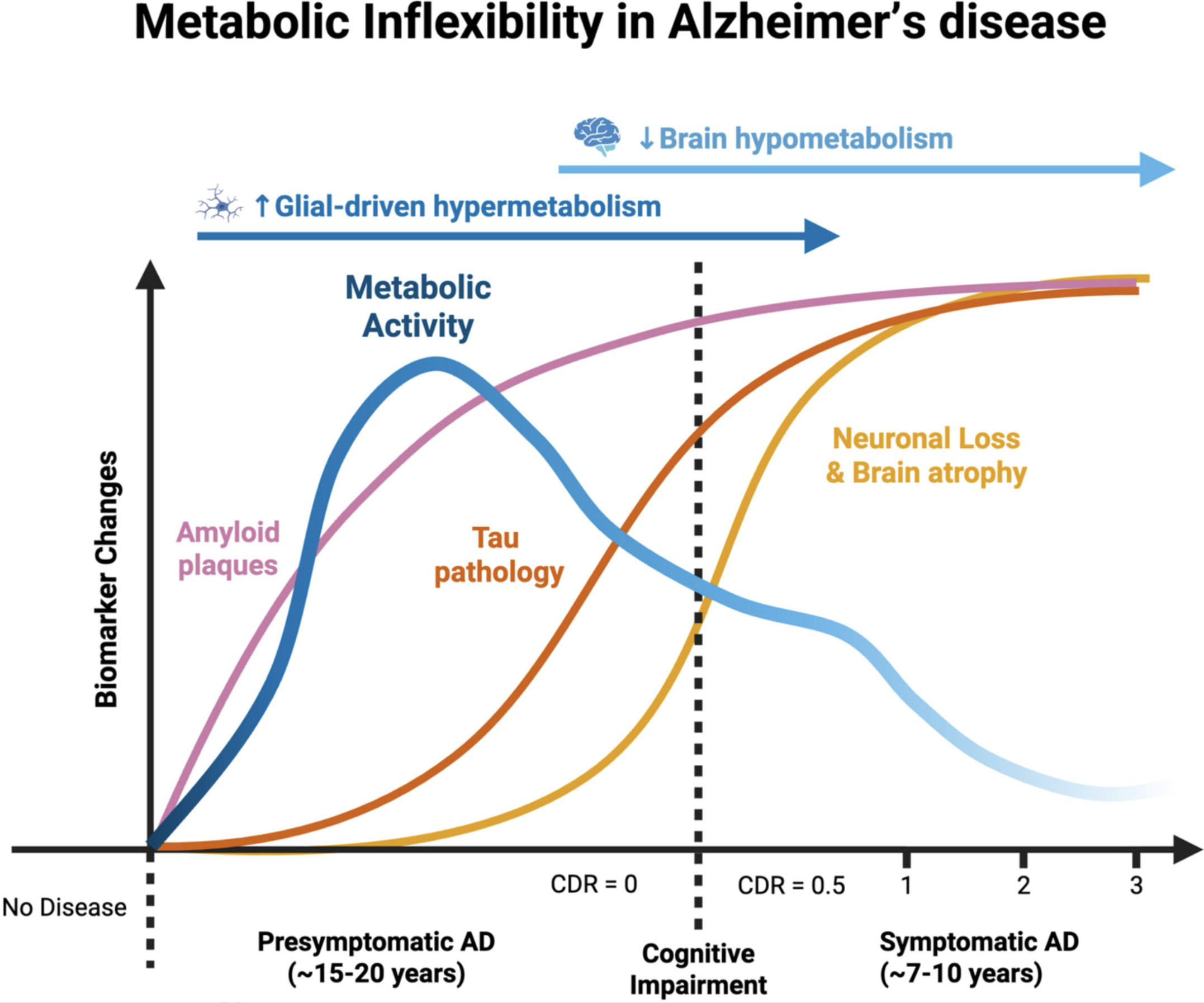
There is a hard implication in this timeline, and the theory does not soften it. If the damage opens with an inflammatory, glia-driven overheating fifteen to twenty years before symptoms, then by the time memory fails, the brain's energy economy has been breaking down for two decades. The disease most people picture as a condition of old age may be, in its decisive phase, a condition of midlife, unfolding in silence in brains that feel entirely well.
How the Theory Makes Room for Amyloid and Tau
Any theory that placed the disease in energy and waved away amyloid and tau would be rightly dismissed, because the case for those proteins is substantial and long-established. The metabolic-inflexibility theory does something more interesting. It does not throw amyloid and tau out. It puts them inside a loop, where the energy failure and the protein pathology each drive the other, and neither is the sole first cause.
The loop runs in both directions, and one direction is already familiar. Amyloid accumulates, and because the microglia are the brain's immune cells, they treat the growing deposits as exactly what they look like: a foreign, damaging intruder to be contained. They swarm the plaques and switch into their inflammatory, glycolytic state, and the metabolic crisis described earlier begins, the fuel monopoly, the starving neurons. In this direction amyloid drives the energy failure, which fits comfortably with the traditional account. The proteins come first and the metabolic trouble follows.
The other direction is the one the theory adds, and it is the one that closes the loop. A brain in metabolic crisis produces more amyloid and tau, not less. The reason is that tau, under normal conditions, does a useful structural job inside the neuron, and keeping it doing that job takes steady energy and careful upkeep. When a neuron is starved and stressed, that upkeep fails, and tau changes into the damaged, misfolded form that clumps into tangles. The same energy failure drives more amyloid as well, and it weakens the brain's ability to clear both proteins, work that happens largely during sleep, itself disrupted by the metabolic trouble. And the chronic inflammation the crisis sustains pushes the proteins to clump further. So the pathology worsens the metabolism, and the worsened metabolism worsens the pathology, around and around.
Once a loop like that is turning, it feeds itself, which helps explain why Alzheimer's is so relentlessly progressive. More amyloid provokes more glial activation, which deepens the metabolic inflexibility, which stresses neurons into making still more amyloid and tau, which provokes still more glial activation. And each turn does something specific and corrosive: it further degrades the brain's capacity to switch fuels. Each of the three fallbacks a healthy brain would rely on gets a little weaker with every cycle. More glia are pushed into the wasteful glycolytic state, so an ever-larger share of the brain's cells are burning fuel inefficiently and competing for glucose rather than sharing it. More of the astrocytes that supply neurons with backup lactate have defected, so that alternative line of supply keeps shrinking. And more of the mitochondria are damaged with each cycle. Burning fuel always produces a small amount of reactive waste, the unstable molecules known as free radicals, and a brain locked in a chronic inflammatory, high-glycolytic state produces far more of them than normal. These free radicals attack the mitochondria themselves, the only machinery that can actually burn an alternative fuel like a ketone or a fatty acid, and damaged mitochondria then leak still more of them, worsening the problem they came from. So even when a backup fuel is available, fewer and fewer cells have the working machinery to use it. The brain does not just lose energy with each turn of the loop. It loses, a little more each time, the flexibility that would have let it cope, which is why the loop accelerates toward collapse instead of settling into a new, lower steady state. The disease builds its own momentum, and no single starting point has to carry the full weight of causation.
This is why the theory can hold amyloid, tau, and energy failure at once without contradiction, and it is also why it fits the multidimensional picture. If metabolic inflexibility is one engine in a system of interlocking engines, mitochondrial decline, inflammation, failing protein quality control, dysregulated growth signaling, then it does not need to be the first cause to be a real one. It needs only to be a force that drives the loop, and the theory makes a strong case that it is. It also explains, more hopefully, why removing amyloid alone has helped so little: if the loop has more than one engine, taking out one and leaving the others running still lets the disease turn over.
How Energy Failure Becomes Cognitive Decline
A theory of fuel and cells earns its standing only if it can explain what the disease does to a person, and the energy account must therefore reach from the biochemistry of a single cell to the loss of memory and self. It does so through a plain and unforgiving logic: neurons starved of energy cannot do their work, and a brain composed of such neurons cannot hold together the coordinated activity on which thinking and remembering depend.
Start with the single neuron. A neuron fires by briefly letting charged particles rush across its membrane, then it has to pump those particles back out to reset for the next signal, and that resetting, done by a molecular pump called the sodium-potassium pump, is the single largest energy cost it carries, consuming roughly half of the brain's entire energy budget. When the neuron is starved of fuel, that pump falters. Sodium it should be expelling leaks in and accumulates, and the neuron's resting charge drifts closer to the threshold at which it fires. The counterintuitive result is that an underpowered neuron does not go quiet. It sits perpetually on a hair trigger, firing erratically and when it should not. Worse, the brakes fail at the same time: the inhibitory circuits that normally restrain firing are themselves energy-dependent and are weakened in the disease, so excitation runs unchecked. This is not a harmless glitch. The misfiring floods the cell with calcium and stress, drives it to produce still more amyloid and tau, and in some patients surfaces as the seizures and epileptic activity that are more common in Alzheimer's than most people realize. A starved neuron is not a slower neuron. It is a destabilized one.
Scale that up and the brain's networks begin to come apart, in a specific order. The regions Alzheimer's attacks first are its busiest hubs, the richly interconnected, high-traffic networks that carry memory and higher thought, among them the default mode network, the set of regions most active during rest and inward reflection. These hubs are the most metabolically expensive real estate in the brain, because constant long-distance signaling burns enormous energy, and that expense is exactly what makes them the first to fail when fuel runs short. As their neurons lose reliable power and begin to fire erratically or fall silent, the synchronized, split-second timing that long-range communication depends on breaks down. Two regions that can no longer fire in step can no longer coordinate, and a memory or a thought that requires several regions acting together cannot be assembled. The network does not go dark all at once. It desynchronizes, piece by piece, as the energy that kept its members firing in concert runs out.
Sleep is another casualty, and it sits in a particularly cruel spot in the loop. The brain's fuel-switching rhythm is tied to the sleep-wake cycle, so losing metabolic flexibility disrupts sleep directly. And sleep is when the brain does much of its cleaning, including clearing the amyloid and tau that build up during waking hours. Disrupted sleep means impaired clearance, which means more accumulation, more pathology, more metabolic stress, and still worse sleep. The energy failure both causes the sleep disruption and is deepened by it.
Memory and thought are what happen when neurons fire reliably and networks communicate in coordinated patterns, both of them energy-intensive, both of them progressively dismantled as the energy crisis spreads. In this account, the forgetting and confusion of Alzheimer's are, at bottom, what a brain looks like when it can no longer power the machinery of cognition, when its neurons are too starved to fire dependably and its networks too frayed to hold a thought together. The disease's most human symptom traces back to its most basic failure: energy that can no longer go where the mind needs it.
Can Metabolic Flexibility Be Restored?
If Alzheimer's is driven in part by a loss of the brain's metabolic flexibility, the natural question is whether that flexibility can be restored, and some early evidence suggests it might. If the inflexibility is a maladaptive state rather than permanent damage, then giving the brain back its ability to adapt how it fuels itself could, in principle, slow the loop or loosen its grip. This is a hypothesis under active test, not an established treatment, but the early evidence is worth taking seriously.
The strongest support so far comes from the laboratory, and it is a genuine proof of principle. In mouse models of Alzheimer's, researchers have gone after the exact metabolic switch at the center of the theory, the shift in glia toward inefficient glycolysis, by inhibiting the enzymes that drive it. Forcing the glia back out of their glycolytic, inflammatory state, restoring a measure of their metabolic adaptability, improved the amyloid pathology, reduced the inflammation, and improved the animals' cognition. That matters because it suggests the metabolic inflexibility is not just a symptom riding along with the disease but a lever: correct it, and the disease's course changes, at least in a mouse.
The idea splits into two broad strategies, and they are worth separating. The first is to relieve the fuel shortage directly, by giving the starved brain a fuel it can still use. This is the logic behind ketones. When glucose metabolism is failing, the brain can often still burn ketone bodies, the fuel the body makes from fat during fasting or on a very low-carbohydrate diet. Ketones are exactly the kind of alternative fuel a flexible brain draws on and an inflexible one struggles to reach on its own, and the thinking is that supplying them, through diet or through ketone supplements, might route energy around the glucose bottleneck to neurons that would otherwise starve. Small studies have tested ketogenic diets and ketone drinks in people with early cognitive decline, with some encouraging signals, though the evidence is still thin and the practical hurdles real.
A striking recent experiment shows how far that backup fuel can go. The brain is often called a glucose-dependent organ, but researchers at Brigham Young University tested that assumption directly, using thin slices of living mouse brain tissue kept alive in a dish, where the experimenter controls exactly what fuel is available.[6] They bathed the tissue in one of three solutions: one with glucose, one with the ketone beta-hydroxybutyrate and no glucose at all, and one with no usable fuel. Then they hit the tissue with one of the most energy-demanding events a brain can undergo, a wave called spreading depolarization, in which neurons lose their electrical gradients and must burn enormous energy to restore them, and they did it twice. Every slice survived the first wave on its own internal reserves. But on the second, the result was stark: all eight slices fed the ketone recovered, and none of the eight slices with no fuel did. Tissue with no glucose whatsoever, running only on a ketone, could do what starved tissue could not. It is a clean demonstration that a ketone can fund even the brain's most expensive work when glucose is gone, which is the whole premise of the fuel-supply strategy, though this was isolated tissue in a dish, not a living brain, and it shows the mechanism, not a treatment.
The second strategy is to go after the inflexibility itself, upstream of the fuel shortage, by repairing the systems that let the brain switch and share fuels in the first place. Several specific targets follow from the theory. One is to restore the astrocyte-neuron lactate shuttle, the supply line that normally delivers backup fuel to neurons and that collapses in the disease. Another is to improve insulin signaling in the brain, since insulin helps brain cells take up and use glucose, and its impairment is part of why the Alzheimer's brain handles fuel so poorly, the overlap that has led some to call the disease "type 3 diabetes." A third is to calm the chronic inflammatory, glycolytic state of the glia, or to support mitochondrial function so cells are not forced onto the wasteful glycolytic route to begin with. What unites these approaches is that they aim less at feeding the brain around the problem than at rebuilding the adaptability it lost.
A clear-eyed view of where this stands is essential. These are early-stage ideas and small trials, not proven therapies, and Alzheimer's drug development is a long record of promising leads that failed in people. Mouse evidence, however clean, is mouse evidence. Nothing here has been shown to prevent or reverse Alzheimer's, and nothing in this account is a reason to start a ketogenic diet, or anything else, as a treatment for the disease. The theory offers not a protocol but a target: metabolic flexibility is worth trying to protect and restore, and researchers now have a coherent reason to pursue the interventions that might.
There is also a broader implication, one that does not wait on any drug or trial. If the brain's capacity to handle fuel shapes its vulnerability to this cascade, then the metabolic flexibility of the whole body, the same flexibility that governs how a person handles food, fasting, and exercise, is not separate from the health of the brain. That connection is where the theory stops being only about disease and starts being about how any of us ages, which is where it matters most for the people reading this.
How to Build Metabolic Flexibility
This is the part of the story that is actually actionable, and it is backed by a large body of established research. Set the brain aside for a moment. Metabolic flexibility is not only a feature of neurons and glia; it is a property of the whole body, and it is one of the most studied and most trainable traits in all of metabolic health. It can be measured. It declines with age and with metabolic disease. And a handful of specific, well-validated interventions reliably improve it.
That matters for this theory in a particular way. The inflexibility the theory places at the center of Alzheimer's, the lost ability to switch cleanly between fuels, is the same defect, mechanistically, that defines insulin resistance and early type 2 diabetes. In a flexible person, the body burns fat between meals and switches smoothly to glucose after eating; in an inflexible one, that switching is sluggish and incomplete, and fat and glucose metabolism both run badly. This is measurable in a lab as the respiratory exchange ratio, how readily a person shifts between burning fat and carbohydrate, and metabolic inflexibility by this measure is an early hallmark of diabetes. The theory's proposal is that a version of the same failure, in the specialized context of the brain, helps drive Alzheimer's. Whether or not that brain-specific claim is ultimately proven, building metabolic flexibility in the body is a well-supported goal for healthspan on its own, and it is the most sensible thing a person can do in the direction the theory points.
Exercise is the strongest lever, and the type matters.
Nothing improves metabolic flexibility as reliably as physical activity, and the research is specific about why. The headline adaptation is in the mitochondria. Aerobic exercise, especially sustained moderate-intensity work, the "zone 2" training that has become a fixture of longevity discussion, activates a master regulator called PGC-1α that drives the cell to build more mitochondria and better ones. More mitochondrial capacity means more ability to burn fat, because fat is burned inside mitochondria, and it is the fat-burning capacity that a flexible metabolism depends on. Trained muscle expresses more of the machinery, enzymes like CPT1, that shuttles fatty acids into mitochondria to be burned, and studies find that consistent moderate-intensity training can raise fat-oxidation capacity substantially, on the order of a third, within a couple of months. The difference this machinery makes is visible when trained and untrained people are compared directly. In work by the physiologist Iñigo San-Millán, sedentary men showed markedly lower mitochondrial efficiency than active men of the same age, along with far less of the transport machinery their cells needed to bring fuel into the mitochondria, roughly half the CPT1 that shuttles fat and about half the protein that brings glucose in.[7] The active men were not just fitter. Their cells were physically better equipped to burn more than one fuel, which is metabolic flexibility at the level of hardware.
The same training sharpens the other half of flexibility, the glucose side. Aerobic exercise improves insulin sensitivity by large margins in previously sedentary people, with reported gains of twenty-five to fifty percent that persist for a day or more after a single session. A metabolism that is both better at burning fat and more sensitive to insulin is, by definition, more flexible: it moves cleanly between the two fuels instead of getting stuck. This is why the capacity that declines with age and metabolic disease is also, encouragingly, the capacity that training restores, and why even older adults, whose mitochondria are often assumed to be fixed, can still build mitochondrial density with consistent aerobic work.
Intensity and variety add to it rather than replacing the aerobic base. Higher-intensity intervals drive their own mitochondrial and insulin-sensitizing adaptations, through overlapping pathways, and offer some of the same benefits in less time. Resistance training contributes a different and complementary piece: it builds and preserves muscle, the body's largest site of glucose disposal, so more muscle means more capacity to absorb and use glucose rather than leave it circulating. The combination of aerobic and resistance training produces better metabolic results than either alone. For a longevity-minded person, the practical shape is an aerobic base, most of it at an easy, conversational intensity, with some harder efforts and regular resistance work layered on. That prescription is not specific to the brain. It is simply the best-established way to build the metabolic flexibility this entire theory is about.
Fasting and meal timing give the system something to switch between.
If exercise builds the machinery for fuel-switching, eating patterns decide how often that machinery actually gets used. A person who eats from waking to bedtime, grazing on carbohydrate across sixteen hours, almost never asks the body to switch fuels. Blood sugar and insulin stay elevated, fat-burning stays suppressed, and the switching capacity, like any unused capacity, atrophies. The simplest way to exercise it is to stop eating for longer stretches.
The physiology here is well-established. After roughly twelve hours without food, the liver's glucose stores run low, and the body flips what researchers call the metabolic switch: it shifts from burning glucose to burning fat and the ketones made from it. That switch is metabolic flexibility in its most literal form, the body moving from one fuel to another as conditions change, and practicing it appears to strengthen it. This is the rationale behind time-restricted eating, confining food to a window of eight or ten hours and fasting the rest. In controlled trials, time-restricted eating improves insulin sensitivity, raises resting fat oxidation, and reduces visceral fat, and in at least one careful study it improved insulin sensitivity and blood pressure in men with prediabetes even without any weight loss, which points to a benefit from the timing itself, not just from eating less.[4]
Two honest qualifications keep this in proportion. First, the ketone rise from ordinary time-restricted eating is modest, far below the levels of a true fast or a ketogenic diet, so the benefit is better understood as improved insulin sensitivity and the practice of switching than as deep ketosis. Second, the capacity to make this switch is itself blunted by age, which is part of why metabolic flexibility declines over the years and why the practice may matter more, not less, as a person gets older. None of this requires extreme fasting. For most people, simply compressing the eating window and leaving a long overnight gap is enough to flip the switch daily and keep the machinery in use.
The foundation is the metabolic environment itself.
Exercise and meal timing work on top of a base state, and that base state can either permit flexibility or prevent it. Insulin resistance, excess visceral fat, and chronic low-grade inflammation are not just consequences of metabolic rigidity; they enforce it, locking the body into a state where fuel-switching does not happen cleanly. This is why the unglamorous cardiometabolic basics, keeping visceral fat down, keeping blood sugar and insulin in good ranges, keeping inflammation low, are not separate from building metabolic flexibility. They are the conditions that make it possible. The same risks that drive heart disease and shorten lives in other ways also degrade the metabolic adaptability this theory cares about, which is one more reason the brain and the body are not separate problems.
Sleep sets the clock.
The body's fuel-switching is tied to its daily rhythm, and that rhythm runs on sleep. The shift toward fat and ketone metabolism overnight, the clearance work the brain does during deep sleep, the timing of insulin sensitivity across the day, all of it depends on a functioning circadian cycle. Chronic short or disrupted sleep degrades insulin sensitivity directly, within days, and desynchronizes the metabolic rhythm that flexibility depends on. Protecting sleep is not a soft recommendation layered on at the end. It is part of the same system, and in the specific context of this theory, it protects both the metabolic switching and the overnight clearance that the failing Alzheimer's brain loses.
You can measure whether any of this is working.
One of the more useful features of metabolic flexibility is that it is not an abstraction. It leaves tracks. Fasting insulin and glucose, and the ratio between them, reflect how well the body is handling fuel at rest. Triglycerides and the cholesterol particle count track the lipid side. In a lab, substrate oxidation can be measured directly, how a person's fuel use shifts between the fasted and fed states, which is metabolic flexibility quantified. And the cardiometabolic markers that drive rigidity, visceral fat, inflammatory markers, blood pressure, are all trackable over time. This matters because the processes the theory describes move silently for years before they surface, in the brain and everywhere else. The only way to know your own metabolic trajectory, rather than guess at it, is to measure it and watch it move, which is the difference between managing your healthspan on evidence and managing it on hope.
From Theory to Prescription: SGLT2 Inhibitors and the Fuel Problem
If the core problem in Alzheimer's is a brain that can no longer manage its own fuel, the obvious question is whether a drug could help it manage better. That question leads somewhere unexpected: to a class of diabetes medications that has become one of the most closely watched in longevity medicine, the SGLT2 inhibitors.
They were not designed with the brain in mind. SGLT2 inhibitors lower blood sugar by a simple trick: they block the kidney from reabsorbing glucose, so the excess is flushed out in the urine. But the consequences of that one action ripple through the whole metabolism, and several of them happen to land on the exact nodes this theory identifies. That is what makes the drug interesting here. It is not that it targets Alzheimer's. It is that it pushes, more or less by accident, on much of the cascade the theory describes.
When the body sheds glucose and blood sugar falls, it shifts toward burning fat and produces more ketones, a mild, sustained rise in beta-hydroxybutyrate. Ketones are the alternative fuel the Alzheimer's brain struggles to reach on its own, and they cross the blood-brain barrier freely and are burned efficiently by neurons. A drug taken to manage blood sugar, as a side effect, supplies the failing brain with exactly the backup fuel it has lost, bypassing the broken glucose machinery and feeding neurons that would otherwise starve. If the disease is in large part an inability to switch fuels, a steady trickle of a usable alternative fuel is a direct, if partial, answer.
The other effects line up with the rest of the cascade. SGLT2 inhibitors are anti-inflammatory, and the chronic neuroinflammation they may help calm is the same glial program that, in the theory, starts the whole energy crisis. By improving the body's insulin sensitivity and lowering circulating insulin, they may ease the brain's own insulin resistance, the impaired glucose handling that sits near the center of the disease. In animal studies they improve mitochondrial function and reduce oxidative stress, countering the forces that push brain cells onto the wasteful glycolytic route in the first place. They raise BDNF, a protein that supports the survival and plasticity of neurons. And they improve blood pressure, blood-vessel function, and cerebral blood flow, easing the delivery of fuel and oxygen to a brain that needs both. These drugs are also lipid-soluble and cross into the brain, so some of these effects may be direct rather than only downstream of better blood sugar. No single one of these is dramatic. The striking thing is how many nodes of the same cascade one drug touches at once.
The theory predicts what should follow, and the observational evidence lines up with it. Across large population studies, people with diabetes taking SGLT2 inhibitors have developed dementia, including Alzheimer's, at meaningfully lower rates than those on other glucose-lowering drugs. The reductions are not small: pooled analyses covering millions of people put the lower risk in the range of a quarter to a third, with the association for Alzheimer's among the strongest.[2][3]
The honest caveats are essential, and they cut in a specific direction. This evidence is observational, drawn from people who have diabetes and take these drugs for that reason, which makes the groups hard to compare cleanly. More tellingly, the randomized trials, the gold standard, have so far been equivocal: when researchers pool the controlled trials rather than the population data, the dementia benefit does not reach significance.[5] The mechanism is compelling and the observational signal is large and consistent, but the two kinds of evidence have not yet converged. Much of the detailed mechanistic work, especially the effects on amyloid, tau, and BDNF, comes from animal models, which do not always translate. Until the randomized evidence catches up, this is a promising lead, not a proven therapy. It has not been established in people without diabetes, and no one should take an SGLT2 inhibitor to prevent Alzheimer's.
The connection is worth understanding anyway for what it represents. SGLT2 inhibitors are not a drug aimed at plaques. They are, in effect, a way of nudging the body's whole fuel economy back toward flexibility, supplying an alternative brain fuel, calming inflammation, improving insulin signaling, easing the metabolic strain that drives the cascade. That is the metabolic-inflexibility theory expressed as pharmacology, and it is a large part of why this drug class has drawn such serious interest in longevity medicine, well beyond the diabetes it was built for. For anyone exploring SGLT2 inhibitors as part of a considered metabolic strategy, the right path is a clinician-guided one, which is what Healthspan's SGLT2 Protocol provides: access to this drug class under medical supervision, with the evaluation and monitoring these medications require. We have covered the broader longevity case for SGLT2 inhibitors in more detail elsewhere.
What the Theory Does and Doesn't Explain
A theory this sweeping is useful in proportion to how honestly its limits are held, and this one has real ones. It is a framework, not a proof, and its parts are not equally established. Some rest on decades of human data. Others are compelling arguments built mostly on animal models. Keeping the two sorted is what separates taking the theory seriously from overreaching with it.
Start with what is solid, because it is the foundation the whole theory is built on. That the Alzheimer's brain fails to use glucose properly is among the most reproducible findings in the field, visible on brain scans years before symptoms and tracking closely with cognitive decline as the disease advances. That Alzheimer's travels with diabetes, insulin resistance, and metabolic dysfunction is well established in large human populations. And studies of human brain tissue and spinal fluid show the altered metabolites and failing energy machinery the theory describes. The raw material, a brain in metabolic trouble, is not in question. It is real, it is human, and it is early.
What is more provisional is the central interpretive claim: that this metabolic failure is not a symptom of the disease but a driver of it, and specifically that the loss of metabolic flexibility, the inability to switch fuels, is what turns a manageable shortage into a progressive collapse. This is a strong and coherent reading of the evidence, but it is a reading. Much of the cellular detail, the glial glycolytic switch, the fuel monopoly, the reversibility when the switch is blocked, comes from mouse models, and mouse brains are not human brains. The clearest demonstration that correcting the inflexibility changes the disease is a demonstration in animals. The theory assembles a persuasive case that the same process runs in people, but assembling a case is not the same as proving it, and the direction of causation, whether metabolic inflexibility leads or merely accompanies the pathology, is genuinely hard to pin down in a disease where everything influences everything else.
The treatment ideas sit further out still. That restoring metabolic flexibility might slow the disease is a hypothesis under test, not a result. The metabolic drugs and diets in trials may or may not pan out, and the SGLT2 connection, compelling as its mechanism is, rests on observational data that the randomized trials have not yet confirmed. Nothing here has been shown to prevent or treat Alzheimer's in people, and the field's history is full of clean mechanisms that failed when finally tested.
The largest caveat of all is the one the opening of this article insisted on and the ending should repeat: this theory is one dimension of a disease that has several. Alzheimer's is not reducible to energy any more than it is reducible to amyloid. Mitochondrial failure, inflammation, failing protein quality control, dysregulated growth signaling, vascular disease, genetics, each carries real weight, and the honest position is that metabolic inflexibility is one propellant among them, interacting with the rest, not the master key. Its value is not that it explains the whole disease. It is that it explains a real and underappreciated part of it, and that, unlike some of the other parts, it connects to things a person can actually measure and act on.
Held that way, the theory is worth exactly what a good theory is worth. It organizes scattered findings into something coherent, it resolves puzzles the plaque-centered view could not, and it points research and personal effort toward a target that is plausible, measurable, and shared with the rest of metabolic health. That is a great deal, as long as it is not asked to be the whole answer.
Conclusion: Follow the Fuel
For most of its history, the effort to understand Alzheimer's has been an effort to read what the disease leaves behind, the plaques, the tangles, the shrinking tissue. This theory asks a different question. It asks not what accumulates in the brain but what the brain can no longer do, and the answer it proposes is that the brain loses the ability to manage its own fuel: to switch between sources, to route energy where it is needed, to adapt. Alzheimer's, in this telling, is what happens when that flexibility fails, when a brain that could once improvise its way around a shortage gets locked into a rigid program and, over two decades of silence, runs itself into collapse.
The strength of the idea is how much it holds together. It explains the strange early overheating of the Alzheimer's brain and the late decline, and why studies disagreed about which one defined the disease. It explains how the brain's own immune cells, meant to protect it, end up starving its neurons. It makes sense of why clearing amyloid has helped so little, if the loop that drives the disease has more than one engine. And it does something the plaque-centered view never could: it connects the most feared disease of the aging brain to the ordinary metabolic health of the whole body, which is where it stops being only a theory about illness and becomes a theory about how any of us ages.
It is not the whole story, and it does not need to be. Alzheimer's is a convergence of failures, and energy is one of them, one dimension, one propellant, interacting with the rest. What distinguishes this dimension is that it is not a dead end. A brain losing its metabolic flexibility is a brain losing something that, elsewhere in the body, can be measured, trained, and partly restored. The capacity to switch fuels cleanly is built by the same unglamorous work that builds metabolic health everywhere, moving the body, giving it real fasts, protecting sleep, keeping the metabolic environment sound, and it can be tracked as it changes. None of that is proven to prevent the disease, and none of it should be sold as a cure. But it points in a direction that is plausible, actionable, and good for the rest of a person regardless.
The brain runs on fuel it has to manage well. This theory's lasting contribution may be to insist that managing fuel well, in the brain and in the body that supplies it, is not a side issue in how we age. It may be close to the center. Whatever becomes of the specific claims, the instruction it leaves is a simple one: follow the fuel, back to where the energy comes from, forward to where it fails, and out to the whole metabolism that the brain, in the end, cannot be separated from.
- Constantino NJ, Ashley CC, Macauley SL. The energetic collapse of the Alzheimer's brain: metabolic inflexibility across cells and networks. Journal of Neurochemistry. 2025;169(11):e70294. doi:10.1111/jnc.70294.
- Kumari K, Bai A, Geeta F, et al. Risk of dementia in patients with type 2 diabetes using SGLT2 inhibitors versus DPP-4 inhibitors: a systematic review and meta-analysis. Endocrinology, Diabetes & Metabolism. 2026;9(2):e70174. doi:10.1002/edm2.70174.
- Zhong Z, Zhao S, He W, Li R, Xia S. SGLT2 inhibitors versus DPP-4 inhibitors and dementia risk in type 2 diabetes: a meta-analysis of cohort studies. Archives of Gerontology and Geriatrics. 2025;131:106065. doi:10.1016/j.archger.2025.106065.
- Sutton EF, Beyl R, Early KS, Cefalu WT, Ravussin E, Peterson CM. Early time-restricted feeding improves insulin sensitivity, blood pressure, and oxidative stress even without weight loss in men with prediabetes. Cell Metabolism. 2018;27(6):1212-1221.e3. doi:10.1016/j.cmet.2018.04.010.
- Jaiswal V, et al. Association between SGLT2 inhibitors and risk of dementia and Parkinson's disease: a meta-analysis of 12 randomized controlled trials. The American Journal of Medicine. 2024;137(11):1136-1142. Available at: amjmed.com.
- Ricks RL, Nevers DS, Poulos T, et al. β-Hydroxybutyrate maintains energetically demanding neural functions during exogenous glucose deprivation. Cellular and Molecular Neurobiology. 2026;46(1):147. doi:10.1007/s10571-026-01834-3.
- San-Millán I, Martinez JL, Sparagna G, et al. Decreased mitochondrial bioenergetics and function define a distinct metabolic phenotype in healthy sedentary individuals detectable through non-invasive CPET. bioRxiv. 2024. doi:10.1101/2024.08.19.608601.
Related studies