The Hyperfunction Theory of Aging: What If Aging Isn't the Body Breaking Down, but Refusing to Slow Down?
Prefer to listen? Hit play for a conversational, audio‑style summary of this article’s key points.
The hyperfunction theory inverts the usual explanation of aging. The dominant view holds that we age because our bodies accumulate damage and wear out. Mikhail Blagosklonny, a cancer researcher who died in 2023, argued the reverse: we age because the growth programs that build us in youth are never switched off, and keep running in overdrive into later life. Aging, in this view, is not erosion but excess, not the body breaking down but the body refusing to slow down.
His central image is a speeding car without brakes. Where the damage theory pictures aging as an old car slowly rusting, Blagosklonny pictured a powerful car racing onto a residential street with no way to slow down. It crashes not because anything broke but because it kept going at full speed where it should have eased off, and it crashes long before it ever has a chance to rust. The crash, not the rust, is what aging is.
"Hyperfunction" does not mean doing more. It means failing to slow down. The term is easily misread. It does not require a function to increase; it describes a program running at a level that was right in youth but has become harmful with age, like driving sixty-five miles per hour, fine on the highway, dangerous on a quiet street. The same unchanged function becomes destructive purely because it runs on past its proper season.
The idea makes sense of pathologies that otherwise look like simple wear. Presbyopia (the eye's lens never stops growing and stiffens), benign prostate enlargement, hypertension and atherosclerosis (arterial cells over-building and over-contracting), thymic involution, and osteoporosis (bone-resorbing cells over-working) can each be read as a growth or maintenance program that ran too long. The babirusa, a wild pig whose tusks grow until they pierce its own skull, is the starkest illustration: a program with no off-switch, working perfectly, that kills.
The molecular engine is mTOR, and the cellular proof is geroconversion. mTOR is the body's master growth switch. Blagosklonny showed in the lab that a cell blocked from dividing while mTOR keeps driving it to grow does not go dormant; it swells into a large, inflammatory, senescent cell, a process he called geroconversion, the speeding car at the scale of one cell. Inhibiting mTOR prevents it. The same pathway links aging to cancer, which is why a cancer researcher saw it first.
The theory made a bold prediction about rapamycin, and it came true in animals. In 2006, before it had been tested in mammals, Blagosklonny predicted that rapamycin, a drug that inhibits mTOR, should extend lifespan. It did: rapamycin reliably lengthens the lives of mice, yeast, worms, and flies, even when started in old age, and nearly every known longevity intervention, caloric restriction, fasting, exercise, converges on the same growth-control pathway. That convergence is one of the strongest arguments in the theory's favor.
The honest consensus is that aging is probably a hybrid. The either/or framing of hyperfunction versus damage has softened. Blagosklonny's more careful claim was that hyperfunction kills us first, before accumulated damage would, not that damage is unreal. Most thoughtful researchers now hold that aging has both programmatic and damage-driven components, in proportions still being worked out. Hyperfunction forced the question onto the table and made "aging is just damage" look naive, without yet being the final answer.
It points longevity in a different direction: restraint, not repair. If aging is damage, the strategy is to repair and protect, the logic behind the antioxidant era, which has largely disappointed. If aging is hyperfunction, the strategy is to turn the overactive growth programs down, which is what caloric restriction, fasting, exercise, and rapamycin all do, and those are the interventions that have actually been found to extend life. The theory reorients longevity from fixing what breaks toward dialing down what runs too hot.
The promise is real but unproven in humans, and the question is still open. That lowering growth signaling extends life is firmly established in animals and biologically coherent in people. That any specific intervention, rapamycin included, will extend human lifespan has never been shown, and these are serious drugs, not casual supplements. Blagosklonny's lasting contribution was less a finished answer than a better question: when we grow old, is it because we are breaking down, or because we never stopped growing up?
Introduction: A Different Answer to Why We Age
Ask almost anyone why we grow old, and you will hear some version of the same answer. The body wears out. Parts break down, damage accumulates, machinery that once ran smoothly rusts and falters. It is the most intuitive idea in all of biology, so intuitive that it barely feels like a theory at all. Of course we age because things fall apart. What else could aging be?
For most of the last century, serious science agreed. The dominant theories of aging have been theories of damage: free radicals battering our cells, mutations accumulating in our DNA, the protective caps on our chromosomes fraying a little more with each cell division. On this view, aging is entropy made flesh, the slow, inevitable triumph of wear and tear over repair. Growing old is the body losing a maintenance race it was never built to win.
Mikhail Blagosklonny thought this was close to backwards.
A cancer researcher and physician with a restless, contrarian mind, Blagosklonny spent the last two decades of his life, until his death in 2023, arguing for a startlingly different answer. Aging, he proposed, is not caused by the body breaking down. It is caused by the body doing too much. The programs that build us in youth, the growth and developmental signals that turn a single cell into an adult, are never fully switched off. They keep running long after their work is done, past the point of usefulness, into excess and ultimately dysfunction. We do not age because our engine wears out. We age because the engine never stops revving, and nothing ever takes its foot off the gas.
His favorite image to illustrate the theory was a car. The conventional theory, he said, imagines aging as an old car rusting in a driveway, breaking down part by part until it no longer runs. But that, according to Blagosklonny, is the wrong picture. The right picture is a powerful car racing down a highway, where its speed is exactly what is called for, that then enters a residential street and cannot slow down. The same acceleration that was right for building and growing in youth has no brake for later life. For a while nothing seems wrong, the car is still running beautifully, just far too fast for where it now is. Then it crashes. An onlooker might say the crash is what destroyed the car. But the real cause was further back: the car never slowed when it should have, holding a speed it no longer had any need for. It was destroyed not by decay but by speed. It crashed long before it ever had the chance to rust.
This is the hyperfunction theory of aging, and it inverts the conventional story at its root. Where the standard view says damage causes aging, Blagosklonny said aging causes damage, that the visible wreckage of old age, the clogged arteries, the enlarged organs, the failing tissues, is the downstream result of growth programs running in overdrive, not the accumulation of random molecular insults. It is one of the most provocative ideas in modern biology, and it carries a practical promise that has made it impossible to ignore: if aging is driven by an overactive growth program, then a drug that turns that program down might slow aging itself. That drug, Blagosklonny argued years before the evidence arrived, is rapamycin.
Two things should be said plainly at the outset. The first is that this theory is taken seriously. It is not fringe. A growing number of respected biologists regard it as an emerging paradigm, a genuine rival to the damage-based view, and one of its boldest predictions, that rapamycin would extend lifespan, has since come true in animals. The second is that it is not settled, and in an important sense it never will be. Aging is almost certainly the product of many overlapping processes, which means no single theory is ever likely to be proven the explanation; the realistic question is not whether hyperfunction is the answer, but how much of aging it accounts for. On that question it remains contested in its details, unproven in humans, and challenged even by scientists sympathetic to it. The honest status of hyperfunction theory is that of a serious, generative, incompletely proven idea, the kind that is reshaping the questions the field asks even as the answers remain open.
What follows is the case for it, and the case against. We will start where the conventional story starts, with damage, and see why Blagosklonny thought it couldn't be the whole truth. Then we will follow his reframe, the speeding car, the stuck accelerator, the growth program that forgot to stop, from its evolutionary logic, why a body would carry a growth program it has no way to switch off, down to the molecular machinery he blamed and the evidence that has, in part, borne him out. And we will let two of his most thoughtful peers, scientists who admire the theory without fully accepting it, mark its limits. The question Blagosklonny forced the field to confront is simple to state and surprisingly hard to answer: when we grow old, is it because we are breaking down, or because we never stopped growing up?
The Standard Story: Aging as Accumulated Damage
To understand why Blagosklonny's idea was so radical, you have to first appreciate how deeply the opposite idea is embedded, not just in popular intuition, but in a century of serious science. The damage theory of aging is not a strawman. It is a sophisticated, evidence-backed, intellectually coherent account of why living things grow old, and for most of the twentieth century it stood essentially unchallenged. Any honest reckoning with hyperfunction has to start by taking it seriously.
The core intuition is thermodynamic. The universe tends toward disorder; ordered systems decay unless energy is spent to maintain them. A living body is an exquisitely ordered system, and keeping it ordered takes constant work, repairing DNA, clearing out damaged proteins, replacing worn tissues. The damage theory says that this maintenance, however good, is never perfect. Tiny errors slip through and accumulate. Over decades, the accumulated imperfections degrade the body's function until it fails. Aging, on this view, is the slow loss of a maintenance battle against entropy.
Over the last century, that broad intuition was filled in with specific, testable mechanisms, and several became famous. The most influential was the free radical theory, proposed in the 1950s. It holds that the very process that keeps us alive, burning fuel with oxygen to make energy, generates dangerous byproducts called reactive oxygen species, or free radicals. These unstable molecules ricochet through the cell, damaging DNA, proteins, and membranes. A lifetime of this oxidative bombardment, the theory says, is what wears us down. It is an elegant idea, and it launched a multibillion-dollar antioxidant industry built on the promise that mopping up free radicals might slow aging.
A second pillar was the discovery of the Hayflick limit. In the early 1960s, Leonard Hayflick found that normal human cells, grown in a dish, can divide only a finite number of times, around fifty, before they stop and enter a state of permanent arrest. This was startling: it suggested that cells carry an internal counter, a built-in limit on their own renewal. The counter was later traced to telomeres, the protective caps on the ends of chromosomes that shorten slightly with each division. When they wear down past a critical point, the cell can no longer divide. Here, it seemed, was a molecular clock for aging, ticking down one cell division at a time toward senescence, the state in which a cell permanently stops dividing but does not die, and telomere shortening became one of the most studied mechanisms in all of gerontology.
Underneath these specific mechanisms sat a powerful evolutionary rationale, one that explained not just how we age but why natural selection would ever permit it. The puzzle is real: if aging is so harmful, why didn't evolution weed it out? The answer, developed by biologists in the mid-twentieth century, is that natural selection weakens with age. In the wild, most animals die young, killed by predators, starvation, cold, or disease, long before old age could ever set in. A squirrel almost never dies of being an old squirrel; something eats it first. This means that selection pressure is intense on traits that matter early in life, when most animals are still alive to reproduce, and nearly absent on traits that matter only in old age, which few animals survive to reach. Genes with harmful effects that surface only late in life are essentially invisible to selection. They slip through, uncorrected, generation after generation.
From this reasoning came the disposable soma theory, one of the most influential ideas in the biology of aging. It frames the body, the soma, as fundamentally disposable. An organism has a limited energy budget, and it must divide that budget between two competing demands: reproduction, and the maintenance and repair of its own body. Because the body in the wild is likely to be killed by external causes before long, it makes no evolutionary sense to invest heavily in maintaining it for decades. The optimal strategy is to spend lavishly on reproduction and only modestly on upkeep, to build a body good enough to last through the reproductive years, and no better. We age, in this account, because we were never built to last. Our bodies are, by design, provisional. Evolution funded a warranty just long enough to get the genes into the next generation, and not a day more. Nature shows this logic in its most extreme form in the Pacific salmon, which swims upstream, spawns once, and then, its single reproductive mission accomplished, dies within a week or two, its body breaking down with startling speed. The salmon is not killed by the river or by age in any ordinary sense. Having reproduced, it is simply discarded, the body spent on the one thing evolution built it to do.
Put together, these ideas form a seamless and compelling picture. Aging is the accumulation of molecular damage, from free radicals, from DNA errors, from the relentless shortening of telomeres, against a backdrop of maintenance systems that evolution deliberately underfunded because the body was never meant to be permanent. It explains the how and the why in a single coherent frame. It fits the intuition that old things wear out. And it has enormous empirical support, damage does accumulate with age, telomeres do shorten, oxidative damage is real and measurable. This is the reigning paradigm for good reason.
And yet, Blagosklonny argued, for all its coherence, it runs into a series of stubborn facts it cannot comfortably explain. It is to those cracks that we turn next.
The Cracks in the Damage Story
A theory can be coherent, well-evidenced, and intuitive, and still be incomplete. What drew Blagosklonny away from the damage paradigm was not a failure of its internal logic but a growing pile of observations that sat awkwardly against it. Individually, each could be explained away. Together, he thought, they pointed to something the damage theory was missing. It is worth walking through them, because this is the empirical heart of his case, the reason a serious scientist came to believe the reigning view had the causation backwards.
Start with antioxidants. If aging is driven by oxidative damage from free radicals, then neutralizing those free radicals with antioxidants should slow aging and extend life. This is not a subtle prediction; it is the direct, testable consequence of the free radical theory, and it was tested, exhaustively, for decades. The results were deflating. Large trials of antioxidant supplements have, by and large, failed to extend human lifespan, and some have shown no benefit or even slight harm. In animals, boosting antioxidant defenses rarely lengthens life, and reducing them often doesn't shorten it the way the theory predicts. For a theory whose central mechanism is oxidative damage, the near-total failure of antioxidants to do anything for longevity is an awkward fact that has never been fully resolved.
The deeper problem is that lifespan can be extended dramatically without touching oxidative damage at all. The interventions that reliably lengthen life across species, caloric restriction, certain genetic mutations, drugs like rapamycin, do not work primarily by reducing free radicals. They work by altering nutrient-sensing pathways that are connected to cellular growth. If you can add fifty percent to an animal's lifespan while leaving its burden of oxidative damage essentially unchanged, then oxidative damage cannot be the main thing setting the length of life. The lever that actually moves lifespan seems to be somewhere else.
Then there is cancer, which Blagosklonny, a cancer researcher, found especially telling. Cancer cells are, in a sense, immortal, they can divide indefinitely. Yet they are riddled with DNA damage and mutations, far more than normal cells. If accumulated molecular damage were what drives cells toward death and senescence, cancer cells should be the first to go. Instead they are the ones that escape aging altogether. A cell drowning in genetic damage can be functionally immortal, while a pristine, undamaged cell can enter senescence. The relationship between damage and aging, at the cellular level, does not run in the direction the theory requires.
The Hayflick limit, too, fits the facts less cleanly than its fame suggests. Telomere shortening is real, but it does not track lifespan the way a true aging clock should. Across species, telomere length and the rate of shortening correlate poorly with how long an animal lives, some short-lived animals have long telomeres and vice versa. Laboratory mice, which age and die within a few years, have telomeres far longer than our own. And in the living body, many cells age without ever approaching their division limit; a neuron or a heart-muscle cell can grow old without dividing at all. Whatever telomere shortening is, it does not look like the universal mechanism of aging it was once taken to be.
But the observation Blagosklonny returned to most often, the one he seemed to find most decisive, was about the sheer consistency of aging. If aging were truly the product of accumulated random damage, free radicals striking wherever they happen to strike, mutations landing by chance, we would expect it to be a disorderly process. Different people, battered by different random insults over different lives, should fall apart in different ways and different sequences. Aging should be idiosyncratic, a lottery of accumulated accidents.
It is almost the opposite. Human aging is almost monotonously regular. We go gray and we wrinkle. We lose muscle and bone. Men's prostates enlarge; women pass through menopause on a predictable schedule. Blood pressure creeps up, arteries stiffen and clog, insulin resistance sets in, the same conditions, in roughly the same order, in population after population across the globe. If you know a person's age, you can predict with considerable accuracy what is happening inside their body. This is not what randomness looks like. Randomness produces variety; aging produces a schedule. The orderliness of aging, Blagosklonny argued, is the signature of a program, something coordinated and directional, running on a timetable, not the scattershot wreckage of a thousand chance collisions.
None of this amounts to a knockout blow, and Blagosklonny's critics would later push back on several of these points, as we will see. Damage is unquestionably real, and it unquestionably accumulates. But the pattern of the evidence, the failure of antioxidants, the uncoupling of lifespan from oxidative damage, the immortality of damaged cancer cells, the poor fit of the telomere clock, and above all the uncanny regularity of how we age, convinced him that damage could not be the primary driver. Something more orderly had to be at work. Something that looked less like decay and more like a program. The question was what kind of program could possibly cause aging, when evolution, as everyone agreed, had no reason to build one.
The Reframe: A Speeding Car Without Brakes
Blagosklonny's starting point was a paradox that the damage theory and the program idea seemed to leave irreconcilable. On one hand, the orderliness of aging looked programmatic, coordinated, scheduled, directional. On the other, evolutionary theory was adamant that there could be no program for aging, no gene selected because it kills us, because natural selection cannot favor a trait whose only effect is to end lives after reproduction. A true aging program would be weeded out the moment it arose. So aging looks like a program but cannot be one. The puzzle seems airtight.
Blagosklonny's resolution was a single, elegant distinction on which the entire theory rests. Aging, he said, is not a program. It is a quasi-program. A program is a process selected by evolution to achieve a purpose, the developmental program that turns an embryo into an adult, for instance, exists because it was favored, step by step, for building a functioning organism. A quasi-program is different. It is not selected to do what it ends up doing. It is the aimless continuation of a real program past the point of its usefulness, a process that runs on, by sheer momentum, after its purpose has been served. Nobody designed it to cause aging. It causes aging as a side effect of not being switched off.
The developmental growth program is the obvious candidate. In youth, powerful biological signals drive growth, cells divide, tissues expand, the body builds itself toward maturity. This program is unambiguously useful, and unambiguously selected. But here is the key point: evolution built an elaborate program to turn growth on, and had little reason to build an equally elaborate program to turn it off. Why not? Because in the wild, as the disposable soma theory already told us, animals rarely live long enough for the "off" to matter. An organism that will be eaten within a couple of years gains nothing from a precise mechanism to wind its growth program down in old age it will never see. So the program to switch off was never built, or never fully built. The growth signals simply keep running, at a lower idle perhaps, but never stopping, for as long as the organism lives. In the protected modern world, where we routinely outlive the age at which our ancestors were killed, we live long enough to experience what happens when a growth program runs for decades past its purpose. What happens is aging.
This is where the car comes in, because it is the single most illuminating image in the whole theory. The damage theory, Blagosklonny said, pictures aging as an old car left out in the weather, rusting, its parts corroding and seizing one by one until it no longer runs. Maintenance can slow the rust; eventually, entropy wins. That is the disposable-soma, wear-and-tear picture, and it feels right because it matches how machines usually die.
But imagine instead a different car, a powerful, well-built car, in perfect working order, racing down an open highway at full speed. Nothing is wrong with it. It is doing exactly what it was built to do. This is the body in youth, the growth program running at full throttle, and running beautifully. Now the highway ends and the car turns onto a narrow residential street, where the safe speed is a crawl. The car should slow down. But it has no brakes, and no driver to press them. So it keeps going at highway speed down a street built for walking pace. For a while, oddly, nothing catastrophic happens. The car is still a fine car, still running perfectly, just going far too fast for where it now is, straining, overshooting, taking the corners too hard. And then, inevitably, it crashes.
Now ask what killed the car. An onlooker arriving at the wreck would see a destroyed vehicle and conclude that something broke, that the crash was a failure of the machine. But the machine never failed. Every part worked perfectly right up to the end. What killed the car was not breakdown but excess, the right behavior in the wrong context, speed that was appropriate on the highway and lethal on the residential street. The car was destroyed by doing, at the wrong time, exactly what it had been built to do. And notice the timing: it crashed while still in excellent condition. It never got the chance to rust. The speed killed it long before decay ever could.
That, in a sentence, is the hyperfunction theory. The growth programs that build us in youth are the car at highway speed, powerful, productive, exactly right for their moment. Aging is those same programs continuing to run at full throttle into a later stage of life where their intensity is no longer appropriate but harmful. The body does not fail because its machinery breaks down. It fails because its machinery keeps running hard when it should have idled, driving tissues and organs into dysfunction through sheer persistent excess. And it reaches that failure, Blagosklonny argued, long before the slow processes of molecular damage would have killed us on their own. The crash comes first. The rust never gets its turn.
From this picture follows the theory's most provocative single claim, the one that most sharply divides it from everything that came before. The conventional view holds that damage causes aging, that the accumulation of molecular wreckage is what makes us old. Blagosklonny turned the arrow around. Aging causes damage, he said, not the other way around. The organ damage we see in old age, the scarred and clogged arteries, the enlarged heart, the failing kidneys, is the wreckage from the crash, the downstream consequence of growth programs running in overdrive. The hyperfunction comes first; the damage is what it leaves behind. We do not grow old because our bodies accumulate damage. Our bodies accumulate damage because they are growing old, in the specific sense of running biological programs that no longer know when to stop.
What "Hyperfunction" Actually Means
The word at the center of the theory, hyperfunction, is also the word most likely to mislead. It sounds as though it must mean doing more, a function dialed up, an organ or cell working overtime, a process cranked past its normal level. Some of aging does look like that. But Blagosklonny was insistent that this literal reading is a misunderstanding, and that getting it wrong causes people to dismiss the theory for failing to explain the many features of aging that plainly involve decline, not excess. The real meaning is subtler, and more interesting.
Hyperfunction, in Blagosklonny's sense, does not mean a function that has increased. It means a function that is higher than it should be for the body's long-term survival, running at a level that was appropriate at an earlier stage of life but has become inappropriate, and harmful, at a later one. The key is not the absolute level of activity. The key is the mismatch between the activity and the moment. A program running at its youthful intensity is not doing more than it used to; it may even be doing somewhat less. But if it should have wound down and did not, then relative to what the aging body needs, it is overactive. It is hyperfunctional not because it sped up, but because it failed to slow down.
Return to the car for a moment, because Blagosklonny used it here too, and the refinement matters. A car traveling at sixty-five miles per hour is not malfunctioning. On the highway, sixty-five is exactly right. The same car at the same sixty-five miles per hour on a narrow residential street is a disaster waiting to happen, not because anything about the car has changed, but because the context has. The speed did not increase. Its appropriateness collapsed. Hyperfunction is sixty-five miles per hour in a twenty-mile-per-hour zone, the identical function, unchanged, turned dangerous purely by the stage of life in which it now runs. This is why the theory can account for features of aging that look nothing like "more." The accelerator is stuck, and the trouble is not that the car accelerated, but that it never let off.
Once you hold the concept correctly, examples of it appear throughout the aging body, and some are remarkably clean. Consider presbyopia, the gradual long-sightedness that sends nearly everyone reaching for reading glasses in their forties and fifties. It is one of the most universal features of human aging. And its cause is growth that never stopped. The lens of the eye continues to grow throughout life, slowly, steadily adding layers, a developmental process that made sense while the eye was forming and simply never switched off. Decade by decade the lens thickens and stiffens, until it can no longer flex to focus on nearby objects. Nothing broke. Nothing wore out. A growth program that should have idled kept running, and the accumulated result is a specific, predictable failure of function. The eye aged by continuing to do, far too long, exactly what it did in youth.
Even the most familiar sign of age, the wrinkling of skin, has a place in this picture, though skin aging is a mixed case. Much of it is damage in the ordinary sense: a lifetime of ultraviolet light breaking down the collagen that keeps skin taut. But Blagosklonny argued that part of the story is hyperfunction too. The skin's outer layer is maintained by keratinocytes, cells that continuously divide and mature to replace the surface as it sheds. Driven by growth signaling that never settles into a youthful balance, this renewal machinery becomes dysregulated with age, over-producing and mis-layering cells, which shows up as the thickened, rough, and blemished skin of later life, including the raised age-spots called seborrheic keratoses, small heaps of overgrown skin cells. Wrinkles and sagging, in his account, are not only the collagen wearing out beneath the surface but the surface's own upkeep program running out of true. Tellingly, a small trial of a rapamycin cream, the very drug the theory predicts should help, reduced fine wrinkles and markers of skin aging, hinting that at least some of what we see in the mirror is excess, not just erosion.
The prostate tells a similar story. In men, the prostate gland grows in response to lifelong hormonal signals, and in many men it simply keeps growing, decade after decade, into the condition called benign prostatic hyperplasia, an enlargement common enough to be nearly a rite of passage of male aging, and a significant cause of later-life misery. Again, the gland is not breaking down. It is doing too much of what it was always doing, growing, on a signal that never shut off.
The pattern reaches well beyond the eye and the prostate, into the conditions that actually kill us. Blagosklonny's favorite example was high blood pressure, which he considered the most prevalent age-related disease of all. The muscle cells lining our arteries are built to contract and to maintain vascular tone, useful, necessary work in a young body. But driven by growth signaling that never winds down, those cells thicken, stiffen, and over-contract, and the arteries they line grow rigid and narrow. The result is hypertension: not a breakdown of the cardiovascular system but an excess of its normal function, blood pressure regulation run too high for too long. Atherosclerosis follows a related logic, as the cells of the arterial wall proliferate and accumulate lipid, narrowing the vessel until, decades on, it closes or ruptures. The heart attack that ends a life at seventy is, in this telling, the crash at the end of a long road of vascular hyperfunction, not the sudden failure of a worn-out pump.
Even the aging of the immune system fits the template, and in a way that surprises most people, because it looks at first like pure decline. The thymus, the organ that trains the immune system's T cells, begins shrinking early in life, its functional tissue steadily replaced by fat, a process called thymic involution that leaves older adults with weakened immunity. This seems like straightforward wear and tear. But the involution is not random decay; it is tied to the body's developmental and hormonal programs, accelerating at puberty and tracking with the same growth signaling implicated elsewhere. Tellingly, caloric restriction slows it, and blocking sex hormones can halt or even partly reverse it, exactly what you would expect if the shrinkage were a quasi-programmed process rather than simple damage. The immune system does not merely wear out. It is, in part, wound down by a program that outlives its purpose.
Osteoporosis makes the same counterintuitive point about bone. The thinning, fragile bones of old age look like the very picture of wear and tear, a structure slowly wasting away. But bone is not a static scaffold; it is constantly being torn down and rebuilt by two opposing crews of cells, osteoclasts that resorb old bone and osteoblasts that lay down new. Osteoporosis is not bone simply crumbling. It is the resorbing crew working too hard relative to the building crew, the osteoclasts over-active, chewing through bone faster than it can be replaced. And that over-activity depends on the same growth signaling implicated across the aging body: the bone-resorbing osteoclasts rely on TOR to survive and do their work, which is why rapamycin, by blocking TOR, drives those cells into retirement and suppresses the excess resorption. The weakening skeleton of old age is, in this light, not a structure that gave out but one demolition program running hotter than the construction program meant to balance it. Loss, once again, is a form of excess.
But the most unforgettable illustration comes not from humans but from a wild pig. The babirusa, found on a handful of Indonesian islands, is an animal whose males grow extraordinary curved tusks, upper canine teeth that, unusually, grow upward, piercing through the skin of the snout and curving back over the face toward the forehead. These tusks never stop growing. In most animals this merely produces an impressive ornament. But in some individuals, the tusks continue their relentless backward curl until they grow into the animal's own skull, and in extreme cases pierce the cranium, killing it. Here, laid bare in a single grotesque image, is the entire logic of hyperfunction. A growth program with no off-switch, performing its normal function perfectly, with lethal consequences, not because anything failed, but because nothing ever told it to stop. The babirusa does not die of a broken tusk. It dies of a working one that grew for too long.
These examples are vivid precisely because they are so clean, cases where a single continuing growth process produces a single, legible pathology. Real human aging, as the theory's critics rightly emphasize, is rarely this tidy; most age-related disease is a tangle of many factors, and we will come back to that honest complication. But as illustrations of the core idea, the stuck accelerator, the program that forgot to stop, they are hard to improve on. They make concrete what might otherwise sound abstract: that doing the right thing for too long can destroy you as surely as doing the wrong thing, and that much of what we call aging may be exactly this, the body's own useful programs, still running, still working, still building, long after the building should have stopped.
The Cellular Engine: mTOR and Geroconversion
A theory of aging needs more than vivid examples and a compelling metaphor. It needs a mechanism, an actual molecular account of what drives the growth programs that supposedly never switch off. Blagosklonny was emphatic on this point, and it is where the theory stops being a philosophical reframe and becomes testable biology. The engine, he argued, is a single, ancient, central pathway, and its name is the reason the key drug is called what it is.
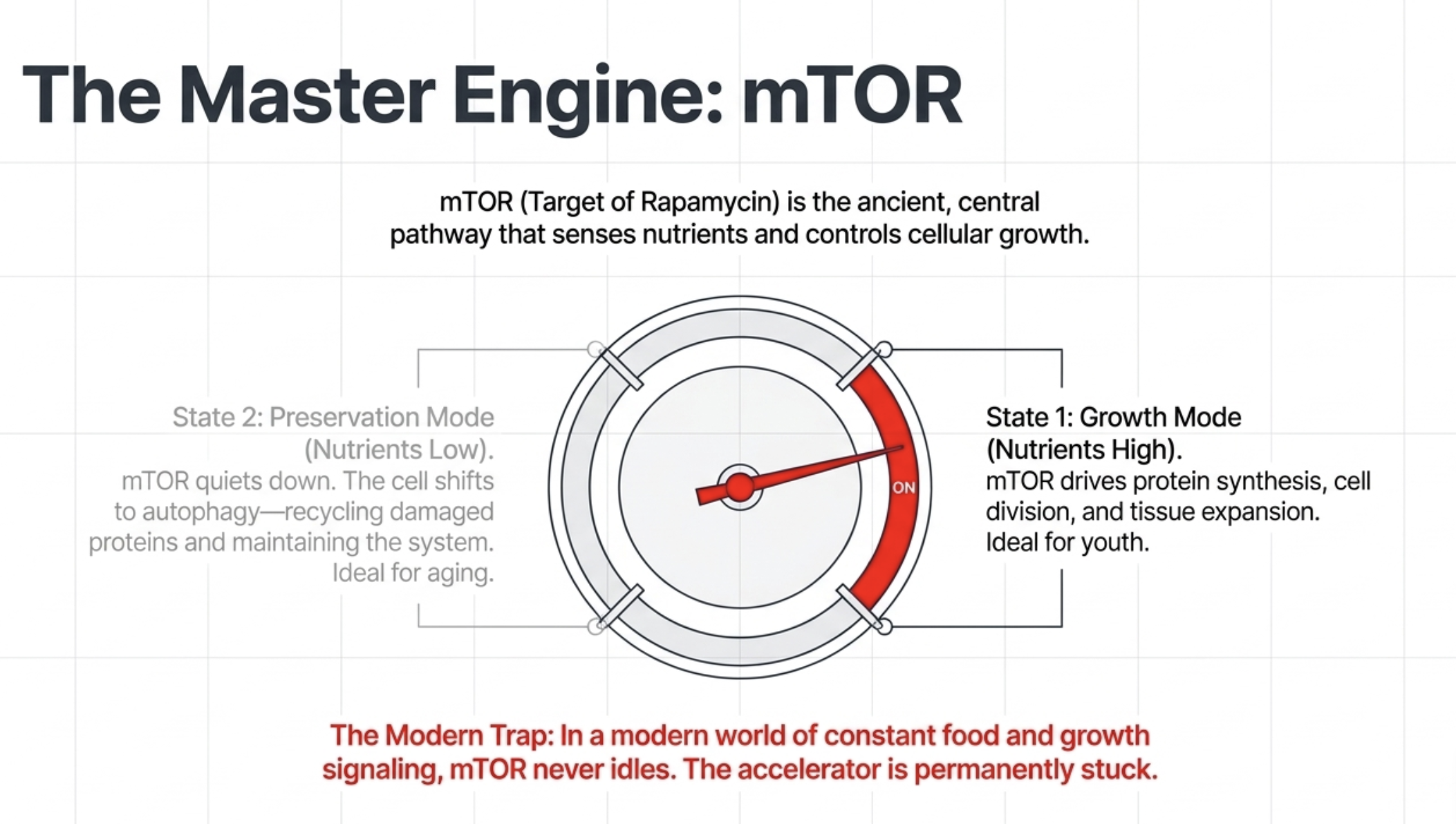
The pathway is called TOR, for "target of rapamycin," known in mammals as mTOR. It is one of the most fundamental control systems in all of biology, present in nearly every living thing from yeast to humans, and its job is to sense whether conditions are right for growth. When nutrients are plentiful, when growth signals are present, when the cell has what it needs to build, mTOR switches on and drives the machinery of growth: making proteins, building cellular structures, telling the cell to enlarge and divide. When nutrients are scarce, mTOR quiets down, and the cell shifts from building to maintenance and recycling, switching on autophagy, the process by which it breaks down its own damaged proteins and worn-out components, reusing the parts to build what it needs and burning the rest for energy. mTOR is, in effect, the master switch between growth mode and preservation mode, the molecular hand on the accelerator.
In youth, high mTOR activity is exactly what you want. Growth is the entire project of early life, and mTOR is its chief engine. The problem, in Blagosklonny's account, is that mTOR never gets the signal to stand down. In the modern world of constant food and chronic growth signaling, it stays active long past the point where growth is useful, continuing to drive cells to build and function at full tilt into an age when the body needs restraint, not expansion. The stuck accelerator, at the molecular level, is mTOR that never idles.
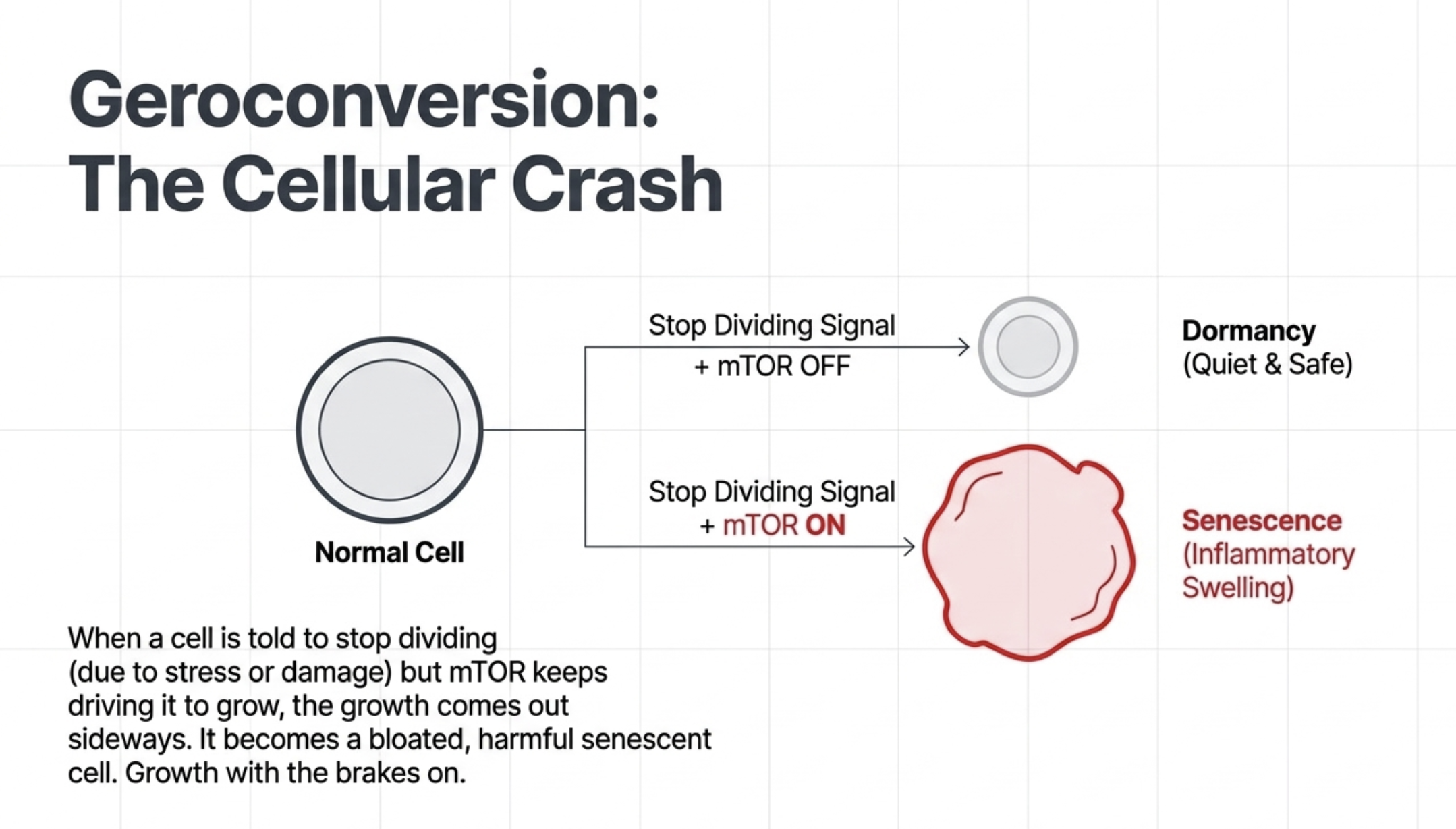
The most important piece of evidence that this is more than a story comes from a cellular process Blagosklonny studied directly, and it is the mechanistic heart of the whole theory. He called it geroconversion, and it repays a moment's attention, because it shows hyperfunction happening in a single cell, in real time, in a dish.
Picture a cell that has been told to stop dividing. This happens constantly in the body and is usually protective, a cell that is damaged or stressed or potentially cancerous is placed under arrest by molecular brakes, so that it can no longer multiply. Arrest by itself is not senescence, a distinction Blagosklonny drew sharply. In a healthy situation, such a cell would go quiet, entering a dormant, low-activity resting state, holding steady until it is needed or cleared away. But this is the twist Blagosklonny identified. If that same cell is told to stop dividing while mTOR is still switched on, still roaring at full growth-mode intensity, something very different happens. The cell cannot divide, the brakes see to that, but mTOR keeps pushing it to grow. Blocked from multiplying yet driven to build, the cell does the only thing left available to it: it swells. It grows large and flat and misshapen, it floods its surroundings with inflammatory signals, and it enters the state biologists call cellular senescence, becoming a bloated, dysfunctional, actively harmful cell that will not divide and will not die.
That transformation, from a quietly arrested cell into a large, hyperfunctional, inflammatory one, is geroconversion. And notice what it is: it is growth with the brakes on. The cell is not aging because it was damaged. It is aging because a growth program kept running in a cell that could no longer grow the right way, so the growth came out sideways, as swelling, dysfunction, and inflammation. Geroconversion is the speeding car without brakes, shrunk down to the scale of a single cell. It is driven by mTOR, and, crucially, it can be stopped: inhibit mTOR with rapamycin, and the arrested cell goes quietly dormant instead of converting into a senescent one. Turn down the accelerator, and the cell does not age in this way. This is hyperfunction demonstrated, not just argued, and it is why Blagosklonny insisted the theory was grounded in a concrete cellular model rather than in evolutionary speculation alone.
Scale this process up from one cell to an entire organism, across many tissues and decades, and you have, in Blagosklonny's view, aging itself. Senescent cells accumulate throughout the body, pouring out inflammatory signals that degrade the tissues around them. Other cells, not senescent but still driven by chronic mTOR activity, become hyperfunctional in their own ways, the arterial muscle cells that thicken into hypertension, the prostate cells that keep dividing, the osteoclasts that over-resorb bone. The same molecular engine, mTOR stuck in growth mode, drives the whole catalogue of age-related change, each tissue expressing the common underlying excess in its own particular pathology.
There is a revealing origin to all of this, and it explains why a cancer researcher was the one to see it. Blagosklonny came to the theory of aging through the study of cancer, and that is no coincidence, because cancer and aging, in his view, are two faces of the same process. Cancer is growth signaling run amok in the most literal way, cells dividing without restraint, driven by the very same pathways, mTOR chief among them, that drive aging. The genes that cause cancer when mutated are growth-promoting genes; the genes that protect against cancer are growth-restraining ones. Aging, Blagosklonny argued, is what the same unrestrained growth drive produces when it does not tip all the way into malignancy, a slower, more diffuse overgrowth that manifests not as a tumor but as the gradual hyperfunction of tissues throughout the body. The pathways that longevity research kept finding at the center of aging turned out to be the same pathways oncologists had spent decades studying in cancer. To a cancer biologist, the growth-driven nature of aging was not a surprise. It was the family business.
This is the mechanistic core that gives the hyperfunction theory its teeth. It names a specific molecular driver, mTOR. It identifies a concrete cellular process, geroconversion, that can be watched and manipulated in the laboratory. It connects aging to cancer through their shared growth machinery. And it makes a prediction so direct that it borders on reckless: if aging is driven by mTOR, then a drug that inhibits mTOR should slow aging. There is such a drug. Its name is rapamycin, and testing whether Blagosklonny was right about it has become one of the most closely watched experiments in all of longevity science.
Hyperfunction in a Human Organ: The Aging Ovary
If the theory is right, aging should somewhere be catchable in the act, a specific human organ declining not because it has worn out but because a growth program in it never eased off. The most convincing place this has been found is also one of the least expected: the ovary. It is a revealing choice because the ovary ages so strangely. It is the first organ in the human body to fail on a clear schedule. Long before the heart stiffens or the brain slows, a woman's fertility enters a steep decline around the age of 34, decades ahead of the rest of her biology. That early, almost developmental timing is itself a clue. It looks less like damage accumulating at random and more like a program running out to its end.
The decline has never been a mystery to anyone who has seen a fertility curve; the numbers fall sharply through the late thirties and into the forties. What was missing was the mechanism underneath it. A 2025 study went looking for it, reading the gene-expression programs of human eggs and the cumulus cells that surround and support them, across donors from their twenties to their late forties. Under a damage model, the expected picture would be one of decline: systems winding down, maintenance genes fading, the cell running low. The study found close to the opposite.
By the mid-thirties, the aging egg and its helper cells were not winding down. They were running hot. The ribosome genes that build the cell's proteins were turned up, not down. mTOR signaling was elevated, protein synthesis had increased, the nucleolus that manufactures ribosomes had enlarged, and ribosomal RNA had climbed. At the same time, the systems that maintain and clean the cell were suppressed: autophagy was reduced, the lysosomes that digest cellular waste were less active, and antioxidant defenses had weakened. This is the hyperfunction signature exactly, now at the scale of a whole human organ. The building machinery is cranked up, the maintenance machinery is turned down, and growth mode is left on well past the point where it serves the cell. The egg does not fail quietly. It fails in overdrive.
This is geroconversion written into reproduction. The thwarted growth drive comes out sideways, as protein aggregates, inflammation, and the markers of cellular senescence, and it carries consequences for a pregnancy. Alongside the overdrive, the study found the collapse of protein quality control and, downstream, the errors in chromosome handling that leave older eggs more likely to carry the wrong number of chromosomes. Damage is still in the picture here, those chromosomal errors are real damage, but it appears to sit downstream of the overdrive rather than upstream of it. The ovary is not simply wearing out. It is being driven too hard, and breaking under the strain.
Then comes the step that turns a correlation into something closer to a test. If the overdrive is the cause, easing it should help, and in the same body of work, rapamycin did. In cultured human cumulus cells it brought the runaway protein synthesis back down and reduced the markers of senescence. In aging mice it quieted the same mTOR signals, lowered oxidative stress, improved the maturation of eggs, and cut the chromosome-alignment errors that age introduces. And in a randomized trial of women with a history of failed IVF, a few weeks of low-dose rapamycin before egg retrieval produced more good-quality embryos and raised the clinical pregnancy rate from 28 to 50 percent. The honest framing matters: rapamycin did not create new eggs or restore the ovarian reserve, and the trial was small, with its most reliable signals in embryo quality rather than in the pregnancy rate, which rested on modest numbers. No single organ settles a theory of aging, and the ovary may be an unusually clean case precisely because its program is so sharply timed, the same reason the lens and the thymus make such tidy examples. But as a demonstration that hyperfunction is a real, measurable mode of human aging, and not only a story told about mice and cell cultures, the aging ovary is the strongest case the theory currently has.
The Evidence: Rapamycin and the Prediction That Came True
A theory is only as good as its predictions, and this is where the hyperfunction theory earned its credibility. In 2006, when Blagosklonny laid out the full argument, the central claim was audacious and almost entirely untested in mammals. If aging is driven by mTOR, he reasoned, then rapamycin, a drug that inhibits mTOR, should slow aging and extend lifespan. He did not hedge. He argued that rapamycin should be taken into the clinic to combat human aging, and he made this case years before anyone had shown the drug could extend the life of a single mammal. It was a prediction with its neck fully extended, the kind that makes or breaks a theory.
It is worth appreciating how unlikely the drug itself is. Rapamycin was discovered in a soil bacterium from Easter Island, called Rapa Nui in the local language, which is where the drug gets its name. It was developed as an immunosuppressant, used to prevent organ-transplant rejection, and for years that was its entire identity. Nobody was looking for an anti-aging drug when they found it. It happened to work by inhibiting the very pathway, mTOR, that Blagosklonny's theory placed at the center of aging. The theory and the drug were a lock and key that had been forged separately and only later discovered to fit.
Then the experiments came, and they were decisive. In 2009, a landmark study from the National Institute on Aging's Interventions Testing Program, a rigorous, multi-site effort designed to test longevity claims with unusual care, reported that rapamycin extended the lifespan of mice. This was not a marginal effect, and it was not in young animals given a head start: the drug lengthened life even when started in mice that were already elderly by mouse standards, the equivalent of beginning treatment in a human's sixties. A drug that extends lifespan when begun in old age is a remarkable thing, and it was exactly what the theory predicted. In the years since, the finding has been replicated and extended many times over, across different mouse strains, different doses, and different laboratories. Rapamycin is now one of the most robustly validated lifespan-extending interventions known, reliably lengthening the lives of mice and showing similar effects in yeast, worms, and flies, the full evolutionary sweep the theory said should respond.
The convergence runs deeper than one drug. Nearly every intervention known to reliably extend lifespan touches the same pathway. Caloric restriction, the oldest and most reproducible life-extending manipulation in all of biology, works in significant part by lowering mTOR activity, when nutrients are scarce, the growth engine idles. The genetic mutations that lengthen lifespan in laboratory animals cluster around growth and nutrient-sensing signaling, the mTOR network and the pathways that feed into it. Exercise, fasting, and the other lifestyle measures associated with longer, healthier lives all tend to lower mTOR signaling. From many different directions, the roads to a longer life keep arriving at the same destination: turn down the growth program. This is precisely what the hyperfunction theory predicts, and it is a powerful convergence. If aging were about accumulated damage, there would be no particular reason for all these interventions to funnel through a single growth-control pathway. That they do is one of the strongest pieces of evidence in the theory's favor.
Blagosklonny captured the whole idea in a four-word proverb: ride slower, get further. A car driven more gently lasts longer. An organism whose growth programs run at lower intensity ages more slowly and lives longer. Caloric restriction rides slower by starving the engine of fuel. Rapamycin rides slower by acting directly on the accelerator. Different means, the same end, easing off a growth drive that, left at full throttle, shortens the journey.
Honesty requires marking the boundary of this evidence clearly, because it is easy to let the mouse data imply more than it proves. That rapamycin extends lifespan in mice and other animals is firmly established. That it does so by inhibiting mTOR is well supported. That the same pathway sits at the convergence point of nearly every known longevity intervention is real and important. What has not been established is that rapamycin extends human lifespan, that experiment, for obvious reasons of timescale, has never been run and may never be run in a clean form. There are promising human signals, rapamycin and related drugs can improve immune function in older adults, and interest in careful human use is growing, but the leap from "triples lifespan in a worm and extends it reliably in mice" to "will lengthen your life" is a leap across a real gap. The theory made a bold prediction and the prediction came true, in animals. Whether it comes true in us is still, genuinely, an open question.
That gap is now beginning to be probed directly. In the last few years, small human trials have started testing whether rapamycin can push back on specific age-related changes, and several report early, encouraging signals. The ovarian trial described earlier is the most developed of them, and others point the same way. In a pilot study in healthy men in their seventies, eight weeks of low-dose rapamycin measurably improved the heart's ability to relax and refill, the stiffening that underlies the most common form of heart failure in older adults, along with the function of their small blood vessels. And in an early trial in chronic fatigue syndrome, where patients collapse after exertion, low-dose rapamycin tracked with restored autophagy and less fatigue.
These are not longevity trials, and it is important not to let them carry more weight than they can bear. Most are small, short, and aimed at particular conditions rather than at lifespan itself, and apart from the IVF study, they lack placebo controls. None of them shows that rapamycin makes people live longer. What they do show is that the translation Blagosklonny called for is underway: the drug his theory pointed to is now being tested in humans, against exactly the kinds of age-related dysfunction, a stiffening heart, aging ovaries, a body that cannot recover from exertion, that the theory predicts an mTOR inhibitor should touch. The early results are promising enough to justify the larger, controlled trials that will actually settle the question. Whether rapamycin earns its place as a human longevity drug now depends on those trials, which are, at last, beginning to be run.
Still, the core achievement stands, and it is not a small one. Blagosklonny looked at a theory most of his field did not accept, derived from it a specific, falsifiable, almost foolhardy prediction, and watched that prediction be confirmed in the gold-standard animal experiments. Theories of aging are cheap; predictions that come true are not. This one did, at least as far as the experiments have so far been able to reach.
Where the Theory Is Strong, and Where It Isn't
A theory this sweeping, and this confidently argued, invites scrutiny, and it has received plenty. The honest picture is neither the triumphal one its strongest advocates sometimes paint nor the dismissive one its critics occasionally reach for. Hyperfunction is a serious, generative, partially validated theory with real strengths and real limits, and the most useful thing to do is lay both out plainly. Two scientists who have thought carefully about it, David Gems and João Pedro de Magalhães, are especially valuable here, because both take the theory seriously, both have contributed to the broader program it belongs to, and both decline to accept it whole. They are critics from inside the project, not opponents of it, which makes their reservations worth more.
Start with the strengths, because they are substantial. The first is that the theory is unusually well grounded in real clinical pathology. Blagosklonny was a physician and cancer researcher, not only a theorist, and his account is built from the actual diseases of aging, hypertension, atherosclerosis, prostate enlargement, the cancers he studied, rather than from abstract models of damage. Gems notes this as a genuine distinction: where many theories of aging float somewhat free of specific human disease, hyperfunction is tethered to it, which gives it unusual explanatory reach into the conditions that actually end lives. The second strength is unification. The theory offers a single frame that connects aging to age-related disease, connects both to cancer, and connects all of them to a specific molecular pathway and a specific drug. Theories that explain many things with one mechanism are not always right, but they are always powerful, and this one explains a great deal. And the third strength is the one from the last section: it made a bold, falsifiable prediction about rapamycin that came true. Few theories of aging can say as much.
These are the reasons the theory has moved from the fringe toward the mainstream of serious discussion. Gems calls it "an emerging paradigm," which is exactly the right register, not established fact, but a genuine contender gaining ground. De Magalhães, writing after Blagosklonny's death, credits him as a bold thinker unafraid to challenge prevailing views, and regards the programmatic view of aging, of which hyperfunction is the leading version, as one of the most important correctives to the damage-centric orthodoxy. This is not a theory being humored. It is a theory being reckoned with.
But the reservations are equally real, and they matter. The sharpest comes from de Magalhães, and it concerns the theory's heavy reliance on a single pathway. Hyperfunction, as Blagosklonny developed it, is intensely mTOR-centric, mTOR is the engine, the accelerator, the near-universal explanation. De Magalhães, a comparative biologist, finds this too narrow. His argument is pointed and hard to dismiss: consider how differently species age. A mouse ages and dies within a few years; a human takes eight or nine decades; some whales and tortoises last longer still. If mTOR alone set the pace of aging, what accounts for these vast differences? The pathway is nearly identical across all these animals. Something else, other growth and developmental pathways, other layers of regulation, must be involved in setting how fast a given species runs through life. mTOR may be a central high-level regulator, de Magalhães grants, but it cannot plausibly be the whole engine. The theory, in its strict form, explains too much with too little.
A second reservation concerns the gap between the clean examples and the messy reality. The illustrations that make hyperfunction so persuasive, the lens that never stops growing, the babirusa's lethal tusk, are compelling precisely because they are simple: one continuing program, one clear pathology. But as de Magalhães emphasizes, these clean cases are the exception, not the rule. Most age-related degeneration does not come with such a tidy story. The majority of what goes wrong in an aging body still lacks a clear mechanistic explanation of any kind, hyperfunction included. Presbyopia and thymic involution may truly be run-on programs; it is far less clear that the same framework cleanly explains the full sprawl of human aging, which is almost always multi-factorial, a tangle of many contributing causes rather than a single program left running. The theory's best examples may be its least representative ones.
Third, and most fundamentally, there is the question of whether hyperfunction and damage are rivals at all. Blagosklonny often framed them as competitors, with hyperfunction the true cause and damage a secondary consequence. But his own more careful statements, and the views of most researchers sympathetic to him, point toward something less absolute. Damage is undeniably real. It accumulates. Blagosklonny's actual claim, in his more precise moments, was not that damage does not exist but that hyperfunction reaches a lethal threshold first, that mTOR-driven aging kills us before accumulated molecular damage would have the chance to. On this reading, the two processes run in parallel, and hyperfunction is simply the faster of the two. That is a more defensible claim than outright dismissal of damage, but it also concedes something important: damage is still there, still real, and in a world where hyperfunction were controlled, it would eventually matter. The either/or framing was always too stark.
Which leads to where the thoughtful middle has settled. De Magalhães puts it plainly: aging is likely a hybrid, a phenomenon with both programmatic and damage-driven components, not a single mechanism waiting to be crowned. Some features of aging look strongly quasi-programmed. Others, cancer most clearly, are driven by genuine molecular damage and mutation, which even Blagosklonny acknowledged. Most of aging probably involves a mixture, in proportions that vary from tissue to tissue and are still being worked out. The field has not resolved this, and it would be dishonest to suggest it has. What hyperfunction has done is force the question onto the table, and make the reflexive assumption that aging is "just damage" look naive. That is a major contribution. It is not the same as being the final answer.
The fair verdict, then, is that hyperfunction is one of the most important and productive ideas in modern aging biology, and also an incomplete and contested one. It reframed the central question, unified a great deal of disparate biology, and made a prediction that held. It is also probably too mTOR-focused, cleanest in its least representative examples, and best understood as one part of a hybrid rather than the whole truth. Both of these things are true at once, and a reader who holds only one of them has not understood the theory's actual standing.
The Radical Last Word: Is There Even Such a Thing as Aging?
Near the end of his life, Blagosklonny pushed his theory to a conclusion more radical than anything that came before, one that many of even his sympathizers find a step too far. If he was right about it, it dissolves the very thing the whole field claims to study. The provocation is contained in a single question: is there really any such thing as aging at all?
The argument runs like this. If aging is nothing more than the sum of specific quasi-programmed processes, the lens thickening, the arteries stiffening, the prostate enlarging, the bone over-resorbing, each a particular growth program running past its time, then "aging" is not a thing in its own right. It is a word we use to bundle together a collection of distinct, concrete processes, each with its own mechanism and its own trajectory. There is no separate entity called aging sitting behind them, no master clock, no unified process of growing old. There are only the individual quasi-programmed changes, and "aging" is the name we give to their accumulation.
Follow this to its end, Blagosklonny argued, and a startling conclusion appears: nobody dies of aging. People die of specific diseases, a heart attack, a stroke, a cancer, an organ failure, and each of those is a particular quasi-programmed process that reached a lethal threshold. When we say someone "died of old age," we are being imprecise. They died of whichever age-related disease happened to reach its endpoint first, the one that got there before all the others. Aging, in this view, is not a cause of death. It is an abstraction, a summary term for the race among many quasi-programmed diseases to see which will prove fatal first.
This reframing is not merely philosophical wordplay; it carries a concrete implication for how to think about intervening. If there is no single thing called aging, then there is no single thing to "cure," and the dream of a one-shot anti-aging treatment is, strictly, a category error. But there is something more tractable in its place. Each person has, in effect, a disease that will be life-limiting for them, the particular quasi-programmed process furthest along, closest to its lethal threshold, given their biology and history. To extend a life is to identify and slow that specific process, to delay whichever disease is set to arrive first. And because the same engine, mTOR-driven hyperfunction, is thought to drive the whole family of these diseases, a single intervention that turns down that engine might delay many of them at once, pushing back the entire field of runners rather than just one. Treating "aging," on this view, means treating the most imminent of the age-related diseases, and doing so, where possible, by easing the common growth drive beneath them all.
It is a bold and clarifying idea, and also a contestable one, and it should be clear that it represents Blagosklonny at his most provocative rather than a settled consensus. Many researchers find real value in treating aging as a distinct biological process in its own right, with shared mechanisms, common biomarkers, and a coherence that the "only separate diseases" framing arguably loses. The hallmarks-of-aging framework that organizes much of modern geroscience rests precisely on the idea that aging has unifying features that cut across individual diseases, and Blagosklonny was pointedly skeptical of that framework. Whether aging is best understood as one process or as the shadow cast by many is not resolved, and his dissolution of the concept is a minority position even among those who accept the rest of his theory.
But there is something fitting in where he ended. Blagosklonny spent his career arguing that aging is not what it appears to be, not damage, not decay, not the body wearing out, but the body continuing, in excess, to do what it was built to do. His final move was simply to follow that logic to its limit. If aging is only overgrown programs, then aging as a unified thing dissolves, and what remains is a set of specific, mechanistic, and potentially treatable processes. It is the theory's most disorienting claim and also its most hopeful: that the vast, inevitable-seeming phenomenon of growing old might really be a collection of concrete problems, each with a mechanism, each in principle addressable, none of them the immovable fact of nature we have always taken aging to be.
Why This Matters: A Different Target for Longevity
Step back from the biology and the debate for a moment, and ask what actually hangs on which theory is right. The answer is a great deal, because the two pictures of aging point toward opposite strategies for doing something about it. How you think aging works determines what you think you should do to slow it.
If aging is fundamentally damage, the accumulation of molecular wear, then the logic of intervention is repair and protection. You would want to mop up the free radicals before they do harm, shore up the body's defenses, remove or replace damaged components, patch the machinery as it degrades. This is the logic that gave us the antioxidant era, and it is the intuition behind much of the supplement industry: aging is corrosion, so fight the corrosion. The trouble, as we have seen, is that this strategy has largely underdelivered. Antioxidants have not extended human life. Decades of effort aimed at reducing or repairing damage have produced disappointingly little in the way of longer, healthier lifespans. If the damage theory were the whole story, its interventions should have worked better than they have.
If aging is fundamentally hyperfunction, the picture inverts, and so does the strategy. The problem is not too little protection but too much activity, a growth engine that will not idle. The intervention, then, is not to repair or add but to restrain, to turn the overactive programs down. And this reframing has a striking feature: the interventions it points to are, unlike antioxidants, the ones that actually work. Caloric restriction restrains the growth engine by limiting its fuel. Exercise and fasting lower the same signaling. Rapamycin acts directly on the accelerator. The best-validated longevity interventions in all of biology are, every one of them, ways of easing off a growth drive, not ways of repairing damage. The hyperfunction theory does not just offer a different explanation of aging; it offers an explanation that matches what has actually been found to extend life.
This is the deeper reason the theory matters, beyond the fate of any single drug. It reorients the entire project of longevity away from the intuitive but disappointing goal of fixing what breaks, and toward the counterintuitive but better-supported goal of dialing down what runs too hot. It suggests that the lever on aging is not maintenance but moderation, not adding capacity but easing off intensity. For anyone thinking seriously about healthy aging, that is a meaningful shift in where to look: less toward the next antioxidant, more toward the measures, dietary, behavioral, and potentially pharmacological, that lower the body's chronic growth signaling.
The honesty of the earlier sections has to carry through here, though, because the practical promise is real but unproven, and the gap matters. That turning down growth signaling extends life is well established in animals and biologically coherent in humans. That any specific intervention will extend human lifespan, rapamycin included, remains unproven, and the drugs involved are serious ones with real effects and real risks, not casual supplements. The sensible reading is not that the theory hands anyone a protocol. It is that it redraws the map, pointing longevity science toward a target, the overactive growth program, that is better supported by the evidence than the damage-repair target that preceded it. What to do with that map, and how aggressively to act on it in humans, is a question still being worked out, and one for careful clinical judgment rather than enthusiasm.
Still, the conceptual shift is genuine and consequential. For a century, the fight against aging was imagined as a fight against decay, a rearguard action to preserve and repair a body destined to wear out. The hyperfunction theory suggests we may have been fighting the wrong enemy, or at least facing the wrong direction. The problem may not be that the body is running down, but that it never stopped running hard. And the way to live longer may be less about shoring up the machine than about letting it, at last, ease off the gas.
Conclusion: The Theory He Left Behind
Mikhail Blagosklonny died in 2023, having spent nearly two decades defending an idea most of his field was not ready to accept. He was, by all accounts, a singular figure, brilliant, combative, prolific to the point of disbelief, willing to state conclusions more boldly than the evidence strictly allowed and to dare the rest of the field to prove him wrong. He did not live to see his central prediction fully tested in humans, and he may have been wrong about some of what he claimed. But he changed the question, and in science, changing the question is often the most lasting thing a person can do.
For a hundred years, the question was: what wears us out? Blagosklonny insisted it was the wrong question, or at least a badly incomplete one, and he replaced it with a stranger and more fertile one: what are we still doing that we should have stopped? That reframing, aging not as the failure of a machine but as the persistence of a program, as excess rather than erosion, has proven to be one of the most generative ideas in modern biology. It made sense of evidence the damage theory struggled with. It unified aging, age-related disease, and cancer under a single mechanism. It identified a molecular target and predicted, correctly, that a drug acting on that target would extend life in animals. Whatever its ultimate fate, it has already earned a permanent place in the argument.
It has not, however, won the argument, and the honest final position is a divided one. The theory is probably too focused on a single pathway; mTOR cannot by itself explain why a mouse and a whale age so differently. Its cleanest examples are its least representative; most of human aging remains a tangle that no single framework yet resolves. And its sharp opposition between hyperfunction and damage has softened, on reflection, into something more like a partnership, with most thoughtful researchers, including some of Blagosklonny's admirers, concluding that aging is likely a hybrid of both. The reigning view is no longer that aging is simply damage. But neither is it that aging is simply hyperfunction. It is that we are still, honestly, working it out, and that hyperfunction has become indispensable to the working.
What the theory offers in the meantime is not certainty but direction. If much of aging really is the body running its growth programs too hard for too long, then the most promising lever is not repair but restraint, and the interventions that follow from that logic, caloric restriction, fasting, exercise, and the drugs like rapamycin that act on the growth machinery directly, are the ones the evidence has most consistently favored. That is a meaningful inheritance, even with the central human question still open. It tells us where to look.
In the end, the image Blagosklonny left us with is the one that lingers. Not a rusting car in a driveway, slowly surrendering to the weather, but a powerful car racing down a road at a speed that was perfect once and has become perilous, with no brakes and no one to press them, magnificent and doomed in the same motion. Whether that image is the whole truth about why we grow old, or only part of it, it permanently altered how the question can be asked. We have long assumed that to grow old is to break down. Blagosklonny's lasting provocation was to suggest that we may instead be dying of our own momentum, undone not by the failure of the machine but by its refusal, long past the appointed hour, to slow down. The science will decide how much of that is right. The question, he made certain, is not going away.
- Blagosklonny MV. Aging and immortality: quasi-programmed senescence and its pharmacologic inhibition. Cell Cycle. 2006;5(18):2087-2102. doi:10.4161/cc.5.18.3288.
- Blagosklonny MV. TOR-driven aging: speeding car without brakes. Cell Cycle. 2009;8(24):4055-4059. doi:10.4161/cc.8.24.10310.
- Blagosklonny MV. The hyperfunction theory of aging: three common misconceptions. Oncoscience. 2021;8:103-107. doi:10.18632/oncoscience.545.
- Blagosklonny MV. Rapamycin treatment for longevity: disease-oriented dosing. Aging (Albany NY). 2023;15(14):6632-6640. doi:10.18632/aging.204920.
- Gems D, de Magalhães JP. The hoverfly and the wasp: a critique of the hallmarks of aging as a paradigm. The hyperfunction theory: an emerging paradigm for the biology of aging. Ageing Research Reviews. 2022;74:101557. doi:10.1016/j.arr.2021.101557.
- de Magalhães JP. A brief history of the hyperfunction theory of aging and future directions. Aging (Albany NY). 2026. doi:10.18632/aging.206403.
- Li J, Wang H, Zhu P, et al. Ribosome dysregulation and intervention in age-related infertility. Cell Reports Medicine. 2025;6:102424. doi:10.1016/j.xcrm.2025.102424.
- Dou X, Sun Y, Li J, et al. Short-term rapamycin treatment increases ovarian lifespan in young and middle-aged female mice. Aging Cell. 2017;16(4):825-836. doi:10.1111/acel.12617.
- Li J, Kim SG, Blenis J. Rapamycin: one drug, many effects. Cell Metabolism. 2014;19(3):373-379. doi:10.1016/j.cmet.2014.01.001.
- Raghuvanshi K, Raghuvanshi D, Kumar D, et al. Exploring the role of the mTOR pathway in aging and age-related disorders. EXCLI Journal. 2025;24:992-1015. doi:10.17179/excli2025-8384.
- Nagaoka SI, Hassold TJ, Hunt PA. Human aneuploidy: mechanisms and new insights into an age-old problem. Nature Reviews Genetics. 2012;13(7):493-504. doi:10.1038/nrg3245.
Related studies